

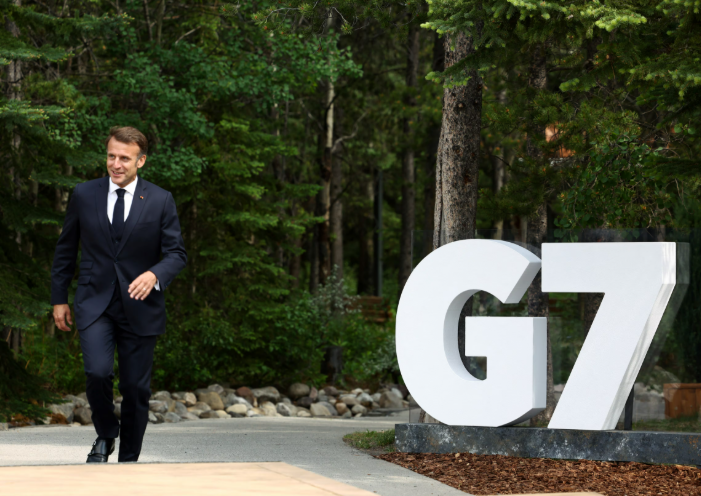
When French President Emmanuel Macron chose global economic imbalances and China’s export model as one of the defining themes of the 2026 G7 summit in Evian, he was attempting to place a long term structural challenge at the centre of Western economic strategy. The challenge is real. Across Europe, North America and parts of Asia, policymakers increasingly argue that China’s industrial policies, state subsidies, massive manufacturing capacity and export driven growth model are reshaping global markets in ways that many countries struggle to absorb. Yet even before the summit begins, one reality has become unmistakably clear: the G7 may be united in recognising the problem, but it remains deeply divided over what should be done about it.
Macron’s effort to build a common front encountered its first obstacle before leaders even arrived in Evian. In what Paris described as a breakthrough initiative, France organised a virtual “Global Convergence for Growth” meeting involving G7 members, the IMF and China. But the symbolism revealed more than the substance. Beijing did not send its top economic decision makers. Instead, Chinese Vice Premier Zhang Guoqing participated remotely and largely reiterated Beijing’s familiar message about multilateralism, openness and inclusive growth. There was little indication that China intended to discuss reducing its trade surplus, altering its industrial strategy or accepting Western arguments about overcapacity.
The outcome of the meeting highlighted the central contradiction confronting Macron’s initiative. Participants agreed that global imbalances exist. They agreed that discussions should continue. They agreed the issue deserved attention from the IMF and eventually the G20. Yet they produced no concrete mechanism for addressing the imbalance itself. In practical terms, the meeting merely confirmed that the problem exists while postponing difficult decisions to future forums.
The reason is simple. China does not view its export model as a problem requiring correction. Beijing sees it as one of the foundations of its economic success. For more than two decades, Chinese policymakers have invested heavily in manufacturing competitiveness, industrial upgrading, infrastructure, supply chains and strategic sectors ranging from electric vehicles and batteries to solar panels, robotics, telecommunications equipment and advanced machinery. What many Western governments describe as overcapacity, Beijing often describes as competitiveness.
This difference in perception explains why Western pressure has achieved limited results. China is unlikely to dismantle a system that transformed it from the world’s factory into the world’s leading industrial power. It is even less likely to do so because a G7 summit asks it to.
The scale of the issue explains growing Western concern. China today accounts for roughly 30 percent of global manufacturing output, more than the combined manufacturing output of several major advanced economies. In sectors such as solar panels, battery production, rare earth processing and electric vehicle supply chains, Chinese firms enjoy dominant global positions. China also retains enormous advantages in industrial ecosystems that competitors struggle to replicate quickly.
The challenge facing Europe is particularly acute. The European Union’s trade deficit with China reached approximately €360 billion in 2025 and continues to expand. European officials increasingly fear that Chinese overcapacity is spilling into international markets precisely at a moment when domestic demand inside China remains relatively weak. Products that cannot be absorbed at home are increasingly finding buyers abroad, often at prices European manufacturers struggle to match.
This concern extends beyond traditional manufacturing sectors. The debate is no longer about textiles, toys or consumer electronics. It now centres on the industries that many governments view as critical to future economic power: electric vehicles, batteries, renewable energy technologies, semiconductors, artificial intelligence infrastructure, advanced machinery and clean energy supply chains.
For Europe, the issue is not merely economic. It is increasingly strategic.
Over the past several years, European policymakers have watched the consequences of excessive dependence unfold in multiple sectors. Dependence on Russian energy became a strategic vulnerability. Dependence on foreign semiconductor production exposed supply chain weaknesses. Dependence on Chinese critical minerals, rare earths and industrial inputs now raises similar concerns. As a result, the discussion has evolved from free trade to economic security.
France has been among the strongest advocates of this shift. Macron increasingly argues that Europe must develop tools capable of defending its industrial base against unfair competition. His concept of “fair protection” reflects a broader European debate about balancing openness with strategic resilience. Paris has repeatedly called for stronger trade defence mechanisms, tougher anti dumping measures and more aggressive industrial policies designed to strengthen European competitiveness.
What makes the situation particularly difficult is that Europe itself remains divided.
Historically, countries such as Germany have approached China more cautiously because of deep commercial ties. For decades, German prosperity benefited enormously from access to Chinese markets. German automakers, machinery producers and industrial exporters built extensive business relationships throughout China. Confrontation carried risks.
Yet even Berlin appears to be reassessing its position. Rising Chinese competition now affects sectors once dominated by European firms. Chinese companies increasingly compete not only in low cost production but also in advanced manufacturing and technology intensive industries. As a result, support for a firmer European response is growing even within parts of Germany’s political and industrial establishment.
The challenge for Macron is that European concerns about China do not automatically translate into transatlantic unity.
The United States and Europe may broadly agree that China’s economic practices create distortions, but they often disagree on remedies. Washington increasingly favours aggressive tariffs, export controls, investment restrictions and industrial subsidies. Europe remains more cautious, partly because its economies remain deeply interconnected with China and partly because many European leaders fear triggering a full scale trade confrontation.
Recent comments from US Trade Representative Jamieson Greer illustrate this divergence. Washington appears increasingly willing to act independently rather than waiting for European consensus. This weakens Macron’s broader objective of constructing a coordinated Western strategy. Without genuine transatlantic alignment, Beijing faces less pressure to modify its behaviour.
China understands these divisions well.
Beijing’s response to the summit demonstrates confidence rather than concern. By sending a senior but not top tier representative to Macron’s virtual meeting, China signalled that it was willing to participate diplomatically without elevating the discussion’s importance. At the same time, Chinese officials continue presenting themselves as defenders of globalisation, open trade and multilateral cooperation, portraying Western restrictions as protectionist reactions to legitimate competition.
This messaging resonates across much of the Global South, where many countries benefit from affordable Chinese infrastructure, investment and manufactured goods. For developing economies, China’s rise often appears less as a threat and more as an opportunity.
That broader geopolitical context further complicates G7 efforts.
Unlike previous eras when Western economies dominated global production, today’s international system is far more multipolar. China is not an isolated economy vulnerable to external pressure. It is the largest trading partner for more than 120 countries. It possesses substantial financial resources, advanced manufacturing capabilities and increasingly sophisticated technological sectors. Any effort to reshape global trade patterns inevitably encounters these realities.
The deeper question facing the G7 is whether the objective is to change China’s behaviour or adapt to China’s rise.
If the goal is to force Beijing to abandon its economic model, the prospects appear limited. China has repeatedly demonstrated its willingness to absorb external pressure while preserving strategic priorities. If the goal is instead to strengthen domestic competitiveness, diversify supply chains and reduce strategic vulnerabilities, the path becomes more realistic.
This distinction may ultimately determine whether Macron’s initiative produces lasting results.
The most important discussions at Evian may therefore not involve China directly. They may instead focus on how Western economies invest in their own industries, support technological innovation, secure critical mineral supplies, strengthen manufacturing ecosystems and coordinate industrial policy. These are areas where governments retain meaningful control.
The irony is that the debate often described as a contest over Chinese overcapacity is increasingly becoming a debate about Western capacity. China’s export success reflects not only subsidies and state support but also decades of sustained investment in industrial development. Addressing the challenge may require less focus on constraining China and more focus on rebuilding competitiveness at home.
For Macron, the summit represents an attempt to place that challenge at the centre of the international agenda. Yet the meeting also reveals the limitations of Western influence in an era when economic power is more widely distributed than at any point in recent history.
The G7 can identify the problem. It can issue statements. It can discuss trade defence instruments and supply chain resilience. But unless Europe and America develop a genuinely coordinated strategy, and unless they invest seriously in their own industrial futures, China is unlikely to alter a model that continues to deliver strategic advantages.
The central reality confronting Evian is therefore uncomfortable but unavoidable: Beijing is not attending the summit to negotiate away its economic strengths. It is attending to demonstrate that the world economy has entered a new era, one in which China is no longer reacting to Western rules but increasingly shaping the environment in which those rules are debated. The G7’s challenge is not simply how to contain China’s rise. It is how to remain competitive in a world where that rise has already become a defining feature of the global economic order.