

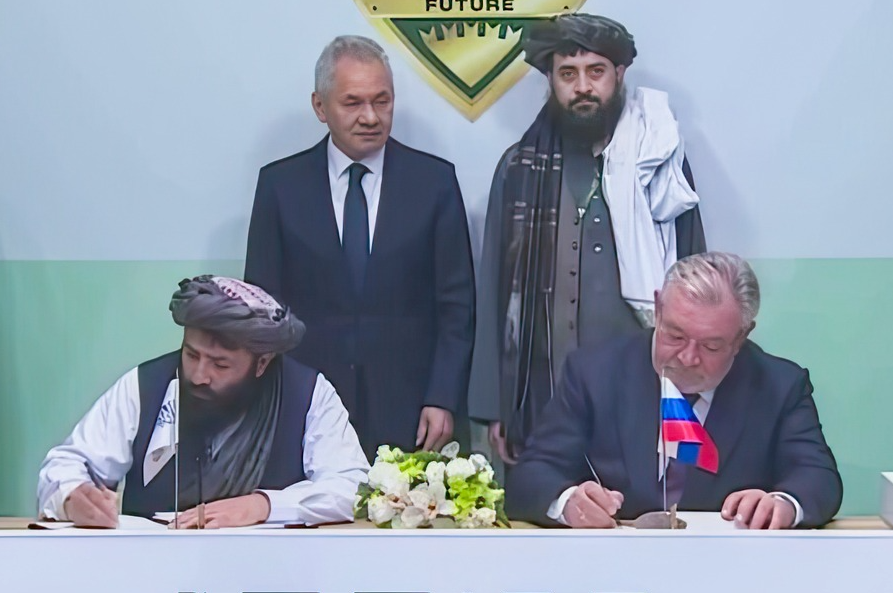
The security Memorandum of Understanding signed between the Taliban administration and the Russian Federation on 27 May has generated considerable interest across the region. Although the contents of the agreement remain undisclosed, its significance lies less in the details currently known and more in the broader geopolitical direction it appears to represent. At a time when Afghanistan remains diplomatically isolated, economically fragile, and politically unrecognised by most of the international community, any security arrangement with a major power inevitably attracts attention.
The central question, however, is not whether Afghanistan has the right to cooperate with Russia. Every sovereign state has the right to pursue relations with foreign governments and seek partnerships that it believes serve its national interests. The more important question is whether this particular agreement advances Afghanistan’s long term strategic interests or whether it risks pulling the country deeper into the geopolitical rivalries that have historically brought instability rather than prosperity.
Afghanistan occupies one of the most strategically sensitive locations in Eurasia. It sits at the intersection of Central Asia, South Asia, West Asia and China. For centuries, this geography has been both a blessing and a curse. It provides immense potential as a transit hub connecting multiple regions, but it also makes Afghanistan vulnerable to external competition among larger powers seeking influence over its territory and political direction.
The Taliban appears to view the agreement as part of a broader effort to break diplomatic isolation and demonstrate that Afghanistan can establish meaningful partnerships despite the absence of formal international recognition. From the movement’s perspective, expanding relations with Moscow helps diversify foreign relations and reduces dependence on any single regional actor. It may also be intended to send a signal to neighbouring countries, particularly Pakistan, that Afghanistan possesses alternative diplomatic options.
Yet strategic partnerships are not measured by symbolism alone. They are measured by the tangible benefits they generate and by whether both parties possess the capacity and willingness to fulfil long term commitments.
This is where important questions begin to emerge.
Russia today faces a dramatically different strategic environment than the one it confronted a decade ago. The war in Ukraine continues to absorb enormous military, financial, and political resources. Western sanctions have reshaped Russia’s economic priorities and constrained many aspects of its international engagement. Moscow remains a major power, but its ability to project economic assistance, development financing, and large scale military support abroad is more limited than in previous periods.
For Afghanistan, this reality matters. Strategic partnerships are meaningful only when both sides can contribute substantial resources and capabilities. Russia may be able to provide diplomatic engagement, intelligence cooperation, limited security assistance, and political support in international forums. However, there is little evidence that Moscow is prepared to invest at the scale required to fundamentally transform Afghanistan’s economic or security situation.
The historical record reinforces this assessment.
Following the Soviet withdrawal from Afghanistan and the subsequent collapse of the Soviet Union, Russia played a relatively limited role in Afghanistan’s reconstruction. Successive Afghan governments received far less support from Moscow than many had anticipated. While Russia maintained interests in Afghan stability, those interests rarely translated into major economic investments or sustained development initiatives.
There is little indication that this pattern is about to change.
The primary motivations behind Russia’s engagement with Afghanistan appear to be security related rather than developmental. Moscow remains deeply concerned about the presence of extremist organisations that could threaten Central Asian allies or Russian interests. Drug trafficking networks originating in Afghanistan also remain a longstanding concern for Russian security agencies. In this sense, Russia’s priorities are largely defensive. The objective is to prevent instability from spreading northward rather than to undertake a major nation building effort inside Afghanistan itself.
China shares many of these concerns. Both Beijing and Moscow seek stability on their borders, but neither currently appears prepared to commit the scale of resources necessary to become Afghanistan’s principal economic patron.
This distinction is crucial because Afghanistan’s most pressing challenges are fundamentally economic and political rather than purely military.
The country faces severe humanitarian pressures, limited international investment, restricted access to global financial systems, and ongoing governance challenges. Security cooperation agreements, while potentially useful in specific areas, do not automatically address these structural problems.
The Taliban’s growing interest in security partnerships also reflects changing regional dynamics.
Relations between Afghanistan and Pakistan have become increasingly strained. Border disputes, cross border militant activity, and military incidents have created a level of tension not seen in several years. Recent clashes along the frontier have highlighted Afghanistan’s limited defensive capabilities and exposed vulnerabilities within its security apparatus.
Under these circumstances, seeking external security cooperation is understandable. The Taliban leadership may believe that closer ties with Russia can provide leverage, strengthen deterrence, or improve access to military expertise and equipment.
However, expectations should remain realistic.
Much of Afghanistan’s military hardware inherited from the previous government depended heavily on American maintenance systems, logistics chains, and technical support. With that support absent, significant portions of the equipment have become increasingly difficult to maintain. Meanwhile, many Soviet era systems that remain in service are ageing, obsolete, or require extensive refurbishment.
Even if Russia wished to provide large scale military assistance, doing so would require resources, infrastructure, and political commitments that Moscow may not currently be willing to provide.
The result is a paradox. The agreement may create political headlines and diplomatic symbolism while delivering relatively modest practical benefits.
More importantly, Afghanistan risks becoming entangled in broader geopolitical rivalries.
This danger should not be underestimated.
Afghanistan’s modern history contains repeated examples of external powers pursuing their own strategic objectives inside the country. Whether during the nineteenth century Great Game, the Cold War, the Soviet intervention, or the post 2001 period, foreign involvement has often reflected external interests more than Afghan priorities.
Today, the international environment is once again characterised by intensifying competition among major powers. Relations between Russia and the West remain confrontational. Strategic rivalry between the United States and China continues to deepen. Regional tensions involving Iran, Pakistan, India, and various West Asian actors remain unresolved.
Within such an environment, Afghanistan must exercise exceptional caution.
A country with limited economic leverage and restricted international recognition cannot realistically maintain identical strategic relationships with powers whose interests directly conflict with one another. Strategic balancing requires resources, institutional capacity, and diplomatic flexibility that Afghanistan currently lacks.
This does not mean Afghanistan should isolate itself. On the contrary, engagement with multiple partners is essential. The challenge is ensuring that such engagement serves Afghan interests rather than external geopolitical agendas.
The deeper issue, however, extends beyond foreign policy.
The Taliban leadership may hope that agreements with Russia, China, or other powers can gradually improve international legitimacy. Yet history suggests that international legitimacy rarely emerges solely from diplomatic recognition.
It begins at home.
Governments derive lasting legitimacy from public acceptance, representative institutions, accountability, and political inclusion. International recognition often follows domestic legitimacy rather than preceding it.
This remains one of the central challenges facing Afghanistan today.
Despite expanding diplomatic contacts with Russia, China, Iran, Central Asian states, and several regional actors, the Taliban government remains unrecognised by most of the world. Key Taliban leaders remain subject to United Nations sanctions. International financial restrictions continue. Diplomatic engagement has expanded, but formal recognition remains elusive.
Neither Russia nor China has succeeded in fundamentally changing this reality.
The reason is straightforward. Major powers may engage with the Taliban for pragmatic reasons, but recognition involves broader political considerations tied to governance, inclusion, human rights, and international norms.
No security memorandum can substitute for domestic legitimacy.
Ultimately, Afghanistan’s long term future depends less on its ability to sign agreements with powerful countries and more on its ability to build a political order that commands confidence among its own population.
The country’s greatest strategic opportunity does not lie in choosing between competing global powers. It lies in transforming its geographic position into an asset rather than a vulnerability.
Afghanistan sits at the crossroads of some of the world’s most important emerging transport corridors. It could serve as a bridge connecting Central Asia to South Asia, linking Eurasian markets to the Arabian Sea, facilitating energy transit, trade flows, digital connectivity, and regional integration. Projects involving railways, energy pipelines, electricity transmission, and trade corridors all point toward this potential.
Yet connectivity requires stability. Stability requires legitimacy. Legitimacy requires institutions that enjoy broad public confidence.
Without these foundations, foreign powers are likely to continue engaging Afghanistan primarily through the lens of security concerns, counterterrorism calculations, and geopolitical competition.
The Taliban–Russia security MoU should therefore be viewed not as a breakthrough, but as a test.
If it contributes to regional stability, supports Afghanistan’s sovereignty, and remains limited to practical cooperation, it may offer modest benefits. If it becomes part of a broader process that draws Afghanistan into great power rivalries, its long term costs could outweigh its immediate advantages.
The lesson of Afghan history remains as relevant today as ever. External powers come and go. Alliances shift. Regional balances change. The countries that endure are those that build legitimacy, cohesion, and resilience from within.
Afghanistan’s future will not ultimately be determined in Moscow, Beijing, Washington, Islamabad, or any other foreign capital. It will be determined by whether Afghanistan can build a political system that serves its own people, commands their confidence, and allows the country to act as a bridge between regions rather than a battleground between competing powers.
That remains the strategic challenge that no memorandum of understanding can solve.