
Preserving Moments, One Stamp at a Time
Canada
12 B. 1937–1942 King George VI Definitive Series – 3 Cents Carmine “King George VI Portrait”,
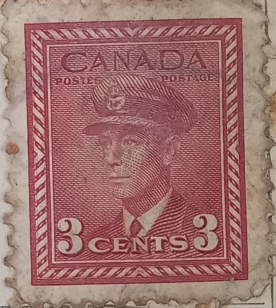
This classic postage stamp is part of Canada’s definitive series issued following the accession of King George VI in 1936. Released in 1937, the series marked the beginning of a new royal era and replaced earlier issues bearing the image of King Edward VIII. These stamps became a staple of Canadian postal use during the late 1930s and the early years of the Second World War.
The central design features a finely engraved portrait of King George VI in military uniform, facing left, conveying authority and stability during a period of global uncertainty. The portrait is framed within a rectangular border filled with intricate line patterns, giving the stamp a formal and dignified appearance. The clean composition reflects the traditional style of British Commonwealth definitive issues of the time.
Printed in a rich carmine red using line engraving, the stamp demonstrates precision in shading and detail, particularly in the facial features and uniform. The inscriptions include “CANADA POSTAGE” at the top, with the denomination “3 CENTS” prominently displayed at the bottom. The symmetrical layout and bold typography ensure clarity and ease of recognition in postal use.
The 3 cents denomination was one of the most commonly used values, typically covering the standard domestic letter rate within Canada during that period. As a widely circulated definitive, this stamp not only fulfilled everyday postal needs but also served as a symbol of continuity and national identity under the British Crown during a defining moment in Canada’s history.
Pakistan
11 B. 1948–1954 Pakistan Definitive Series – 6 Pies Purple “Rural Landscape with Hills and Homestead”
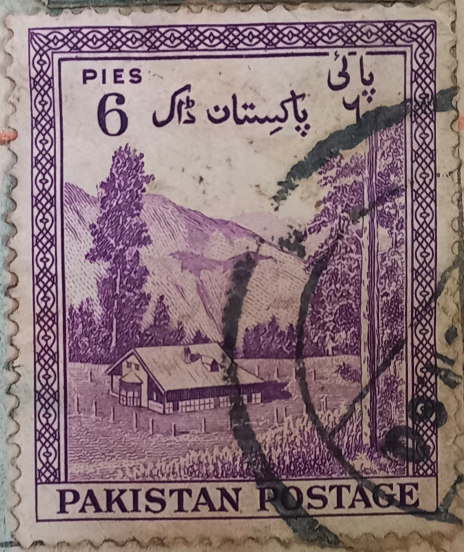
his early postage stamp is part of Pakistan’s first definitive series issued shortly after independence in 1947, marking the country’s transition toward an independent postal identity distinct from British India. Introduced in the late 1940s, these stamps focused on simple yet meaningful imagery, often highlighting rural life and natural surroundings as the foundation of the new nation.
The central illustration presents a quiet rural landscape, featuring a modest countryside dwelling set amidst open fields, with tall trees and layered hills rising in the background. The composition reflects agricultural life and self-reliance, portraying a grounded and stable image of the country. The distant hills suggest northern terrain, adding depth while reinforcing the connection between land and livelihood.
Rendered in a single-tone purple using fine line engraving, the design creates texture and contrast through detailed shading. The decorative border incorporates geometric patterns, giving the stamp a formal and balanced appearance. Inscriptions include “PAKISTAN POSTAGE” at the bottom in English, while the top carries Urdu text “پاکستان ڈاک” (Pakistan Daak – Pakistan Post). The denomination “6 PIES” is clearly placed in the upper corner, reflecting the pre-decimal currency system used in Pakistan’s early years.
As a low-denomination definitive, the 6 pies stamp was widely used for everyday postal needs such as postcards and printed matter. Beyond its functional role, it reflects the early visual identity of Pakistan, where rural life and landscape were presented as central to the nation’s character during its formative phase.
Nepal
20 A. 1959–1962 Nepal Definitive Series – 32 Paisa Violet and Blue “Nyatapola Temple, Bhaktapur”
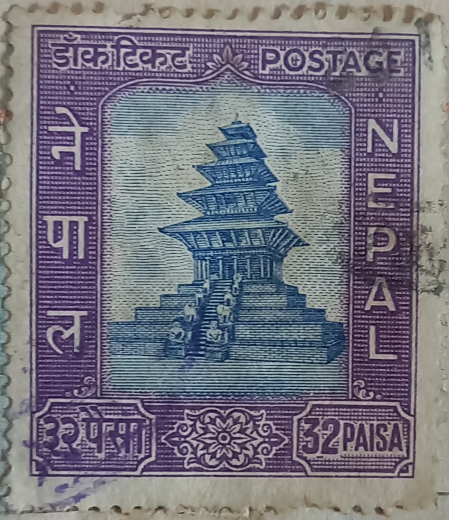
This visually striking postage stamp is part of Nepal’s early modern definitive series issued during the late 1950s and early 1960s, a period when the country was gradually opening up and formalising its postal system. The design reflects a conscious effort to showcase Nepal’s architectural heritage and cultural identity on everyday postal issues.
The central illustration features the iconic Nyatapola Temple, a five-tiered pagoda temple built in 1702 during the reign of King Bhupatindra Malla. Known as the tallest temple in Nepal, it is a masterpiece of Newari architecture, rising in receding tiers above a stepped plinth guarded by stone figures symbolising strength and protection. The stamp captures the temple’s symmetrical structure and elevated form, emphasising both its spiritual and architectural dominance.
Rendered in a two-tone combination of deep violet framing and soft blue central engraving, the stamp uses fine line typography to create depth and texture. The bilingual inscriptions include “डाक टिकट” (Ḍāk Ṭikaṭ – postage stamp) in Devanagari at the top, “NEPAL” vertically along the right, and the denomination “32 PAISA” at the bottom. The ornate border with floral motifs reinforces traditional design elements while maintaining clarity for postal use.
Issued in a relatively higher denomination, the 32 paisa value was typically used for heavier domestic or international mail rates. This definitive issue not only fulfilled postal needs but also served as a cultural statement, presenting Nepal’s historic monuments to a wider world at a time of national transition and identity-building.
20 B. 1960–1962 Nepal Definitive Series – 5 Paisa Blue “Panchayat Symbol (Pancha Deep)”
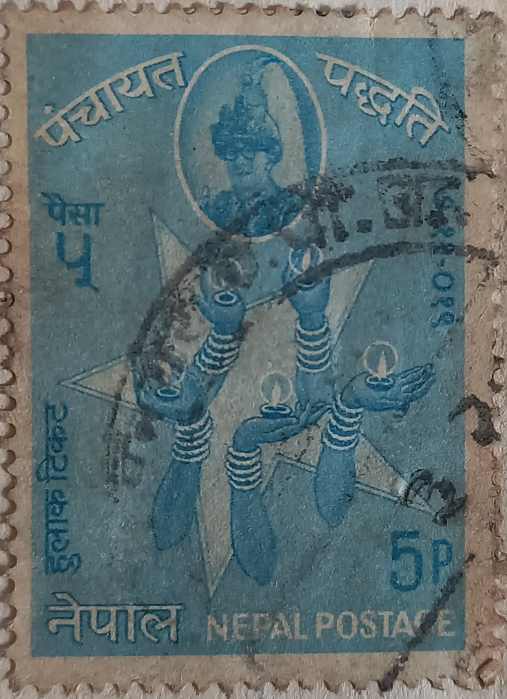
This distinctive postage stamp belongs to Nepal’s early Panchayat-era definitive series, issued after the political restructuring under King Mahendra when the Panchayat system was introduced in 1960. The series reflects a shift from purely architectural themes to symbolic representations of governance and national ideology, aligning postal imagery with the state’s new political identity.
The central design features the Panchayat emblem, commonly interpreted as the “Pancha Deep” or five lamps, symbolising unity, guidance, and grassroots governance. The illustration shows five stylised hands, each holding a lit oil lamp, arranged around a radiant star. Above them appears an oval portrait of the monarch, reinforcing the central role of the crown within the Panchayat system. The composition blends symbolism with authority, presenting a visual narrative of monarchy-led participatory governance.
Printed in a monochromatic blue tone using fine typographic lines, the stamp maintains clarity while conveying depth through shading and repetition. The inscriptions include “पञ्चायत नेपाल” (Panchayat Nepal) across the top, “NEPAL POSTAGE” at the bottom, and the denomination “5P” (5 paisa) clearly marked. Additional Devanagari text along the side reinforces its official and national character.
As a low-denomination definitive, the 5 paisa stamp was widely used for everyday postal needs, making it one of the more commonly circulated issues of its time. Beyond its utilitarian function, it stands as a political artefact, capturing a specific phase in Nepal’s governance and reflecting how state ideology was communicated through ordinary instruments like postage stamps.
Japan
4 B. 1946–1951 Japan Definitive Series – 4 Sen Carmine Red “Hōryū-ji Pagoda”

This evocative postage stamp is from Japan’s immediate postwar definitive series, issued starting October 15, 1946 – the first new designs under the Allied occupation to replace wartime issues. The intricate illustration depicts the iconic five-story pagoda of Hōryū-ji Temple in Nara, the world’s oldest surviving wooden structure (rebuilt circa 670 CE after a fire, with parts dating to the early 7th century) and a UNESCO World Heritage site renowned for its Asuka-period architecture.
Rendered in deep carmine red through typography, the 4 sen value (low denomination for printed matter or supplementary rates) features the pagoda elevated on a platform with ornate roofs and brackets, framed by a decorative border. Inscribed “日本郵便” (Nippon Yūbin – Japan Post) at the top right and “4” prominently at the top left, this series highlighted national cultural treasures to foster pride amid reconstruction.
Belgium
19 A. 1884–1891 Kingdom of Belgium King Leopold II Definitive Series

This classic postage stamp belongs to the definitive series featuring King Leopold II (1835–1909), the second King of the Belgians, who reigned from 1865 until his death. Issued starting in 1884 (with the 10 centimes value in carmine rose on bluish paper), the finely engraved design shows a profile portrait of the bearded monarch facing left within an oval frame, reflecting the formal iconography of late 19th-century European royalty.
Printed by typography on unwatermarked paper with perforation around 14, the stamp is inscribed “BELGIQUE” (French for Belgium) at the bottom – typical of issues before the bilingual “BELGIE BELGIQUE” appeared in 1891. This low-value stamp served everyday domestic postal rates during Belgium’s rapid industrialization and colonial expansion under Leopold’s rule.
Singapore
18 A. 1948–1952 Malaya (Singapore) King George VI Definitive Series

This classic postage stamp is from the post-World War II definitive series issued for Singapore under the Malayan Postal Union, released starting in 1948 and continuing through the early 1950s. It revives the iconic “coconut palms” design – a beloved motif in Malayan philately since the 1930s – symbolizing the region’s tropical landscape and rural kampong life.
The design features a left-facing oval portrait of King George VI in naval uniform, flanked by two graceful coconut palms (often called the “Palm Oasis” or “Coconut Definitive”). The palms are framed by stylized attap roof elements in the corners, evoking traditional Southeast Asian architecture. The denomination “4c” appears in each lower corner, with “MALAYA” at the top and “SINGAPORE” boldly overprinted vertically in black at the right.
Italy
17 A. 1953–1977 Italy “Siracusana” (Italia Turrita) Definitive Series

This elegant postage stamp is from the iconic “Siracusana” definitive series (commonly known as Italia Turrita – “Turreted Italy”), one of the longest-running issues in Italian postal history. Launched in 1953, the design draws inspiration from ancient Greek coins of Syracuse, featuring a classical profile of a young woman personifying Italy, adorned with a mural crown (towered headdress) symbolizing the nation’s cities and civic pride.
Printed in rich violet (or deep purple), the 25 lire value – inscribed “LIRE 25” at the top and “POSTE REPUBBLICA ITALIANA” at the bottom – became a staple for higher domestic and international rates during Italy’s postwar economic boom (“Il Miracolo Economico”). The series saw numerous reprints with varying watermarks (winged wheel, then stars), perforations, and paper types until its gradual replacement in the late 1970s.
Brazil
16 A. 1941–1950s Brazil Definitive Series – 5.000 Réis Blue “Marshal Floriano Peixoto”

This striking postage stamp is part of Brazil’s long-running definitive series issued during the Estado Novo era under President Getúlio Vargas, featuring Marshal Floriano Peixoto (1839–1895), the “Iron Marshal” and second President of the Republic of Brazil (1891–1894). Known for consolidating the young republic amid rebellions and crises following the 1889 proclamation, Peixoto’s stern leadership earned him lasting recognition as a stabilizer of the nation.
The design shows a finely engraved profile portrait of Peixoto in military uniform, facing left, inscribed “BRASIL CORREIO” at the top, “M. FLORIANO PEIXOTO” below, and denominated “5.000 RÉIS” (5,000 old réis, a high value reflecting wartime inflation). Printed in deep blue by the American Bank Note Company (or local printings), this value appeared in various print runs from the early 1940s through the postwar period.
United States Of America
2 B. 1938 United States Presidential Series – 5 Cents James Monroe Bright Blue

This classic postage stamp is part of the beloved Presidential Series (affectionately known as the “Prexies”), issued starting April 25, 1938 – the most comprehensive definitive set up to that time, honoring all 29 deceased U.S. presidents from George Washington to Calvin Coolidge, plus Benjamin Franklin, Martha Washington, and the White House.
The 5-cent bright blue value, released on July 21, 1938 (Scott #810), features a dignified profile portrait of James Monroe (1758–1831), the fifth President (1817–1825). Best known for the Monroe Doctrine and the “Era of Good Feelings,” Monroe’s likeness was adapted from a U.S. Mint medal. Printed by rotary press in vast quantities (over 2.5 billion), with perforation 11 × 10½, this workhorse stamp paid key rates like international surface mail and brief periods of domestic airmail.
Denmark
15 A. 1905–1928 Denmark Wavy Lines Definitive Series

This charming postage stamp is part of Denmark’s iconic Wavy Lines (Bølgelinier) numeral definitive series, first issued in 1905 and one of the longest-running stamp designs in the world – lasting over a century with minor variations until modern times. The simple yet symbolic motif features a bold “5” in an oval, flanked by three wavy lines on each side representing the waters separating Denmark’s major islands (Zealand, Funen, and Jutland). At the top sits a royal crown flanked by heraldic lions from the Danish coat of arms.
Printed in deep carmine red (sometimes described as rose-red or lake), the stamp bears “DANMARK” arched above and “ØRE POSTFRIMÆRKE” (Øre Postage Stamp) below, with the denomination repeated. Early issues like this one were typographed on watermarked paper (crown) with perforation 12¾.
Spain
14 A. 1940–1953 Spain General Francisco Franco Definitive Series

This classic postage stamp belongs to the long-running definitive series featuring General Francisco Franco, the Caudillo who ruled Spain from the end of the Civil War in 1939 until his death in 1975. Issued starting in 1940 (with the 50 céntimos value appearing around that time), the design shows a profile portrait of Franco facing right, alongside the ornate Spanish coat of arms – symbolizing the nationalist regime’s emphasis on tradition, unity, and authority under his leadership.
Printed in deep blue by offset lithography, the stamp is inscribed “ESPAÑA” at the top and “CORREOS” below, with the denomination “50 CTS” prominently displayed. Early printings often bore the imprint “SANCHEZ TODA,” while later ones (up to 1953) appeared without it and in varying perforations. This series was a staple of Spanish postal issues during the postwar isolation and subsequent economic recovery.
Britain
13 A. 1958–1967 Great Britain Queen Elizabeth II Wilding Definitive Series

This charming postage stamp belongs to the celebrated Wilding series, the first definitive issue featuring Queen Elizabeth II, introduced starting in 1952–1953 and running through multiple printings until decimalization in 1971. Based on a regal portrait by photographer Dorothy Wilding, the design shows the young Queen in profile, adorned with a diamond tiara and necklace, framed by an elegant wreath of Tudor roses – symbolizing England’s national flower.
The 1½d (one and a half pence) value, issued in this distinctive green shade from 1958 onward, was inscribed “1½d POSTAGE REVENUE” at the bottom, indicating its dual validity for both postage and certain revenue (fiscal) purposes – a tradition carried over from earlier British stamps. Printed by Waterlow & Sons (later De La Rue) using photogravure, with various crown watermarks and perforations, this common yet beloved value paid supplementary postal rates during the late 1950s and 1960s.
Canada
12 A. 1954 Canada Queen Elizabeth II Wilding Portrait Definitive

This elegant postage stamp is from the Queen Elizabeth II Wilding Portrait series, Canada’s first definitive issue featuring the young monarch following her coronation in 1953. Rushed into production on April 1, 1954, to meet a postal rate increase for domestic letters, the 5-cent value was the first released – with the full set following in June.
Based on a coronation photograph by renowned British portraitist Dorothy Wilding, the design shows Her Majesty in three-quarter profile, wearing a diamond tiara and necklace. Engraved with exquisite detail and printed in bright blue (sometimes described as ultramarine), it bears bilingual inscriptions “POSTES / CANADA / POSTAGE” and the denomination “5¢” repeated.
Pakistan
11 A. 1948–1950s Dominion of Pakistan Definitive Series

This beautifully ornate postage stamp is part of Pakistan’s first original definitive series, issued starting on August 14, 1948 – exactly one year after independence – to replace the initial overprinted Indian stamps. The elegant design features the national emblem: a crescent moon facing northeast (in the initial printing) with a small star above, encircled by flowing floral wreaths symbolizing growth and prosperity, and the word “پاکستان” (Pakistan) in bold Urdu script within the central medallion.
Rendered in rich emerald green, the 4 annas value (denoted “4 As” in English and “٤ آنہ” in Urdu) includes “PAKISTAN POSTAGE” at the bottom, with bilingual inscriptions reflecting the new nation’s identity. This series included multiple designs, with the crescent and star motif appearing on several values to evoke Islamic heritage and national unity.
Ireland
10 A. 1940–1968 Ireland Definitive Series – 1 Shilling Plum “The Death of Cú Chulainn”

This evocative postage stamp belongs to the long-running pictorial definitive series of Ireland, introduced starting in 1940 on watermarked “e” paper (replacing earlier 1922–1934 issues). The dramatic design depicts “The Death of Cú Chulainn”, a bronze sculpture by renowned Irish artist Oliver Sheppard (1911–1912), showing the legendary Ulster Cycle hero mortally wounded yet defiantly tied to a standing stone, his sword in hand – a powerful symbol of heroic sacrifice and Irish resilience.
Chosen personally by Éamon de Valera, the stamp’s imagery resonated deeply as a national emblem, commemorating the spirit of the 1916 Easter Rising (Sheppard’s original statue was selected as the official 1916 memorial in 1935). Rendered in rich plum (or deep purple-brown), the 1 shilling value features ornate Celtic-inspired framing, “ÉIRE” prominently at the top, and bilingual text “Scilling Amháin / One Shilling” below.
French Indochina
9 A. 1931–1941 French Indochina Definitive Series

This evocative postage stamp is part of the long-running pictorial definitive series of French Indochina, issued between 1931 and 1941 during the height of colonial rule. Titled “La Rizière” (The Rice Field), the design vividly captures a traditional Vietnamese farmer bent over, hand-planting rice seedlings in a flooded paddy – a timeless scene emblematic of the region’s agrarian economy and the vital role of rice cultivation in Southeast Asian life.
Austria
8 A. 1934 Republic of Austria Traditional Costume Series

Issued on February 13, 1934, as part of the celebrated “Erste Trachtenserie” (First Costume Series), this postage stamp showcases the rich cultural heritage of Austria through the depiction of traditional folk attire. Designed by artist Georg Jung and printed by the Austrian State Printing Office using letterpress for lower values, the series of 12 stamps highlights regional costumes from across the nation, promoting national identity and pride during the interwar period.
USSR
7 A. 1908–1919 Russian Empire Arms Issue – 7 Kopecks Blue

This elegant postage stamp is from the classic definitive series of the Russian Empire, issued starting in 1908 (with printings continuing through the early Soviet period) during the reign of Tsar Nicholas II. It features the majestic imperial double-headed eagle coat of arms, holding a scepter and orb, surrounded by thunderbolt arrows and post horns at the base – a timeless symbol of imperial power and authority.
China
6 A. 1912 Republic of China Yuan Shikai Commemorative Stamp

Issued in December 1912, this elegant postage stamp is from one of the Republic of China’s earliest commemorative series, released just months after the 1911 Revolution ended imperial rule. It honors Yuan Shikai, the influential military leader who became the Republic’s first formal president in 1912.
India
5 A. 1932–1936 British India King George V Official Service Stamp

This distinctive postage stamp is from the official “Service” series issued during the reign of King George V, overprinted for exclusive use on government and official mail in British India. The design features a finely engraved profile portrait of the King wearing the Imperial Crown of India, facing left, set against an emerald green background – the standard color for the 9 pies denomination in this iconic definitive series.
First issued in 1932 (with printings continuing until 1936), these stamps were adapted from the regular King George V definitives by adding a bold black “SERVICE” overprint at the bottom. This overprint restricted their use to official correspondence, a practice pioneered by India in 1866 to prevent misuse of postage. The inscription “INDIA POSTAGE” remains at the top, with “9 PS” (9 pies) repeated on each side.
5 B. 1965 Republic of India Indian Mount Everest Expedition Commemorative Stamp

Issued on August 15, 1965 – India’s Independence Day – this iconic commemorative stamp celebrates the triumphant 1965 Indian Everest Expedition, the first successful all-Indian ascent of Mount Everest. Led by Captain M.S. Kohli, the expedition saw an unprecedented nine climbers reach the world’s highest summit between May 20 and 29, setting a world record that stood for over a decade.
The dramatic design depicts two mountaineers roped together on the snowy slopes, one assisting the other toward the peak, symbolizing teamwork, perseverance, and national pride. Rendered in deep reddish purple (often appearing lilac or violet in varying lights), the stamp bears the denomination “0.15” (15 paise) at the bottom left, with “भारत INDIA” and bilingual text honoring the achievement.
5 C. 1963 Republic of India Freedom from Hunger Commemorative Stamp

Issued on March 21, 1963, this striking postage stamp marks India’s participation in the global Freedom from Hunger Campaign, a major initiative launched by the United Nations Food and Agriculture Organization (FAO) in 1960. The campaign aimed to combat hunger and malnutrition worldwide, culminating in the World Food Congress that year – prompting an unprecedented joint stamp issue by 153 countries, the largest such effort in postal history at the time.
The design, printed in a soft blue-grey shade, powerfully symbolizes abundance and hope: a sheaf of golden wheat stalks rises triumphantly from the earth, with rays of light bursting upward. At the center shines the official FAO emblem – a globe encircled by ears of grain – representing the global fight against hunger. The English inscription “FREEDOM FROM HUNGER” appears at the top, flanked by “FAO” on either side, while the bottom features bilingual text: “15 np” (naye paise), “मुक्त भूख से नाशन” (Freedom from Hunger in Hindi), and “भारत INDIA”.
5 D. 1964 Republic of India Jawaharlal Nehru Mourning Issue Commemorative Stamp

Issued on June 12, 1964 – just weeks after his sudden passing on May 27 – this somber commemorative stamp honors Pandit Jawaharlal Nehru, India’s beloved first Prime Minister (1947–1964) and a towering figure in the nation’s independence movement. Known affectionately as “Chacha Nehru” for his deep affection toward children, he was a visionary architect of modern India, championing secularism, democracy, and non-alignment on the global stage.
The elegant grey design features a dignified profile portrait of Nehru wearing his signature cap, gazing thoughtfully forward, with a subtle crowd of admirers below symbolizing the masses he inspired. Inscribed “Jawaharlal Nehru 1889–1964” and denominated “0.15” (15 paise), the stamp reflects the mourning period’s restrained tone – a departure from more colorful issues.
France
1 A. 1945–1951 France Marianne de Gandon Definitive Series

This elegant postage stamp belongs to the renowned Marianne de Gandon definitive series, one of the most beautiful and enduring issues of post-World War II France. Designed and engraved by Pierre Gandon – using his wife Raymonde as the model – it was first issued on February 15, 1945, shortly after the Liberation, to symbolize the renewed pride, freedom, and resilience of the French Republic.
The iconic profile depicts Marianne, the national personification of Liberty, wearing the Phrygian cap and gazing resolutely forward. Rendered in deep blue through intaglio (recess) printing for exquisite detail, this 4.50 francs value (issued in 1947) features “RF” (République Française) at the bottom left, “POSTES” at the right, and the engraver’s signatures “GANDON DEL.” and “CORTOT SC.” below.
United States Of America
2 A.1954–1968 United States Liberty Series

Issued on April 9, 1954, this iconic postage stamp launched the long-running Liberty Series, a definitive set that replaced the 1938 Presidential Series and remained in use for over a decade. As the inaugural stamp of the series, it proudly features the Statue of Liberty in striking bi-color design – the statue in carmine red against a dark violet blue background – symbolizing freedom and enlightenment.
Notably, it was the first U.S. definitive stamp in a denomination under $1 to be printed in two colors, and one of the earliest to bear the motto “IN GOD WE TRUST” (appearing subtly above the statue). Designed by Charles R. Chickering and printed by the Bureau of Engraving and Printing, this 8-cent value paid the surface rate for international airmail letters and quickly became a “postal ambassador” representing America abroad.
Germany
3 A. 1954–1960 West Germany President Theodor Heuss Definitive Series

This classic postage stamp is part of the long-running Theodor Heuss definitive series, issued by the Deutsche Bundespost starting on January 31, 1954. It honors Prof. Dr. Theodor Heuss (1884–1963), the distinguished liberal politician, journalist, and first President of the Federal Republic of Germany (West Germany) from 1949 to 1959 – a key figure in the nation’s postwar democratic reconstruction and the “Wirtschaftswunder” economic miracle.
The simple yet dignified design features a steel-engraved profile portrait of President Heuss facing left, set against a solid carmine red background that lightens toward the center. Inscribed “DEUTSCHE BUNDESPOST” at the bottom and “20” for the 20 pfennig denomination, this value was one of the workhorse stamps for domestic letter rates during the 1950s.
Japan
4 A. 1937–1946 Japan Nyoirin Kannon (Goddess of Mercy) Definitive Series

This evocative postage stamp belongs to Japan’s wartime definitive series featuring national treasures, issued during a period of economic strain and postal rate increases. The central design depicts Nyoirin Kannon (the Wish-Granting Bodhisattva, a form of the Buddhist Goddess of Mercy), based on the revered 9th-century wooden statue housed at Kanshin-ji Temple in Osaka – one of Japan’s most important cultural properties.
Originally issued in 1937 at 10 sen in deep carmine red, this example bears a bold black surcharge “30” over the original value, upgrading it to 30 sen to meet rising postal tariffs during World War II. Such provisional surcharges were common in the early 1940s as inflation and wartime demands altered rates frequently.
Germany
3 B. 1948–1956 West Germany “Notopfer Berlin” Postal Tax Stamp

Nicknamed the “Blue Flea” by collectors for its small size and ubiquity, this distinctive blue postal tax stamp was introduced on December 1, 1948, in response to the Berlin Blockade (June 1948–May 1949). The blockade isolated West Berlin, prompting the massive Berlin Airlift and a nationwide effort to support its residents. Proceeds from the mandatory 2 pfennig tax funded emergency aid and reconstruction in West Berlin during the early Cold War years.
Inscribed “NOTOPFER / 2 BERLIN / STEUERMARKE” (Emergency Contribution / 2 Berlin / Tax Stamp), the simple typographed design in deep blue was printed in vast quantities – over 10 billion in total – with various perforations, watermarks, and minor plate varieties across multiple issues until compulsory use ended on March 31, 1956.
Germany
3 C. 1951–1952 West Germany Posthorn Definitive Series

This timeless postage stamp is from the legendary Posthorn series (Posthornsatz), the first definitive issue of the Deutsche Bundespost in the newly established Federal Republic of Germany. Released starting June 20, 1951 – with the 20 pfennig value among the inaugural trio (alongside 4pf and 10pf) – this 16-stamp set marked a symbolic fresh start for postwar German postal services.
Designed by Professor Georg Mathèy, the uniform motif features a classic postal horn (Posthorn) in white silhouette below the bold numeral “20”, set within an oval on a hatched carmine red background. Encircling the oval is the inscription “DEUTSCHE BUNDESPOST” in elegant antiqua lettering – a proud declaration of the unified West German postal authority.
Disclaimer:
The information provided about these stamps is intended as a simple introductory overview only. It does not represent a complete or detailed analysis. The actual historical background, rarity, and significance of each stamp may be far more extensive and valuable than what is described here. For in-depth understanding or precise evaluation, further research and expert consultation are recommended.
Interested in Adding These Stamps to Your Collection?
If any of the stamps featured here catch your eye and you’d like to inquire about availability, pricing, or make a purchase, please feel free to get in touch!
Email me at: info@geoxaxis.com
Looking forward to hearing from you!
Best regards,
GeoXAxis