

The announcement that Chinese President Xi Jinping will travel to North Korea for his first state visit in nearly seven years would have been significant under any circumstances. Yet the timing of the visit is what makes it especially important. In the days immediately preceding Xi’s arrival, North Korean leader Kim Jong Un has overseen a carefully choreographed series of military and nuclear demonstrations that appear designed to send a message not only to Beijing but also to Washington, Seoul, Tokyo and Moscow.
Within the span of a few days, North Korean state media revealed Kim’s visit to a nuclear material production facility, showcased what appears to be an expansion of uranium enrichment capabilities, reiterated a commitment to “exponentially” increase the country’s nuclear arsenal, highlighted the implementation of a new five year strategic military plan, and publicised sea trials of the destroyer Kang Kon, a warship intended to symbolize Pyongyang’s growing naval ambitions. These developments were not isolated military events. Together they formed a strategic statement about how North Korea sees itself in an increasingly unstable international system.
The central message is difficult to miss. Pyongyang wants the world to understand that it no longer views nuclear weapons as a bargaining chip. Instead, it sees them as the permanent foundation of national security, regime survival and geopolitical influence. As Xi prepares to enter Pyongyang, Kim appears determined to ensure that any discussion about North Korea’s future begins with recognition of that reality.
For decades, international diplomacy regarding North Korea revolved around a single assumption: that enough incentives, sanctions or pressure might eventually persuade Pyongyang to abandon its nuclear ambitions. Successive American administrations, South Korean governments, Chinese leaders and international institutions pursued variations of this objective. Agreements were signed, negotiations were held and summits took place. Yet the trajectory of North Korea’s nuclear programme suggests that Pyongyang has drawn a very different conclusion from the events of the past three decades.
From North Korea’s perspective, the international system has repeatedly demonstrated that nuclear weapons remain the ultimate guarantee of regime survival. The fate of countries such as Iraq and Libya continues to shape strategic thinking in Pyongyang. The ongoing conflict in Ukraine has reinforced those perceptions. North Korean officials frequently point to these examples as evidence that states which lack a credible deterrent remain vulnerable to external pressure or military intervention.
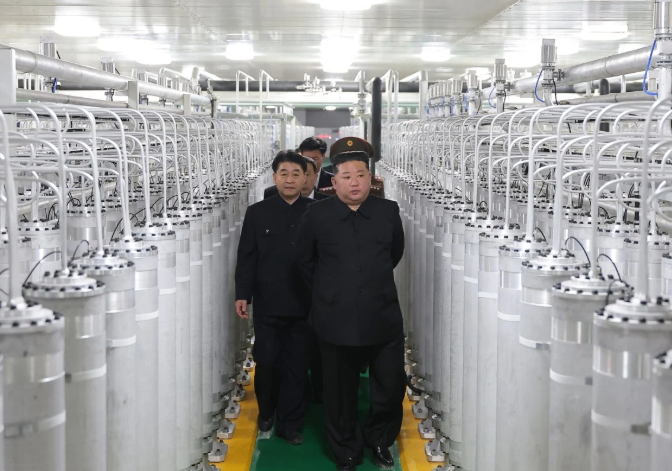
Against this backdrop, Kim’s recent inspection of a newly revealed nuclear material production facility takes on broader significance. During the visit, he reportedly praised scientists and technicians responsible for expanding the country’s capacity to produce fissile material while emphasizing the need for a dramatic increase in nuclear weapons production. North Korean state media quoted him as calling for the arsenal to grow at an “exponential” rate, a phrase that immediately attracted international attention.
The images released by state media were equally revealing. They showed rows of advanced centrifuges operating within a tightly controlled facility. According to South Korean defence officials, the installation appears to be either a newly constructed uranium enrichment plant or a major expansion of an existing programme. Analysts remain divided over whether the site is located within the long known Yongbyon nuclear complex or represents an entirely new enrichment location that had not previously been identified by foreign intelligence services.
Either possibility carries significant implications.
If the facility is part of Yongbyon, it suggests North Korea has succeeded in substantially expanding the productivity of its most important nuclear complex despite years of sanctions and international monitoring efforts. If it is a previously undisclosed site, it would indicate that Pyongyang’s nuclear infrastructure is more extensive than many outside observers believed.
In either case, the strategic conclusion remains the same. North Korea is increasing its ability to produce the raw material required for additional nuclear weapons.
This development is particularly important because North Korea’s nuclear programme has reached a stage where production capacity matters as much as technological advancement. Pyongyang already possesses operational nuclear weapons and a diverse missile inventory. The next phase involves expanding the quantity, survivability and deployment flexibility of those weapons.
Recent estimates suggest North Korea possesses enough fissile material for between seventy and ninety nuclear weapons, while maintaining an active stockpile of approximately fifty assembled warheads. Those figures remain disputed, but there is broad consensus among experts that North Korea continues producing additional material each year. Kim’s latest statements suggest he intends to accelerate that process rather than stabilize it.
The political context surrounding these developments is equally important.
Earlier this year, North Korea held its Ninth Party Congress, an event that established strategic priorities for the coming five years. Among the key objectives adopted during the congress were the expansion of nuclear material production, increased warhead manufacturing, modernization of delivery systems and the strengthening of what Pyongyang describes as its “self defensive nuclear deterrent.”
These policies are not temporary reactions to current events. They represent a long term national strategy.
What makes the timing especially noteworthy is that these announcements coincide with growing discussions between the United States and South Korea regarding nuclear powered submarines and advanced nuclear fuel cycle technologies. Although these initiatives remain distinct from nuclear weapons development, North Korean officials have repeatedly portrayed them as evidence of an expanding military threat.
From Pyongyang’s perspective, the security environment is becoming increasingly hostile.
The United States continues strengthening trilateral cooperation with South Korea and Japan. Joint military exercises remain active. Missile defence integration is expanding. Intelligence sharing mechanisms have deepened. Meanwhile, discussions about advanced submarine technologies have raised concerns in North Korea that the regional military balance may eventually shift further against it.
Kim’s response appears straightforward. Rather than attempting to match every development individually, he is strengthening the one capability he believes guarantees strategic relevance: nuclear deterrence.
Yet the nuclear programme is only one component of a broader military transformation.
Equally significant was Kim’s inspection of the 5,000 ton destroyer Kang Kon. The vessel has become a symbol of both North Korea’s ambitions and its determination to overcome technological setbacks.
The warship originally attracted international attention after suffering a failed launch during a highly publicized ceremony. Kim reacted furiously at the time, reportedly describing the failure as criminal negligence. For a leadership that places enormous importance on prestige and military symbolism, the incident represented a significant embarrassment.
The subsequent repair and relaunch of the vessel therefore carried political importance beyond its military value.
During recent sea trials, Kim personally inspected the ship and reiterated his vision of building a more capable navy. State media reported that he called for the rapid development of naval forces capable of contributing directly to the country’s nuclear deterrent.
This objective reflects a broader evolution in North Korean military thinking.
Historically, Pyongyang’s nuclear arsenal was overwhelmingly land based. Missiles launched from mobile platforms, underground facilities and hardened sites formed the backbone of deterrence. While effective, such systems remain vulnerable to advances in surveillance, reconnaissance and missile defence technologies.
A nuclear capable navy introduces new possibilities.
Surface combatants equipped with long range missiles, submarine launched weapons and maritime strike capabilities create additional layers of deterrence. Even if North Korea remains years away from deploying a fully operational sea based nuclear force, the strategic direction is clear.
Kim wants North Korea’s deterrent to become multidimensional.
This ambition extends beyond individual ships. Recent years have seen significant investment in submarine development, underwater drone systems, cruise missiles and naval infrastructure. Although many Western analysts question the effectiveness of these platforms, their cumulative impact should not be underestimated.
North Korea is steadily building the foundations of a military force designed to complicate adversary planning across multiple domains simultaneously.
The importance of Xi Jinping’s visit must be understood within this larger strategic picture.
Relations between China and North Korea have undergone significant changes over the past several years. While China remains North Korea’s most important economic partner, Pyongyang’s growing relationship with Russia has introduced new dynamics into the equation.
Since the outbreak of the war in Ukraine, military cooperation between Moscow and Pyongyang has expanded dramatically. North Korea has reportedly supplied artillery ammunition, missiles and other military equipment to Russia. In return, analysts believe Moscow may be providing technological assistance, economic cooperation and diplomatic support.
This growing partnership inevitably raises questions in Beijing.
China does not want North Korea drifting entirely into Russia’s strategic orbit. Nor does it want instability on the Korean Peninsula. At the same time, Beijing remains deeply opposed to the expansion of American military influence in Northeast Asia.
These overlapping interests help explain Xi’s decision to visit Pyongyang.
The visit allows China to reaffirm its influence while reminding regional actors that Beijing remains an indispensable stakeholder in Korean Peninsula affairs.
For Kim, however, the summit serves a different purpose.
By unveiling nuclear facilities, showcasing military modernization and emphasizing strategic self reliance immediately before Xi’s arrival, Kim is entering the meeting from a position of perceived strength. He is signalling that North Korea values its relationship with China but intends to make its own strategic decisions.
This balancing act has become a defining feature of North Korean foreign policy.
Pyongyang seeks support from Beijing, military cooperation from Moscow and deterrence against Washington, while preserving maximum strategic autonomy. The leadership views dependence on any single external actor as a potential vulnerability.
The result is a foreign policy that increasingly resembles a balancing strategy rather than a traditional alliance structure.
What emerges from these developments is a picture of a North Korea that is becoming more confident, more ambitious and more determined to secure recognition as a permanent nuclear power.
The display of new enrichment facilities demonstrates confidence in the sustainability of the nuclear programme. The expansion of fissile material production highlights long term planning. The launch of new naval platforms signals aspirations beyond simple territorial defence. The timing of these announcements before Xi’s arrival underscores Pyongyang’s desire to shape the diplomatic agenda rather than react to it.
The broader geopolitical implications extend far beyond the Korean Peninsula.
A stronger North Korean deterrent affects calculations in Beijing, Washington, Seoul, Tokyo and Moscow simultaneously. It influences alliance structures, defence spending, missile defence systems, naval deployments and regional diplomacy. It also complicates any future attempt to revive denuclearisation negotiations.
Most importantly, it reflects a strategic reality that many policymakers have been reluctant to acknowledge.
North Korea is no longer behaving like a state seeking security guarantees in exchange for nuclear concessions. It is behaving like a state that believes its nuclear status has already been secured and that future negotiations should revolve around managing that reality rather than reversing it.
As Xi Jinping arrives in Pyongyang, the symbolism will focus on friendship, stability and cooperation. Behind the ceremonies, however, lies a more consequential story. Kim Jong Un is not preparing North Korea for a future without nuclear weapons. He is preparing North Korea for a future in which its nuclear arsenal is larger, its delivery systems more diverse, its navy more capable, its ties with both China and Russia stronger, and its position in the regional balance of power increasingly difficult to ignore.
That, more than any diplomatic statement issued during the summit, may prove to be the most important message emerging from Pyongyang this week.