

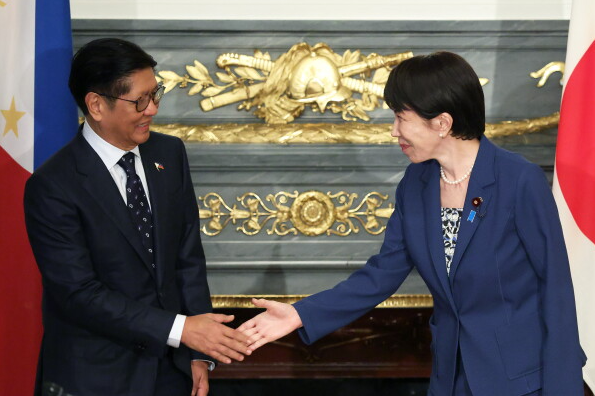
The growing strategic partnership between Japan and the Philippines is no longer a peripheral development in the Indo-Pacific. What began as maritime cooperation and coast guard coordination has evolved into something far more consequential: the gradual construction of a security network positioned along some of the most strategically important waterways in Asia. Beijing increasingly views this relationship not as a bilateral arrangement but as a component of a broader regional architecture designed to constrain Chinese military freedom of action in a potential Taiwan contingency.
The latest decision by Tokyo and Manila to begin negotiations on maritime boundary delimitation around waters east of Taiwan has elevated tensions to a new level. For Japan and the Philippines, the negotiations are framed as a legal and technical process conducted under international law. For Beijing, however, the area in question intersects with waters that China claims through its position on Taiwan and associated maritime entitlements. Chinese officials have condemned the talks as “illegal and void” and have formally protested to both governments. Within days of the announcement, China’s Coast Guard conducted patrols east of Taiwan, signalling that Beijing intends to challenge what it views as an emerging strategic alignment.
The significance of the negotiations extends beyond maritime cartography. Geography explains why Beijing is concerned. Japan and the Philippines occupy two critical positions along the First Island Chain, the network of islands stretching from Japan through Taiwan and the Philippines toward Southeast Asia. In any conflict involving Taiwan, the ability of Chinese naval forces to move freely between the East China Sea, the South China Sea and the wider Pacific would become a decisive factor. Chinese strategic thinkers increasingly argue that closer Japan–Philippines cooperation could complicate that freedom of movement by improving surveillance, anti-submarine capabilities and maritime coordination across these chokepoints.
Particular attention has been directed toward the Bashi Channel, the narrow waterway between Taiwan and the Philippines. For decades, military planners have viewed the channel as one of the most important maritime corridors in East Asia. Chinese submarines entering the Pacific frequently operate through these waters, while American and allied forces view the same corridor as a key area for monitoring Chinese naval movements. The proposed transfer of Japan’s Abukuma-class destroyers to the Philippine Navy has attracted attention precisely because these vessels were designed with anti-submarine warfare in mind. Although the transfer remains under discussion, Chinese analysts already see it as evidence of a long term effort to improve Philippine capabilities in waters adjacent to Taiwan.
What concerns Beijing even more than ships or patrol vessels is the growing intelligence relationship between Tokyo and Manila. The two governments have agreed to begin negotiations on a military intelligence-sharing framework. If implemented, such an agreement would allow both countries to exchange surveillance data, maritime tracking information and security assessments more efficiently. From Beijing’s perspective, this creates the possibility of an integrated reconnaissance network stretching from the East China Sea to the South China Sea. Chinese analysts argue that the arrangement would reduce dependence on American intermediaries and create a more resilient regional intelligence architecture capable of monitoring Chinese military movements across multiple theatres simultaneously.
This development is taking place against the backdrop of a rapidly expanding defence relationship. The Reciprocal Access Agreement between Japan and the Philippines entered into force in September 2025, providing a legal framework for military deployments, exercises and cooperation between the two countries. The agreement effectively institutionalises defence cooperation and improves interoperability between their armed forces. What once required complex diplomatic arrangements can now occur through an established legal mechanism. From Beijing’s perspective, this is not merely administrative progress. It represents the gradual normalisation of Japanese military activity closer to Taiwan and the South China Sea.
Chinese strategists therefore appear to be contemplating responses across multiple domains rather than relying solely on military pressure. The first layer would likely involve expanded military operations. Recent events already provide a glimpse of this approach. The Chinese aircraft carrier Liaoning conducted extensive operations east of the Philippines and near Japan’s southwestern approaches in late May, while Chinese Coast Guard vessels increased activity around Taiwan following the announcement of the maritime negotiations. These actions demonstrate how Beijing can employ persistent military presence to signal resolve without crossing the threshold into direct confrontation.
A second layer would involve electronic warfare and information dominance. Chinese analysts increasingly argue that future conflicts in the Western Pacific will be decided as much by data networks as by missiles. If Japan and the Philippines deepen intelligence cooperation, Beijing will seek methods to disrupt communications, degrade surveillance systems and interfere with information sharing. In modern military planning, disabling an opponent’s situational awareness can be as valuable as destroying physical assets. Consequently, electronic warfare is becoming a central pillar of Chinese deterrence strategy.
Economic pressure forms the third component of Beijing’s potential response. China remains one of the most important trading partners for both Japan and the Philippines. Chinese analysts have openly discussed restricting exports of dual-use technologies, imposing sanctions on defence-related firms and targeting specific sectors of the Philippine economy, including agricultural imports. Beijing has demonstrated in previous disputes that it is willing to use market access, trade restrictions and regulatory measures as geopolitical tools. The objective would not necessarily be to inflict maximum economic damage but to increase the political cost of closer security cooperation.
Yet Beijing faces important constraints. Unlike previous periods of regional tension, the Indo-Pacific of 2026 is increasingly characterised by interconnected security partnerships. Japan is strengthening cooperation not only with the Philippines but also with Australia, India, South Korea, NATO partners and several Southeast Asian states. Manila, meanwhile, continues to deepen defence ties with the United States while simultaneously expanding cooperation with Japan and Australia. Any aggressive Chinese response therefore risks accelerating exactly the type of regional balancing coalition that Beijing seeks to prevent.
Another challenge for Beijing is that military pressure has often produced unintended consequences. Chinese operations around Taiwan, the East China Sea and the South China Sea have frequently strengthened political support for defence cooperation among neighbouring states. The more assertive China’s military posture becomes, the easier it becomes for regional governments to justify expanded defence budgets, intelligence agreements and military partnerships. This creates a strategic paradox. Measures intended to weaken emerging partnerships may instead reinforce them.
The deeper reality is that the Japan–Philippines relationship is no longer solely about bilateral interests. It has become part of a broader struggle over the future security architecture of the Western Pacific. Beijing sees a network of states gradually integrating their surveillance systems, military planning and maritime operations around China’s periphery. Tokyo and Manila, by contrast, view their cooperation as a necessary response to an increasingly uncertain security environment. Both sides believe they are acting defensively. Both sides believe they are responding to actions initiated by the other.
This is what makes the situation particularly dangerous. The issue is no longer limited to territorial disputes or maritime boundaries. It is becoming a contest over strategic geography itself. The waters surrounding Taiwan, the Bashi Channel, the Miyako Strait and the South China Sea are increasingly being viewed through the lens of future conflict scenarios rather than routine diplomacy.
The strategic significance of the Japan–Philippines partnership therefore lies not in what it has already achieved but in what it could become. For Beijing, the challenge is preventing the emergence of a coordinated security network stretching across the First Island Chain. For Tokyo and Manila, the objective is to create enough deterrence to discourage coercion. The result is a region entering a new phase of competition, one where military deployments, intelligence sharing, economic leverage and maritime law are becoming interconnected instruments of power. The struggle unfolding today is not merely about Taiwan or the South China Sea. It is about who will shape the strategic balance of the Indo-Pacific for decades to come.