

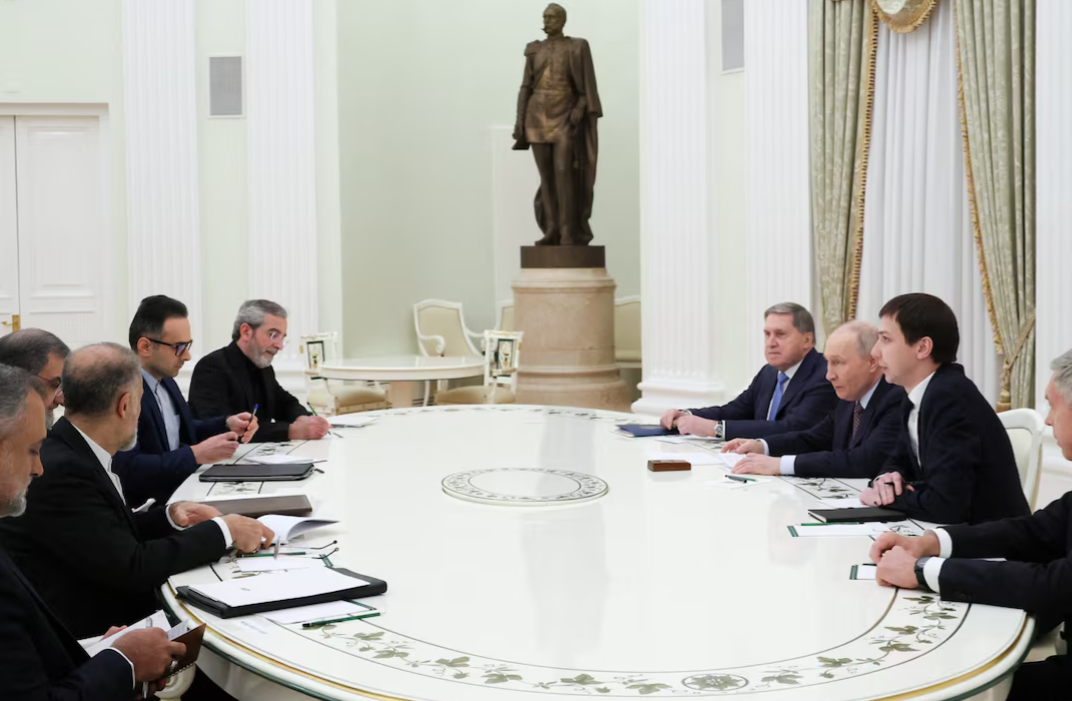
The meeting between Russian President Vladimir Putin and Iran’s Supreme National Security Council Secretary Mohsen Rezaei in Moscow on November 5 came at a critical moment in the confrontation between Tehran and Washington. Its significance extended beyond the customary language of bilateral cooperation. Rezaei delivered a message from Iran’s Supreme Leader Mojtaba Khamenei, while the presence of Kremlin aide Yuri Ushakov and military intelligence chief Igor Kostyukov placed the encounter within a broader political and security context. Although neither government disclosed the full contents of the discussion, the meeting demonstrated that communication between Moscow and Tehran was continuing at a time when the prospects for ending the war remained uncertain.
The sequence of events adds to its importance. Putin and Rezaei spoke by telephone on November 2 before meeting in person three days later. This does not establish that an agreement was imminent, nor does the presence of a senior military intelligence official prove that specific military arrangements were discussed. Nevertheless, the speed and level of the engagement suggest that Tehran considered direct communication with Moscow important. After eight months of conflict, Iran faces the challenge of preparing for renewed military action while exploring diplomatic arrangements that could prevent another escalation. Its leadership needs to understand what support it can realistically expect from its partners and whether a negotiated settlement can protect its interests.
Iran’s position is shaped by a fundamental concern. Its leadership has little reason to accept an agreement that leaves the country exposed to further attacks after making concessions. Previous military operations and the continuing uncertainty surrounding Washington’s intentions have deepened Tehran’s distrust. From the Iranian perspective, a temporary pause in hostilities offers limited reassurance unless it is accompanied by credible arrangements against renewed aggression. Supreme Leader Mojtaba Khamenei has rejected the idea of yielding to American pressure, while Rezaei has indicated that Iran has presented seven conditions for diplomacy. Tehran is therefore seeking negotiations on terms that recognise its security concerns rather than treating military pressure as a basis for unconditional surrender.
Those conditions have become a significant obstacle. Rezaei said Iran would not reopen the Strait of Hormuz or resume negotiations until its conditions were implemented. The wider dispute involves the American blockade of Iranian ports, sanctions, maritime access and the future of negotiations over Iran’s nuclear programme. Washington and Tehran remain far apart on the terms of a settlement. Neither side can approach the confrontation as a purely military episode because its outcome will also shape economic access, regional security and the political limits each government is prepared to accept.
The Strait of Hormuz gives the conflict consequences extending well beyond the two countries. Disruption to the waterway threatens energy shipments and increases uncertainty for economies dependent on stable supplies. Regional governments have strong reasons to prevent a prolonged confrontation, even if they have limited influence over the decisions that produced it. For Tehran, the strait represents strategic leverage. For Washington, freedom of navigation and the security of regional partners remain central objectives. Any settlement would have to address these competing priorities. Military pressure may alter the balance temporarily, but it cannot by itself establish a lasting arrangement for one of the world’s most important maritime routes.
Recent diplomatic activity indicates that negotiations remain possible. Qatar has continued its mediation efforts, and its prime minister said on November 7 that contacts between Washington and Tehran were ongoing to prevent further escalation. He reported progress and expressed confidence that an agreement remained achievable, while emphasising the importance of a workable settlement rather than an ideal one. This is significant because Russia would be entering an existing diplomatic process rather than attempting to create one independently. Moscow could contribute by using its relations with both sides to narrow differences and encourage practical compromises.
Russia’s potential role rests on a diplomatic position that few other major powers can replicate. Moscow maintains a strategic partnership with Tehran while continuing to engage Washington, particularly over the Ukraine conflict. These relationships do not make Russia a neutral mediator. Moscow has its own interests in West Asia and would naturally seek an outcome that protects its regional position. However, mediation does not always require complete neutrality. It requires access to the parties, an understanding of their priorities and the ability to communicate proposals that might otherwise be rejected. Russia possesses some of these advantages, although its influence should not be confused with the power to dictate an agreement.
For Iran, the meeting also carried a message about the durability of its relationship with Moscow. Improving Russian American relations would not necessarily mean that Tehran would be abandoned. The public reception of Rezaei demonstrated that Russia intended to maintain high level engagement with Iran despite its separate dealings with the United States. This matters because Tehran cannot assume that its strategic partnership guarantees military protection. The comprehensive strategic partnership between the two countries does not constitute an automatic mutual defence commitment. Iran may therefore value Russia as a diplomatic partner and potential intermediary while remaining conscious that its security cannot depend entirely on another government.
Economic cooperation provides another reason for both countries to preserve their relationship. Following the meeting, Rezaei referred to discussions about a proposed gas pipeline connecting Russia and Iran. Such a project could support Iranian energy requirements while creating opportunities for Russian supplies to reach neighbouring markets. Its implementation would depend on financing, infrastructure and the sanctions environment. It cannot resolve the immediate conflict, but it illustrates that the relationship has interests beyond the current military crisis. For Moscow, sustained cooperation with Tehran also reinforces its position in a region where American influence remains considerable.
The possibility of renewed American military action nevertheless remains the immediate danger. Washington retains the option of further operations, while Iran has demonstrated that it is unwilling to accept American demands simply because military force has been used against it. Another campaign could trigger retaliation against American assets or targets associated with Washington across the region. Neighbouring countries could consequently face greater insecurity, while energy markets would absorb additional pressure. Even if neither side initially seeks a prolonged war, individual military decisions could produce a cycle of retaliation that becomes increasingly difficult to contain. Preventing that outcome should be the immediate objective of diplomacy.
Claims about the possible use of nuclear and chemical weapons have further complicated the atmosphere. Tucker Carlson claimed that Trump was considering a nuclear strike near Natanz, an important Iranian nuclear facility. Trump rejected the need for such an attack, and the allegation has not been independently established. Reports have also circulated that Israel warned Washington about an alleged Iranian chemical weapons plan, which Tehran denies. These claims should not be treated as confirmed evidence of an impending attack. Nevertheless, the introduction of weapons of mass destruction into public debate during an active conflict can deepen mistrust and encourage worst case planning. Any diplomatic process must distinguish verified information from allegations that could intensify the confrontation.
Trump also faces a domestic political calculation. The Republican defeat in the midterm elections has increased pressure on his administration, while dissatisfaction with the war could make a prolonged conflict politically expensive. Military action may appeal to those who believe American credibility depends on demonstrating strength. Yet another bombing campaign would not automatically produce a political victory. If Iran withstands further attacks and continues to reject Washington’s demands, Trump would have to explain what the use of force had achieved. A military operation without a sustainable political outcome could weaken the administration’s argument that its strategy has made the United States more secure. Diplomacy therefore offers an opportunity to claim progress without becoming trapped in an open ended confrontation.
A negotiated settlement would allow Trump to present an agreement as evidence that American pressure had produced results. That would not require Iran to abandon its core interests or Washington to withdraw every demand. An initial arrangement could focus on stopping attacks, reducing the maritime confrontation and establishing a verifiable process for addressing sanctions and nuclear concerns. More difficult questions could be handled through successive commitments. The sequence would be essential. Iran would be unlikely to make irreversible concessions without credible assurances against renewed attacks, while Washington would demand evidence that Iranian commitments were genuine and enforceable. Both sides would need to see practical benefits before accepting compromise.
The political situation in Israel could also influence Washington’s calculations. Prime Minister Benjamin Netanyahu has consistently supported a hard line toward Tehran and favoured strong American pressure. If his political position weakens, a new Israeli government could approach the timing and scope of further military action differently. However, a change in leadership would not automatically resolve the underlying tensions. Israeli security concerns, Iran’s regional relationships and the nuclear dispute would remain. A diplomatic opening should therefore be based on the strategic interests of the parties rather than expectations about the political fortunes of an individual leader.
The proposed meeting involving Trump, Putin and Chinese President Xi Jinping on the sidelines of the November 18 and 19 APEC summit in Shenzhen could provide another opportunity for diplomatic discussion. However, such a meeting should not be treated as a confirmed forum for resolving the Iran conflict. China has its own interests in regional stability, energy security and its relationship with Washington. Its involvement could broaden diplomatic engagement, but the three powers do not necessarily share the same priorities. Any summit would matter only if it generated practical follow up and gave the parties directly involved a meaningful role in negotiations.
Rezaei’s visit ultimately demonstrates that Tehran is seeking diplomatic options while preparing for the possibility of renewed hostilities. Russia may be able to offer Trump a route towards a political outcome that neither side can secure through military pressure alone. But Moscow cannot guarantee Iranian compliance, compel Washington to lift sanctions or eliminate the strategic differences between the two countries. Its value lies in keeping diplomatic channels open and helping both sides identify terms that do not require either to accept outright defeat. Iran is unlikely to surrender its central security interests, while Washington will seek an agreement it can defend as a meaningful achievement. The opportunity for Russia lies in bridging that divide. Whether it succeeds will depend on the willingness of Tehran and Washington to recognise that a negotiated settlement may serve their interests better than another round of war.