

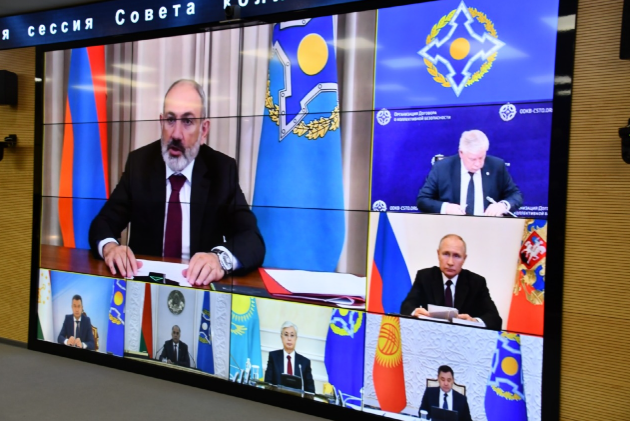
Armenia’s dispute with the Collective Security Treaty Organization has reached a decisive point. Russian Foreign Minister Sergey Lavrov says the door remains open, Armenia will not be expelled, and even if its voting rights are suspended, it will retain the right to collective security. Yet this reassurance leaves the central issue unresolved. Armenia’s estrangement from the organisation did not begin with unpaid membership fees. It developed after Yerevan repeatedly sought support during confrontations with Azerbaijan and concluded that the alliance was unwilling or unable to provide the protection it expected.
Speaking in Moscow on November 10, following a meeting of CSTO foreign and defence ministers and security council secretaries, Lavrov said Armenia had not paid its annual contributions since 2024. He explained that a draft decision under Article 25 of the CSTO Charter would suspend Armenia’s voting rights and its ability to nominate citizens for positions within the organisation until the outstanding debt was repaid. The proposal was due to be considered by the Collective Security Council on November 11. Lavrov insisted that Armenia would retain its fundamental rights under the treaty, including collective security. The financial dispute is clear, but its political context cannot be ignored.
Armenia’s frustration has deep roots in its conflict with Azerbaijan, particularly over Nagorno Karabakh. The territory was internationally recognised as part of Azerbaijan, although its population was predominantly ethnic Armenian. During the 2020 war, Azerbaijan recovered substantial territory, while a Russian brokered ceasefire brought Russian peacekeepers into the enclave. The arrangement, however, failed to produce a lasting settlement or guarantee the security of the remaining Armenian population.
The subsequent restrictions on the Lachin corridor, the principal route connecting Nagorno Karabakh with Armenia, deepened the humanitarian crisis. In September 2023, Azerbaijan launched a military operation against the enclave’s de facto Armenian authorities, who capitulated within a day. More than 100,000 ethnic Armenians subsequently fled to Armenia. The exodus effectively ended the region’s centuries old Armenian community presence and dismantled its existing political institutions. The CSTO did not intervene militarily, while Russian peacekeepers failed to prevent the operation or the departure of the population. For Armenians, this was a devastating demonstration of the limits of the security arrangements they had relied upon.
The legal position requires precision. Nagorno Karabakh was internationally recognised as Azerbaijani territory, and the CSTO’s collective defence provisions did not automatically require the organisation to defend every disputed territory or a member’s forces operating beyond its recognised borders. Armenia’s strongest complaint, therefore, is not that the CSTO was unquestionably required to fight for Nagorno Karabakh. Rather, the crisis exposed the limitations of Russia’s role as a security guarantor and intensified doubts about the alliance’s willingness to respond when Armenia itself came under pressure.
Those doubts had already sharpened during the border confrontations of 2021 and 2022. In May 2021, Azerbaijani forces moved into areas that Armenia said were within its sovereign territory. In September 2022, fighting spread across border areas and affected locations including Vardenis, Goris, Sotk and Jermuk. Armenia appealed to the CSTO, expecting a clear political assessment and a meaningful response. The organisation discussed the situation and considered a fact finding mission, but its response did not satisfy Yerevan. Prime Minister Nikol Pashinyan subsequently accused the organisation of failing to fulfil its security commitments.
These confrontations provide the strongest foundation for Armenia’s criticism. The CSTO may debate the precise application of its charter, but its response to reported incursions into Armenia proper damaged its credibility. A collective security agreement is ultimately judged by how members respond when its commitments are tested. For a smaller state facing military pressure from a stronger neighbour, uncertainty over whether its allies will act can undermine the entire purpose of the arrangement.
The distinction between Nagorno Karabakh and Armenia proper is important, but it should not obscure the wider political consequences of the 2023 offensive. Even if the CSTO’s treaty obligations did not extend to defending the enclave, the failure of the Russian peacekeeping arrangement to prevent the population’s displacement further weakened Armenia’s confidence in Moscow. The combination of these experiences created a broader perception that Russia’s security guarantees could no longer be relied upon in the way Yerevan had previously expected.
Armenia froze its participation in CSTO activities in February 2024 and subsequently stopped paying contributions. It has not formally withdrawn from the organisation. Lavrov is therefore correct that no official application to leave has been received. However, legal membership and political commitment are different matters. Armenia’s government has repeatedly expressed dissatisfaction with the alliance and has indicated that it does not intend to resume normal participation under existing conditions. On November 5, Pashinyan said Armenia’s interest in the CSTO had run its course.
The proposed suspension of Armenia’s voting rights could widen the divide. The CSTO has a legitimate interest in ensuring that members meet their financial obligations. Armenia’s decision to stop paying contributions is consequently open to institutional criticism. But treating nonpayment as the central problem avoids the reason Yerevan withdrew from active participation in the first place. From Armenia’s perspective, the organisation is demanding financial compliance without adequately addressing the security failures that destroyed trust.
Lavrov says Armenia will retain its right to collective security even if its voting rights are suspended. That may reflect the organisation’s legal interpretation, but it creates a practical contradiction. Voting is one of the principal ways members influence institutional decisions, assess common threats and shape responses to crises. Removing Armenia’s vote while insisting that its fundamental security rights remain intact would weaken its influence over the very institution expected to protect it. The measure may be presented as temporary and reversible, but it risks making Armenia’s membership even less meaningful.
Moscow has also argued that Yerevan cannot reject the organisation’s activities while continuing to retain the benefits of membership. Lavrov criticised Pashinyan’s position on a possible referendum concerning Armenia’s relationship with the European Union and the Eurasian Economic Union, suggesting that the government was presenting citizens with a fait accompli. He applied similar reasoning to the CSTO, arguing that if Armenia believes the organisation no longer serves its interests, it should leave rather than expect to be expelled.
This argument focuses on Armenia’s procedural choices while overlooking the reasons behind its dissatisfaction. Foreign policy is not a loyalty test. Governments reassess alliances when existing arrangements no longer meet their national security requirements. Armenia’s decision carries economic and strategic risks, but it is not inherently illegitimate for Yerevan to question whether its security partnership provides adequate protection.
Russia remains an important power in the South Caucasus, but its war against Ukraine has placed considerable demands on its military and diplomatic resources. Its influence across the former Soviet space has also faced new challenges. Armenia cannot simply replace Russia’s geographical, economic and security role, and a rapid realignment would create vulnerabilities of its own. Nevertheless, expanding diplomatic and defence partnerships is a rational response for a government that no longer considers its traditional security arrangements dependable.
The changing relationship between Armenia and Azerbaijan adds another dimension to this calculation. The Washington summit of August 8, 2025 produced a joint declaration and the initialling of a peace agreement, although the agreement has not yet been formally signed. Subsequent developments have included discussions on trade, transport connectivity and the reopening of regional routes. Pashinyan and Azerbaijani President Ilham Aliyev also met on the sidelines of the Shanghai Cooperation Organization summit in Bishkek on August 31, 2026, discussing normalisation and regional cooperation.
The Trump Route for International Peace and Prosperity has become an important part of this emerging framework. Armenia maintains that the route must operate under its sovereignty and jurisdiction. Cooperation with the United States over its implementation reflects Yerevan’s effort to attract external investment and establish connectivity without surrendering control over its territory. These developments do not mean Armenia has abandoned Russia or that the regional disputes have been settled. They demonstrate that the South Caucasus is developing new diplomatic and economic arrangements beyond the traditional security framework centred on Moscow.
Peace nevertheless remains fragile. The initialled agreement has not been formally signed, and questions surrounding constitutional provisions, connectivity and the implementation of commitments remain unresolved. The fate of Armenian prisoners held in Azerbaijan and the broader humanitarian consequences of the conflict also continue to affect relations. The recent diplomatic progress is significant, but it should not be mistaken for a permanent resolution of the security problems that have shaped the region for decades.
The CSTO now faces a choice. It can treat Armenia’s nonpayment as an isolated institutional violation and proceed with suspending its voting rights, or it can recognise that the financial dispute is a consequence of a much deeper crisis. If the organisation believes its response during the 2021 and 2022 border confrontations was consistent with the treaty, it should explain which obligations applied, what assessments were made and why its response took the form it did. If internal disagreements or limitations in the charter prevented stronger action, those constraints should be acknowledged openly.
Collective security depends on more than formal guarantees. Its credibility is established when members face pressure and must decide whether their partners will stand behind them. For smaller states, a treaty that inspires little confidence offers limited reassurance, even when its legal provisions remain in force. Armenia’s experience has exposed the gap between institutional promises and the political willingness to act. Other CSTO members will inevitably draw their own conclusions from this dispute.
Lavrov is right that Armenia has not formally withdrawn and that the organisation has rules governing financial contributions. But these facts do not answer Yerevan’s strongest argument. The loss of Nagorno Karabakh and the CSTO’s response to incursions into Armenia proper created a crisis of confidence that unpaid fees did not cause. The legal distinction surrounding the enclave must be respected, but it cannot erase the political damage caused by the organisation’s handling of Armenia’s security concerns.
Suspending Armenia’s voting rights may enforce an institutional rule, but it will not restore the CSTO’s credibility. That requires an honest examination of its record, a clearer explanation of its obligations and a willingness to address why Armenia no longer considers the organisation dependable. Armenia must decide what security arrangements best serve its national interests in a changing South Caucasus. The CSTO, meanwhile, must confront a more fundamental question about its own future. An alliance may keep its doors open, but formal membership means little when a member no longer believes that collective security will protect it.