

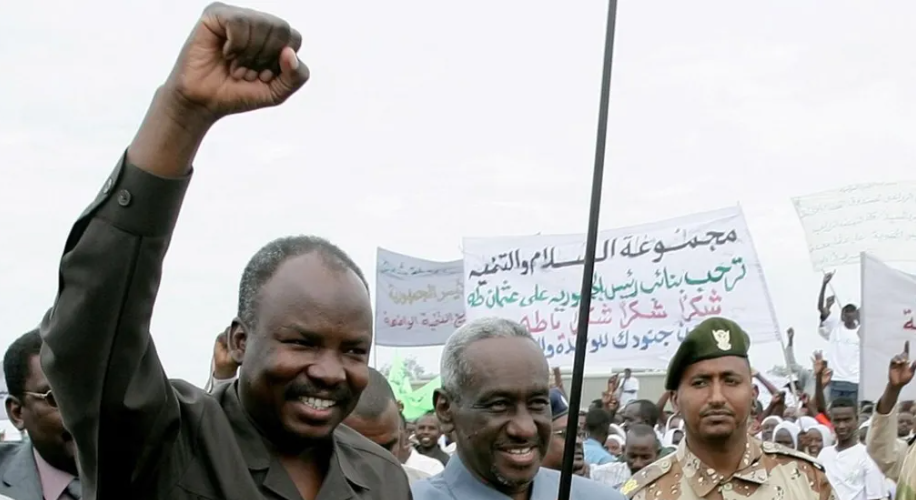
Sudan’s re-arrest of Ahmed Haroun has brought an unresolved question back to the centre of its political crisis. Can a country fighting a devastating civil war confront the crimes of its former rulers, or will the demands of the present conflict once again push accountability aside. Haroun, a senior official under former president Omar al Bashir and chairman of the former ruling National Congress Party, is wanted by the International Criminal Court for alleged war crimes and crimes against humanity committed in Darfur. His detention is significant, but it will mean little for justice unless it leads to a credible judicial process and, ultimately, his transfer to the court that has sought his arrest for years.
The circumstances surrounding the detention make the development politically complicated. Haroun had remained outside custody after escaping from prison during the turmoil of Sudan’s war in April 2023. He reappeared publicly in a podcast interview in which he discussed the former regime, the military leadership and the relationship between his party and the Rapid Support Forces. He argued that the National Congress Party and the armed forces might not share the same political objectives but were united in fighting the RSF. Shortly afterwards, military authorities detained him again. His lawyers said his whereabouts were unknown, while accounts differed over the location of the arrest. The authorities have not publicly established whether the detention is connected to his statements, the outstanding international warrant or another investigation.
Haroun’s case sits at the intersection of two struggles. One concerns the military’s attempt to defeat the RSF in a war that has devastated Sudan since April 2023. The other concerns whether political and security figures associated with Bashir’s government will ever face accountability for abuses committed during their rule. These questions cannot be separated entirely, but neither should one be used to erase the other. Defeating an armed rival does not settle the crimes of a former government, just as pursuing accountability must not become a pretext for arbitrary detention.
Haroun is not an ordinary former politician facing renewed scrutiny. During Bashir’s rule, he held senior security and government responsibilities before leading the National Congress Party, which was rooted in the Islamist movement that dominated the country’s political system. The ICC accuses him of involvement in crimes against humanity and war crimes in Darfur in 2003 and 2004. The charges include murder, rape, persecution, forcible transfer and torture. Haroun denies the allegations, and his guilt must be determined through judicial proceedings. Yet the existence of an international arrest warrant creates a legal obligation that cannot be dismissed as a routine dispute between rival political factions.
The Darfur conflict began in 2003 when rebel movements challenged the government, accusing it of marginalising the region’s populations. The government responded through military operations and its relationship with Arab Janjaweed militias, which became notorious for attacks against non Arab communities. The violence produced mass displacement, killings and sexual abuse. Its legacy extends far beyond the original military campaign. Survivors have spent years seeking recognition and justice while many of the people accused of directing or facilitating the atrocities remained beyond the reach of courts.
Haroun’s alleged role in that period gives the present arrest a significance beyond his recent political statements. For victims, the possibility that a senior former official might finally face judicial proceedings is important. But detention is only the beginning. If the authorities conceal his whereabouts or use him solely as a political bargaining instrument, the process risks reproducing the arbitrary practices that accountability is supposed to overcome. The objective must be a lawful process capable of establishing responsibility, not political convenience or revenge.
The military’s position is difficult to assess because it has previously refused to surrender Bashir and other former officials wanted by the ICC. Haroun was detained after Bashir’s removal in 2019, when a popular uprising forced the military to oust the longtime ruler. Other senior figures were also arrested, but the authorities did not hand the wanted men over to the international court. Haroun eventually escaped during the breakdown of prison security amid the current war. His return to custody raises a fundamental question about whether the military is prepared to meet its international obligations or is simply managing a politically sensitive figure whose public reappearance has become inconvenient.
The National Congress Party has demanded Haroun’s immediate release, arguing that he was detained for expressing his views. Freedom of expression matters, even when the speaker is a controversial political figure. A government should not imprison someone merely because an interview challenges its preferred political narrative. However, the right to express an opinion does not cancel an outstanding international arrest warrant. His political speech and his status as an ICC suspect are separate matters. Treating the detention exclusively as a question of free expression avoids the more serious issue of whether Sudan will finally address the allegations against him.
His comments also reveal the uneasy relationship between the military leadership and Islamist networks associated with the former regime. Since the outbreak of war, members of the Islamist movement have supported mobilisation against the RSF. Their participation may offer the army manpower and political support, but it also raises questions about the influence former ruling structures could regain through the conflict. The military needs allies in a difficult war. Yet reliance on networks linked to the Bashir era risks allowing figures who lost power during the 2019 uprising to return to public life without answering for their past conduct.
This is one of the war’s most consequential political contradictions. The uprising that removed Bashir demanded an end to authoritarian rule and a different political future. The subsequent transition failed to establish a stable civilian government, and the struggle between the armed forces and the RSF eventually overwhelmed the remaining political process. Former regime figures may now find opportunities to regain influence by presenting themselves as partners in the national struggle. Cooperation against the RSF may serve an immediate military purpose, but it should not provide political immunity or restore the old order without scrutiny.
The RSF’s own record makes consistent accountability even more urgent. The paramilitary force grew out of the Janjaweed militias mobilised during the Darfur conflict. Its emergence as a major armed power did not erase the history from which it developed. During the current war, the RSF has been accused of extensive abuses, including ethnic killings, mass rape, arbitrary detention and forced displacement. United Nations investigators concluded that its October 2025 takeover of El Fasher involved atrocities amounting to war crimes and possible crimes against humanity. A separate UN fact finding mission said the pattern of violence bore the hallmarks of genocide against non Arab communities, particularly the Fur and Zaghawa.
The scale of the violence in El Fasher illustrates the consequences of allowing armed actors to operate beyond effective legal restraint. A UN human rights report published in February 2026 documented more than 6,000 killings during the first three days of the RSF offensive, including thousands inside the city and along escape routes. Investigators described widespread murder, sexual violence, torture, pillage and attacks on civilians. These findings concern the present conflict, not merely the historical crimes associated with Haroun’s case. They demonstrate that accountability is central to preventing the repetition of atrocities against Sudan’s population.
There is an important distinction between the allegations against Haroun and the findings concerning the RSF. His guilt remains to be determined by a court. The evidence documented by international investigators regarding El Fasher provides grounds for urgent efforts to identify and prosecute those responsible. Applying legal standards consistently means that no faction should receive immunity because it claims to defend the country, and no accused person should be condemned without a fair process. The military cannot credibly demand accountability for RSF abuses while refusing to address outstanding cases involving former government officials.
Sudan’s wider political and humanitarian crisis makes these obligations harder to fulfil. The war has displaced millions, damaged essential services, disrupted livelihoods and created severe food insecurity. Control of territory remains divided, with the army holding major areas in the east and centre while the RSF dominates much of Darfur. International efforts to end the fighting have repeatedly failed to produce a durable settlement. In such circumstances, accountability can appear distant from the immediate priorities of survival. Yet impunity is not separate from the causes of instability. When armed leaders believe that military victory or political power will protect them from prosecution, civilians remain exposed to further abuse.
The ICC’s involvement is therefore more than a symbolic international intervention. Its outstanding warrants reflect the failure of Sudanese authorities to bring several senior suspects before justice. Sudan’s relationship with the court has been marked by resistance, delay and political calculation. The authorities may argue that national institutions should take precedence, but that position carries weight only when those institutions can act independently and credibly. A judicial system unable or unwilling to pursue powerful figures cannot reasonably demand that international scrutiny disappear.
Haroun’s detention should prompt the military to clarify its intentions. If he is being held under domestic legal authority, the basis for his detention and the procedures governing it should be made clear. If the arrest is intended to address the ICC warrant, the next steps should lead towards lawful surrender rather than indefinite custody. His lawyers must be able to establish his whereabouts and communicate with him. These safeguards do not excuse the alleged crimes. They ensure that the response to them is legally defensible.
The same principle applies to Bashir and former defence minister Abdel Rahim Muhammad Hussein, who also remain among the senior figures wanted by the ICC. Selectively detaining one official while leaving others beyond judicial reach would raise questions about the consistency of the authorities’ approach. The court’s demands should not be used to pressure political rivals while allies remain protected. A credible commitment to justice requires a consistent process for all suspects, based on the applicable warrants and legal obligations.
There is also a responsibility towards Darfur’s survivors. For many, the failure to bring senior figures to trial has reinforced the belief that political power can insulate perpetrators from consequences. The victims are not simply a historical constituency whose suffering can be acknowledged in official statements. Their rights to truth, justice and effective remedies remain relevant while new atrocities are being documented. Sudan’s future cannot be built securely if communities targeted in the past are left to believe that their suffering will again be subordinated to the calculations of armed leaders.
The re-arrest of Ahmed Haroun may ultimately prove to be a tactical move, an internal political dispute or the beginning of a genuine effort to address the ICC warrant. The available information does not establish which explanation is correct. What the authorities do next will be more revealing than the arrest itself. They must demonstrate that the detention has a lawful basis, that Haroun’s rights are protected and that the case will not disappear into the opaque arrangements that have defined Sudan’s treatment of senior suspects.
Sudan cannot resolve its current war simply by changing which armed faction controls the capital or which political network gains influence over the military. A lasting settlement requires a political order in which public authority is subject to law and civilians are protected regardless of ethnicity, region or political affiliation. That objective becomes impossible if past atrocities remain negotiable and current abuses are treated as unavoidable consequences of war.
Haroun’s case offers the military an opportunity to demonstrate that justice is not reserved for defeated opponents. It also tests whether the 2019 uprising’s demand for accountability retains any meaning amid the struggle for survival. If the authorities return him to political obscurity without addressing the international warrant, the detention will reinforce the suspicion that justice remains subordinate to power. If they pursue a transparent and lawful process, it could become a meaningful step towards ending the culture of impunity.
The victims of Darfur have already waited more than two decades. Sudan’s present conflict has added new victims and renewed the pattern of atrocities that once made the region a symbol of international failure. The country cannot undo those crimes, but it can choose whether to confront them. Haroun’s re-arrest will matter only if it advances that choice. The measure of Sudan’s commitment to justice will not be whether a former official is briefly taken into custody, but whether the law can finally reach those who have long stood beyond it.