

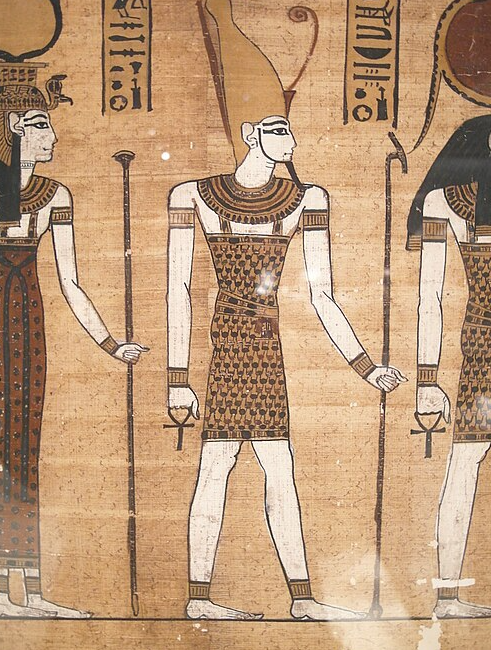
Atum (also spelled Atem, Tem, Temu or Tum) was one of the oldest and most important deities in Egyptian mythology — the primordial creator god who brought the universe into existence from the chaotic waters of Nun. Known as “the Complete One” or “the All,” he embodies both the beginning and the end of all things. Atum rose from the primordial ocean, created himself, and fathered the first gods, setting in motion the entire cosmos. He is the evening sun, the ultimate ancestor of the gods, kings, and humanity, and the deity who will one day return the world to chaos at the end of time. For over 3,000 years he remained central to Egyptian royal ideology, solar theology, and the afterlife, often worshipped as Atum-Ra.
Early Origins and Rise in Mythology
Atum’s worship dates back to predynastic times, making him one of the most ancient gods in the Egyptian pantheon. His primary cult centre was Heliopolis (ancient Iunu, “City of the Sun”), near modern Cairo, where he was revered as the supreme creator long before the prominence of other solar gods.
According to the Heliopolitan creation myth, recorded in the Pyramid Texts from the Old Kingdom onward, before anything existed there was only the dark, chaotic primordial ocean called Nun. From these waters rose the primeval mound — the Benben stone — upon which Atum appeared. In some versions he emerged as a serpent; in others he created himself through sheer will and the power of heka (magic).
Lonely in the void, Atum masturbated (or, in gentler temple versions, spat or sneezed) and produced his first two children: Shu (god of air and life) and Tefnut (goddess of moisture and order). When they wandered off and became lost in the darkness, Atum sent his Eye to search for them. Upon their joyful return, his tears fell and became the first humans.
From Shu and Tefnut came Geb (earth) and Nut (sky), then Osiris, Isis, Set, and Nephthys — completing the Great Ennead. Atum thus stands as the ultimate ancestor of all gods, pharaohs, and humanity.
Mythological Achievements and Cosmic Role
Atum’s greatest achievement was the act of self-creation and the ordering of the cosmos from chaos. He separated the sky from the earth, established the principles of Ma’at (truth, balance, and order), and set the sun on its daily journey.
As a solar deity, Atum specifically represented the evening sun — the aged, setting sun that travels through the underworld (Duat) each night. He formed one of the three main aspects of the sun god alongside Khepri (morning sun, scarab beetle) and Ra (midday sun). Together they formed Atum-Ra, the complete solar cycle: rising, shining, and setting before rebirth at dawn.
In the afterlife, Atum protected the deceased king and helped him ascend to the sky. Pyramid Texts describe the pharaoh uniting with Atum after death, becoming “one with the creator.” At the end of the current cosmic cycle, Atum was believed to return to his serpent form in the waters of Nun, destroying the world and preparing for the next creation — making him both creator and destroyer.
He also guarded the pharaoh in life: kings were considered “sons of Atum,” and he was shown crowning pharaohs and granting them the ankh (life) and was-sceptre (power).
Building Projects, Temples, and Cultural Patronage
Atum’s main temple complex at Heliopolis was one of the most important religious centres in Egypt for millennia. It housed the sacred Benben stone (a pyramidal mound symbolising the primeval hill) and towering obelisks that caught the first rays of the sun.
The god inspired the construction of countless obelisks, temples, and solar shrines across Egypt. Priests at Heliopolis composed hymns, rituals, and theological texts that influenced Egyptian thought for thousands of years. Atum’s mythology directly shaped royal ideology: every pharaoh was the living image of Atum on earth, and his name appeared in countless royal titles and pyramid rituals.
He was also closely linked to the sacred Bennu bird (the Egyptian phoenix), symbol of renewal and resurrection.
Personal Life (Mythological), Appearance, and Habits
Atum had no human wife or family in the mortal sense; he created his first children alone. In later myths he was paired with the lioness goddess Sekhmet or Iusaaset (the “great one who comes forth”), regarded as his feminine aspect or hand.
Appearance (standard Egyptian iconography): A majestic, fully human king wearing the Double Crown (pschent) of Upper and Lower Egypt, a long curved divine beard, and often holding the ankh in one hand and the was-sceptre in the other. In later images he leans on a staff as an old man to show his aspect as the setting sun.
Alternative forms include:
- A coiled serpent (his original and final form).
- A ram-headed man or black bull (solar/underworld aspects).
- A mongoose, lion, lizard, or ape (sometimes armed with a bow).
Daily “Habits” in Myth: Atum rises from Nun each morning, creates or renews the world through his power, sails across the sky in the solar barque, descends into the Duat at evening, defeats the chaos serpent Apophis, and is reborn at dawn — a never-ending cycle of creation, order, and renewal.
Personality, Character Traits, Likes, Dislikes, and Hidden Characteristics
Publicly, Atum is portrayed as the wise, all-powerful, benevolent creator — the “Great He-She” or “Two-in-One,” containing both male and female principles within himself. He is the ultimate source of life, order, and kingship.
Likes: Order (Ma’at), the daily solar cycle, protecting the king and the righteous dead, and the act of creation itself. He delights in the return of his children and the flourishing of humanity.
Dislikes: Chaos (isfet), the serpent Apophis who threatens the sun boat each night, and the dissolution of Ma’at. As the finisher of the world, he ultimately destroys what he once created.
Hidden or Lesser-Known Characteristics:
- Androgynous/Self-Generating Nature: Atum is both male and female; he created his first children without a partner, embodying complete self-sufficiency.
- Dual Role as Creator and Destroyer: While he brings life, he is also the god who will one day swallow the universe back into Nun.
- Chthonic and Underworld Connections: As the evening sun, he spends half his existence in the Duat, linking him to death, resurrection, and the afterlife.
- Mystical and Esoteric Side: In later theological texts, Atum was seen as the hidden, transcendent “One” from whom all multiplicity arises — a philosophical concept of unity behind diversity.
- Close Association with the Pharaoh: Every king was the living image of Atum on earth; the god’s name was often part of royal titles and pyramid rituals.
- Animal Transformations: His ability to appear as serpent, bull, lion, or ape shows his mastery over all forms of existence.
These hidden traits reveal a god who is not merely a distant creator but an eternal, self-contained force that both begins and ends all things.
Challenges, Setbacks, and Later Evolution
Atum faced no dramatic “fall” — he is eternal. However, from the Middle Kingdom onward he was gradually overshadowed by the rising popularity of Ra (and later Amun-Ra). Many of his attributes and myths were absorbed into the more prominent sun god, and Atum became more of a theological complement than the sole focus of worship.
In the New Kingdom he continued to be honoured in Heliopolis and in royal tombs, but his independent cult diminished. Even then, he never disappeared: he remained vital in funerary texts, solar hymns, and the ideology of kingship until the very end of pagan Egypt in the Roman period.
Legacy
Atum created the theological foundation for the entire Egyptian worldview. The Heliopolitan Ennead and creation myth influenced every later cosmogony in Egypt. His concept of a self-created, all-encompassing deity shaped ideas of kingship, the daily rebirth of the sun, and the cycle of life and death for over 3,000 years.
Modern scholars view Atum as one of the most sophisticated early concepts of a supreme being — a god who is simultaneously everything and the source of nothing, the beginning and the end. He remains a powerful symbol of creation, renewal, and the eternal cycle that governed ancient Egyptian civilisation.
In the words of the ancient Egyptians themselves: “I am Atum when I am alone in Nun… I am the one who created the gods.”