

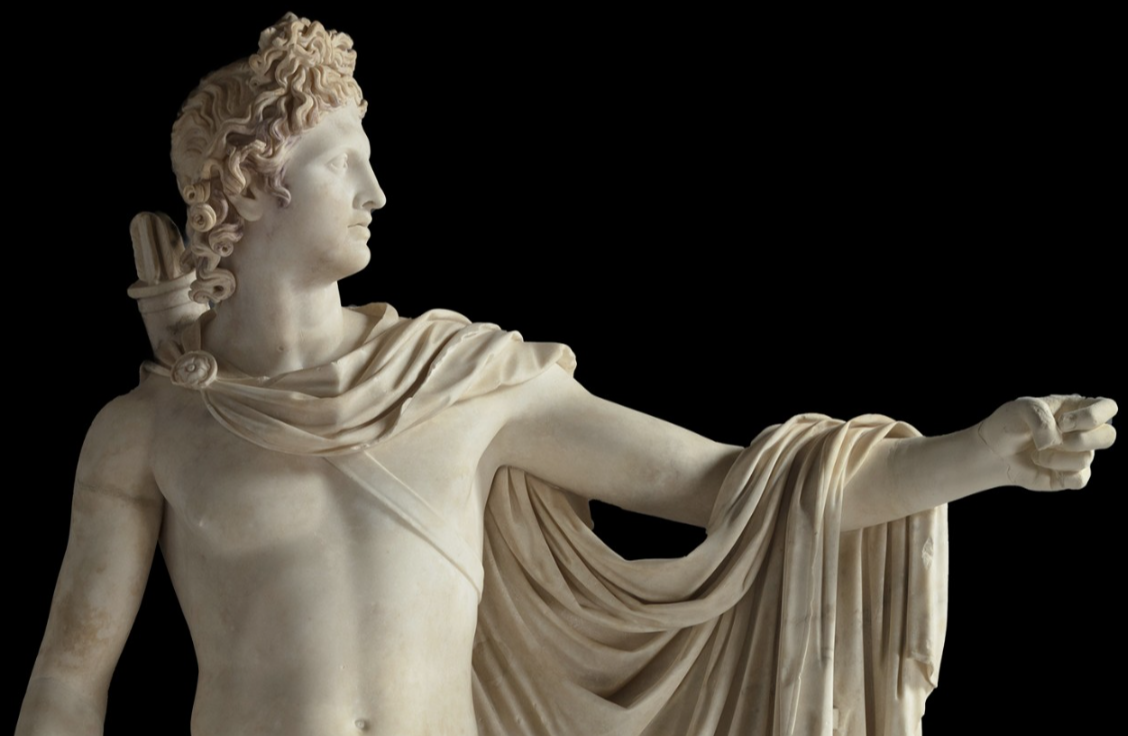
Apollo (Greek: Ἀπόλλων; Roman: Apollo) was one of the most widely worshipped and multifaceted gods in the ancient Greco-Roman world. Son of Zeus and Leto, twin brother of Artemis, he embodied the ideal of youthful male beauty, reason, order, and civilisation. Known as the god of the sun (in later tradition), music, poetry, archery, prophecy, healing, and plague, Apollo represented both light and darkness, creation and destruction. His oracle at Delphi was the spiritual centre of the Greek world for over a thousand years, where the famous maxim “Know thyself” was inscribed. He influenced philosophy, art, medicine, and kingship from the Archaic age until the end of pagan antiquity.
Early Origins and Rise in Mythology
Apollo’s worship dates back to the Mycenaean period (c. 1400–1200 BC), with possible roots in earlier Anatolian or Near Eastern deities. His name appears in Linear B tablets as “Pe-ro” or similar forms. By the Archaic period (8th–6th centuries BC) he had become one of the twelve Olympian gods.
According to the Homeric Hymn to Apollo, his mother Leto, pregnant by Zeus, was pursued by the jealous Hera and could find no place to give birth until she reached the floating island of Delos. There she bore Apollo and Artemis. Immediately after birth, Apollo demanded a lyre and bow, declaring he would be the god of music, archery, and prophecy.
As a young god, he slew the monstrous serpent Python that guarded the oracle at Delphi, claimed the site as his own, and established the Pythian Games. He also avenged his mother by killing the giant Tityos and pursued the nymph Daphne, who was transformed into a laurel tree to escape him — the laurel thereafter became his sacred tree.
Mythological Achievements and Cosmic Role
Apollo’s greatest achievements include:
- Establishing the Oracle of Delphi, the most authoritative prophetic centre in the ancient world. The Pythia (priestess) delivered his oracles in a trance, influencing kings, colonists, and philosophers for centuries.
- Inventing or perfecting the lyre (given to him by Hermes in exchange for cattle) and becoming the leader of the Muses (Musagetes), patron of music, poetry, and the arts.
- Granting the gift of healing while also sending plagues (as in the Iliad, where he strikes the Greek army with arrows).
- Serving as protector of young men, shepherds, colonists, and cities; he helped found many Greek colonies and was worshipped as Apollo Delphinios (of the dolphin) by sailors.
- Defeating Python and claiming Delphi, symbolising the triumph of order and reason over chaos.
As a solar deity in later Hellenistic and Roman times, Apollo was identified with the sun itself (Helios), driving a chariot across the sky each day.
Building Projects, Temples, and Cultural Patronage
Apollo’s most famous sanctuary was the Temple of Apollo at Delphi, rebuilt several times and regarded as the navel (omphalos) of the world. It housed the sacred tripod, the omphalos stone, and vast treasures offered by kings and city-states.
Other major temples included the Temple of Apollo at Delos (his birthplace), the Temple of Apollo Epicurius at Bassae (one of the best-preserved classical temples), and grand sanctuaries at Didyma and Claros in Asia Minor.
Apollo inspired countless works of art, literature, and music. The Pythian Games (held every four years at Delphi) combined athletic, musical, and poetic contests. He was the patron god of poets, musicians, and physicians (his son Asclepius became the god of medicine).
Personal Life (Mythological), Appearance, and Habits
Apollo never married but had many lovers, both male and female. Notable relationships include Daphne (who became the laurel), Hyacinthus (a Spartan prince whom he accidentally killed; the hyacinth flower sprang from his blood), Coronis (mother of Asclepius), and the male lovers Cyparissus and Admetus. His children include Asclepius, Orpheus, and the Sibyl of Cumae.
Appearance (per classical sculpture and literature): The perfect image of youthful male beauty — tall, athletic, beardless, with long golden curls, radiant skin, and piercing bright eyes. He is usually depicted nude or semi-nude, wearing a laurel wreath, holding a lyre or bow and arrows, often with a cloak draped over one shoulder.
Daily “Habits” in Myth: Apollo rises with the sun, plays the lyre to delight the gods on Olympus, consults with Zeus, visits his oracles, and spends time hunting with his sister Artemis or training young heroes. In the evening he returns to Olympus or retreats to his temples.
Personality, Character Traits, Likes, Dislikes, and Hidden Characteristics
Publicly, Apollo is the embodiment of Greek ideals: reason, moderation, beauty, order, and harmony (the “Apollonian” principle later contrasted with Dionysian ecstasy by Nietzsche).
Likes: Music, poetry, prophecy, archery, healing, young men in their prime, laurel trees, dolphins, crows, swans, and the number seven. He delights in order, truth, and civilisation.
Dislikes: Hubris (excessive pride), chaos, lies, and those who challenge the gods. He is swift to punish with plague or sudden death.
Hidden or Lesser-Known Characteristics:
- Dual Nature (Light and Dark): While associated with light and healing, he is also the god of sudden death, plague, and destructive arrows — the “far-shooter” who strikes from afar.
- Androgynous Beauty and Bisexuality: His idealised youthful form blurs gender lines in art; he had prominent male lovers, reflecting Greek aristocratic pederasty.
- Prophetic and Philosophical Depth: Beyond fortune-telling, his oracle encouraged self-knowledge and moderation (“Nothing in excess”).
- Vengeful and Jealous Side: He flayed the satyr Marsyas alive for losing a musical contest and relentlessly pursued those who offended him or his mother.
- Connection to Civilisation and Colonisation: He guided Greek settlers to new lands and promoted law, music, and medicine as foundations of society.
- Solar and Cosmic Aspect: In later periods he merged with Helios and became a symbol of universal order and the triumph of rationality.
These hidden traits reveal a god who is not merely beautiful and harmonious but also powerful, dangerous, and deeply complex — the perfect balance of reason and passion.
Challenges, Setbacks, and Later Evolution
Apollo faced several mythological setbacks: he was temporarily banished from Olympus for killing the Cyclopes (punishment for the death of his son Asclepius), served as a mortal shepherd for King Admetus, and lost musical contests (though rarely). In the Trojan War he supported the Trojans, yet his champion Hector still fell.
In the Hellenistic and Roman periods his worship spread across the Mediterranean and was adopted by the Romans without change. Emperor Augustus particularly favoured him, building the Temple of Apollo on the Palatine Hill after the Battle of Actium. His cult survived until the Christian emperors closed the pagan temples in the 4th–6th centuries AD; the oracle at Delphi finally fell silent in the late 4th century.
Legacy
Apollo shaped Western civilisation more than almost any other deity. The ideal of classical beauty in sculpture, the concept of the “Apollonian” spirit of order and reason, the foundations of Western medicine (through Asclepius), the importance of oracles and self-knowledge, and the centrality of music and poetry in culture all trace back to him. His temple at Delphi influenced philosophy (Socrates claimed his wisdom came from the Delphic oracle), and the laurel wreath became the eternal symbol of victory and poetic achievement.
Even today, Apollo remains the enduring archetype of youthful male perfection, artistic genius, and enlightened reason — a god whose light still illuminates the arts, sciences, and the human pursuit of harmony and truth.