

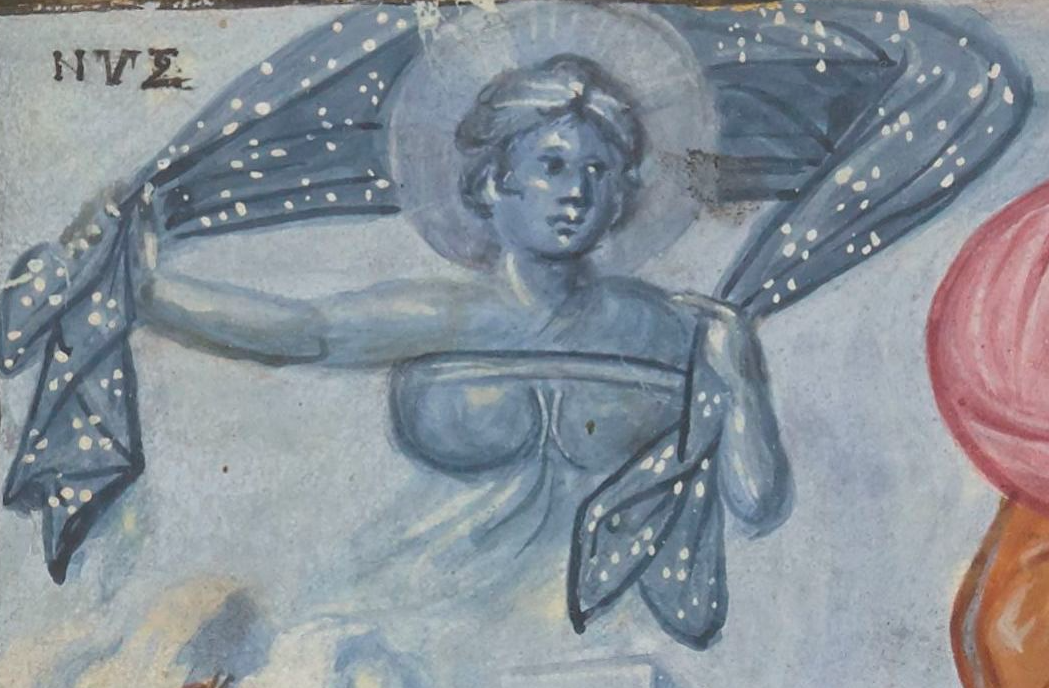
Nyx (Greek: Νύξ, “Night”) is the ancient Greek primordial goddess and personification of the night. One of the first beings to emerge from Chaos, she is a powerful, shadowy force feared even by Zeus, the king of the gods. In Hesiod’s Theogony, Nyx is the mother of numerous abstract deities representing both destructive and neutral forces — from Death and Sleep to Day and Light. She embodies the mysterious, enveloping darkness that precedes and outlasts the Olympian order, drawing a veil of night across the sky each evening in her chariot. Revered and respected more than worshipped, Nyx represents the eternal, cosmic aspect of night — beautiful, terrifying, and inevitable.
Early Origins and Rise in Mythology
Nyx is among the oldest deities in Greek cosmology, appearing in Hesiod’s Theogony (late 8th century BC) as a child of Chaos — the primeval void from which all existence sprang. Alongside her brother Erebus (Darkness), she is one of the first personifications to emerge.
In the primordial generation, Nyx mates with Erebus to produce Aether (upper sky/light) and Hemera (Day) — her opposites, who scatter the mists of night at dawn. Alone, without a consort, she gives birth to a vast brood of dark and fateful children, including Moros (Doom), Thanatos (Death), Hypnos (Sleep), the Oneiroi (Dreams), the Moirai (Fates), Nemesis (Retribution), Eris (Strife), and others. These offspring embody the inevitable forces that govern mortal and divine life.
Homer in the Iliad describes her as so mighty that even Zeus fears to anger her, retreating when she intervenes to protect Hypnos.
Mythological Achievements and Cosmic Role
Nyx’s primary role is to bring and embody night itself. She rides across the sky in a chariot drawn by shadowy horses, spreading darkness and allowing the world to rest.
Her greatest “achievement” is her generative power: as a primordial mother, she produces both the comforting (Sleep, Dreams) and the terrifying (Death, Strife, Doom) aspects of existence. She dwells at the edges of the cosmos in a misty palace where she and Hemera pass each other daily, maintaining the eternal cycle of night and day.
Even Zeus, the supreme Olympian, respects her authority — in one myth, he refrains from punishing Hypnos because Nyx shelters her son. Her fearsome presence underscores that primordial forces predate and outrank the younger gods.
Building Projects, Temples, and Cultural Patronage
Nyx had few dedicated temples or cults in classical Greece — she was more a cosmic principle than a deity of daily worship. Ancient art depicts her in vase paintings, often as a winged charioteer or veiled woman drawing night’s mantle.
She influenced later literature, Orphic hymns (where she is a cosmic advisor and oracular figure), and philosophical thought on darkness and the origins of existence. Her children — especially Hypnos, Thanatos, and the Fates — appeared widely in art, drama, and mystery cults.
Personal Life (Mythological), Appearance, and Habits
Nyx partners with Erebus (Darkness) to produce light and day, but most of her children are born parthenogenetically — from her alone.
Appearance (in ancient art and descriptions): A majestic, veiled or winged goddess draped in black robes or mists, often crowned with stars or an aureole. She drives a chariot pulled by dark horses, sometimes accompanied by her shadowy children. Later artistic traditions portray her as a beautiful, ethereal woman with long dark hair, radiating quiet power and mystery.
Daily “Habits” in Myth: Each evening Nyx emerges from her cosmic palace, drives her chariot across the sky to draw the veil of night, and allows her daughter Hemera to depart at dawn. She shelters her children, watches over the sleeping world, and maintains the balance between light and darkness.
Personality, Character Traits, Likes, Dislikes, and Hidden Characteristics
Publicly, Nyx is a distant, awe-inspiring primordial force — neither benevolent nor malevolent, but inevitable and commanding universal respect.
Likes: The quiet of night, restful sleep, the mysteries of darkness, and the natural cycle of day and night.
Dislikes: Interference with her domain, threats to her children, and the hubris of younger gods who challenge primordial order.
Hidden or Lesser-Known Characteristics:
- Immense Power and Fear Factor: Even Zeus fears her wrath — she is one of the few beings capable of making the king of gods retreat.
- Dual Motherhood: She births both comforting forces (Sleep, Dreams) and terrifying ones (Death, Strife), embodying night’s dual nature as rest and danger.
- Protective and Maternal: Fiercely guards her offspring, intervening when they are threatened.
- Neutral and Balanced: Not cruel or vengeful like some Olympians — she is calm, reserved, and wise, representing the profound stillness and mystery of night.
- Cosmic Primacy: As a protogenos, she predates the Olympians and represents an older, more fundamental layer of reality.
These traits reveal Nyx as a goddess of quiet, overwhelming authority — beautiful in her darkness, protective of her realm, and eternal beyond the petty conflicts of younger deities.
Challenges, Setbacks, and Later Evolution
Nyx faces no true defeats — as a primordial being, she is eternal and unchallenged. In some Orphic traditions she becomes an oracular advisor to later cosmic rulers (Uranus, Cronus, Zeus).
Her worship remained minimal in classical Greece, overshadowed by Olympian gods. In Roman mythology she became Nox, retaining her primordial status but with less emphasis. She survived in poetry, art, and philosophy as the archetype of night’s mystery and power.
Legacy
Nyx shaped the Greek understanding of cosmic origins, the cycle of day and night, and the inevitability of fate and death. Her children — Sleep, Death, the Fates — became central figures in literature and art. She influenced later concepts of the night as a time of rest, dreams, and hidden truths.
Even today, Nyx symbolizes the profound beauty and terror of darkness, the power of the primordial feminine, and the eternal balance between light and shadow. In a world that fears the unknown, she reminds us that night is not merely absence — it is a powerful, living presence that cradles the world in mystery and renewal.