

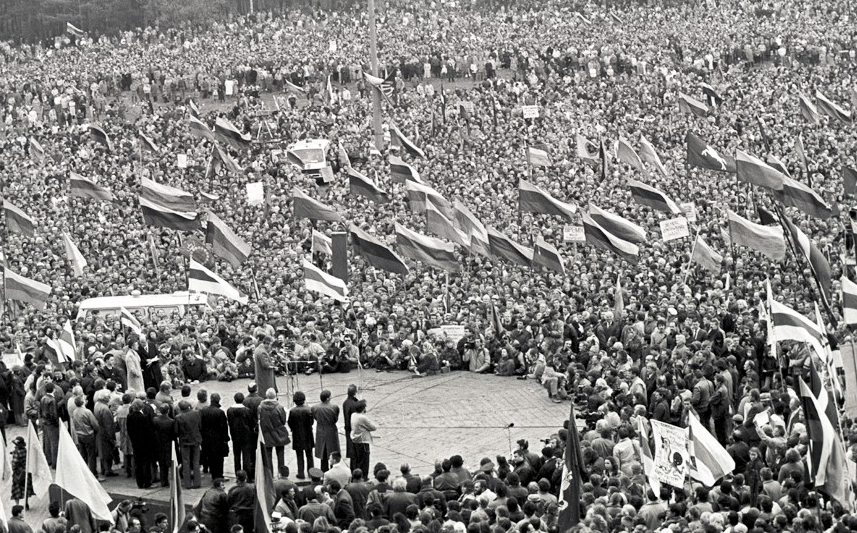
On March 11, people in Lithuania celebrate the Day of the Restoration of Independence of Lithuania, marking the historic moment in 1990 when Lithuania restored its independence from the Soviet Union.
On March 11, 1990, the Lithuanian parliament, known as the Supreme Council of Lithuania, adopted the Act of the Re-Establishment of the State of Lithuania. The declaration proclaimed that Lithuania was restoring the sovereign state that had existed before the Soviet occupation in 1940. The act asserted that the annexation of Lithuania by the Soviet Union during World War II was illegal and therefore void.
The declaration was led by Vytautas Landsbergis, who became the head of the Lithuanian state. Lithuania thus became the first Soviet republic to openly declare the restoration of its independence, setting in motion a wave of independence movements across the Soviet bloc.
The Soviet leadership under Mikhail Gorbachev initially rejected the declaration and imposed political and economic pressure on Lithuania. Tensions escalated in January 1991 when Soviet forces attempted to seize strategic locations in Vilnius during the January Events (Lithuania 1991), resulting in the deaths of several civilians. Despite these challenges, Lithuania maintained its stance and eventually gained international recognition as the Soviet Union collapsed later that year.
Significance
Day of the Restoration of Independence is one of the most important national holidays in Lithuania.
It symbolizes the restoration of Lithuanian sovereignty after five decades of Soviet rule and the peaceful determination of the Lithuanian people to reclaim their democratic state.
The day represents national resilience, the revival of Lithuanian political independence, and the reaffirmation of the country’s cultural identity and democratic values.
Observances and Activities
Official ceremonies in Vilnius:
The main commemorations take place in Vilnius, the capital of Lithuania. Government leaders deliver speeches, and official ceremonies are held at the parliament building and major national monuments.
Flag raising and patriotic displays:
Lithuanian national flags are displayed across cities, towns, and homes. Public buildings, schools, and streets are decorated with the yellow, green, and red colours of the Lithuanian flag.
Parades and public gatherings:
Citizens participate in marches, concerts, and patriotic events celebrating Lithuania’s independence and democratic achievements.
Educational and cultural programs:
Schools, universities, museums, and cultural institutions organize lectures, exhibitions, and historical presentations reflecting on Lithuania’s independence movement and its struggle for sovereignty.
Community celebrations:
Lithuanians at home and abroad gather for cultural performances, folk music concerts, and traditional celebrations that highlight national heritage and unity.
The Day of the Restoration of Independence remains a powerful symbol of Lithuania’s determination to restore its freedom and maintain its national identity after decades of foreign rule.
A common sentiment expressed on this day reflects pride in the nation’s freedom and sovereignty. 🇱🇹