

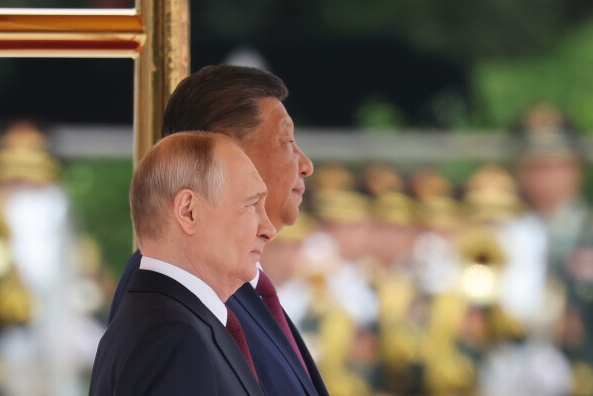
When Chinese President Xi Jinping welcomed Russian President Vladimir Putin to Beijing with military honours, gun salutes and carefully choreographed symbolism, the meeting was about far more than diplomatic ceremony. The summit came only days after US President Donald Trump concluded his own high-profile visit to China. That timing alone transformed the Xi-Putin summit into a geopolitical statement.
Beijing was sending a message to Washington, Europe and the wider world: China now sees itself not merely as a rising power navigating the international order, but as a central pole shaping it.
Xi described China’s ties with Russia as “unyielding,” while Putin called bilateral relations “unprecedentedly high” despite what he referred to as “unfavourable external factors.” Neither leader needed to explicitly name the United States for the target of those remarks to be understood.
The symbolism mattered. Trump’s visit to Beijing was filled with ceremony, business deals and attempts at stabilising a deeply competitive US-China relationship. Putin’s visit, by contrast, appeared less performative and more strategic. The Xi-Putin relationship no longer requires spectacle because both sides already understand the depth of their mutual dependence. What Beijing and Moscow increasingly share is not simply partnership, but strategic necessity.
Since the start of the Ukraine war in 2022, China has effectively become Russia’s largest economic lifeline. As Western sanctions isolated Moscow financially and technologically, Beijing absorbed discounted Russian oil and gas exports at enormous scale. Russia, in turn, became increasingly dependent on Chinese markets, Chinese banking channels and Chinese industrial demand to sustain both its economy and its war effort.
That dependency has now evolved into a far broader geopolitical alignment.
Energy security stood at the centre of the Beijing summit. Kremlin officials openly framed Russia as a “reliable energy supplier” during a period of West Asia instability and disruption linked to the Strait of Hormuz crisis. Russia’s oil exports to China reportedly rose by 35 percent during the first quarter of 2026 alone, while Moscow continues pushing for final approval of the long-delayed Power of Siberia 2 pipeline project.
The timing is no coincidence. The US-Israeli war against Iran and instability across West Asia have once again exposed China’s core strategic vulnerability: maritime dependence.
China imports enormous quantities of energy through maritime chokepoints vulnerable to disruption, particularly the Strait of Hormuz and the Strait of Malacca. Beijing understands that any prolonged naval confrontation involving the United States could place China’s energy lifelines under severe pressure. This explains why Xi repeatedly called for a “comprehensive ceasefire” in the West Asia during his talks with Putin and warned that renewed escalation was “inadvisable.”
Russia and China, however, approach the West Asia crisis differently.
For Moscow, higher energy prices generated by regional instability create short-term strategic and economic advantages. Russia benefits financially from rising oil and gas prices while simultaneously increasing its leverage over energy-starved Asian markets. Some Russian officials even suggested Moscow could compensate for Chinese shortages caused by the Hormuz disruption.
China’s priorities are different. Beijing’s economic model depends on uninterrupted global trade flows, stable shipping lanes and predictable energy supplies. China cannot fully realise its industrial ambitions if the world’s major maritime corridors remain unstable. This is one of the reasons Beijing increasingly presents itself as a supporter of negotiations, ceasefires and “global stability,” even while deepening strategic coordination with Moscow.
At the same time, China continues carefully balancing multiple fronts. Only days before Putin’s arrival, Trump held extensive talks with Xi in Beijing. China reportedly agreed to major Boeing purchases while discussions also touched on energy diversification and supply chains.
This reveals the true sophistication of Beijing’s geopolitical strategy.
China does not want full confrontation with the United States. Nor does it want Russia weakened to the point of collapse. Instead, Beijing seeks a controlled balance where both Washington and Moscow remain dependent on Chinese economic engagement in different ways. China’s leadership increasingly behaves like a civilisational balancing power managing relations across competing blocs rather than fully aligning itself inside one camp.
Yet despite the warm rhetoric, the China-Russia relationship is not entirely equal.
Russia now relies on China far more than China relies on Russia. Beijing has become Moscow’s indispensable economic partner, but China still maintains substantial access to Western markets, Western finance and global trade networks. Reports emerging around the summit suggest tensions remain beneath the surface over gas pricing, technological imbalance and long-term dependency concerns inside Russian strategic circles.
Still, both sides understand that their partnership serves a larger strategic purpose.
For Putin, China provides economic survival, diplomatic cover and access to critical markets while Russia remains locked in confrontation with the West. For Xi, Russia functions as a geopolitical counterweight against American pressure, a strategic energy reservoir and a partner in reshaping global institutions toward a more multipolar structure.
That shared vision was visible in Xi’s call for a “more just and reasonable” system of global governance. Behind the diplomatic language lies a broader ambition: weakening the Western-led order that dominated international politics after the Cold War.
This is why the Beijing summit matters far beyond bilateral relations.
The world is increasingly entering an era where power is no longer organised around a single uncontested superpower. China and Russia are attempting to construct parallel systems of influence through BRICS expansion, alternative financial arrangements, energy networks, regional organisations and strategic coordination against Western sanctions architecture.
Whether that project ultimately succeeds remains uncertain.
China still faces slowing economic growth, demographic decline, export vulnerabilities and growing distrust from neighbouring powers including India, Japan and parts of Southeast Asia. Russia remains trapped in a costly war in Ukraine and increasingly dependent on Beijing economically. Both powers also remain vulnerable to global financial instability and prolonged technological competition with the West.
But what the Xi-Putin summit demonstrated clearly is that neither Beijing nor Moscow believes the future international order should remain American-led indefinitely.
The deeper message from Beijing this week was not simply that China and Russia are cooperating. It was that China increasingly sees itself capable of engaging Washington and Moscow simultaneously while positioning itself at the centre of global diplomacy, energy politics and strategic negotiations.
Taken together, the summit revealed how rapidly the global balance of power is evolving from a Western-dominated order into a far more competitive and fragmented multipolar system.