

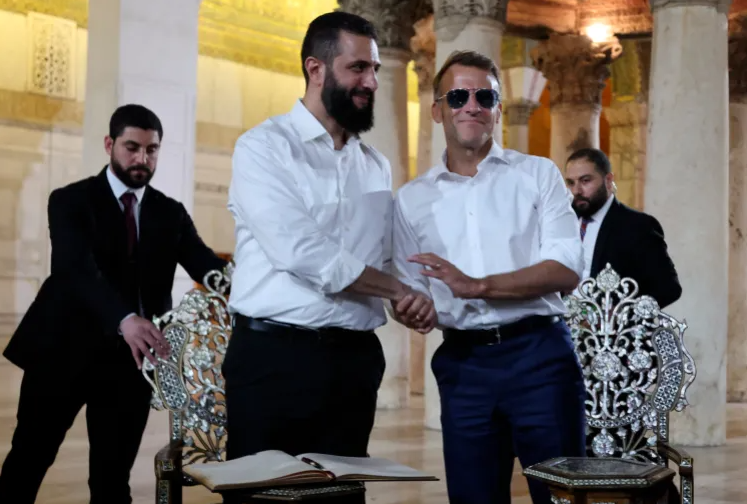
The smoke that billowed over the Damascus skyline on Tuesday provided a stark visual metaphor for the paradoxes of contemporary Syria. Inside the presidential palace, President Ahmed al-Sharaa was hosting French President Emmanuel Macron, marking a watershed diplomatic breakthrough as the first visit by a European Union head of state since the spectacular collapse of the Bashar al-Assad regime in December 2024. Outside, twin explosions ripped through a bustling commercial artery nestled between the Tourism Ministry and the National Museum, directly across from the Four Seasons Hotel where the French delegation had stayed. The blasts left eighteen people wounded and cast a long, familiar shadow over the government’s meticulously managed narrative of state stabilization and international reintegration.
This dramatic juxtaposition underscores the profound fragility of Syria’s transition. Coming less than a week after a separate bombing at a Damascus cafe claimed ten lives, the latest violence served as a rude awakening for a state attempting to signal a return to normalcy. For al-Sharaa, the former militant commander who successfully rebranded himself as a pragmatic statesman, the stakes could not be higher. His administration is currently trying to lure back hundreds of billions of dollars in foreign direct investment to rebuild a country shattered by fourteen years of total war. Yet, as the plumes of grey smoke near the hotel demonstrated, the capacity of hidden networks to disrupt the state-building project remains intact, proving that a handful of actors with crude explosives can effectively jeopardize monumental diplomatic endeavors.
The political theater in Damascus, despite the security breaches, yielded significant diplomatic and economic milestones. Al-Sharaa and Macron utilized the visit to formally announce the reappointment of ambassadors, ending more than a decade of deep diplomatic estrangement following France’s embassy closure in 2012. Furthermore, the bilateral talks produced a sprawling roadmap for national reconstruction, featuring a dozen economic agreements with major French conglomerates. These initiatives target critical infrastructure bottlenecks, including the rehabilitation of water and electricity networks in the devastated city of Homs, modernization of the Damascus airport cargo systems, and technical support for the Syrian Central Bank’s sweeping financial reforms. For the Syrian administration, these pacts, alongside ongoing maritime logistics expansions with shipping giants like CMA CGM at the Port of Latakia, represent an invaluable stamp of Western legitimacy.
Nevertheless, the security failures highlight a multifaceted array of structural threats that continue to contest the new order from both within and beyond government-controlled territories. While no faction immediately claimed responsibility for Tuesday’s twin detonations, intelligence analysts and regional experts are focusing heavily on the underground networks of the Islamic State of Iraq and the Levant, known widely as ISIL or ISIS. Despite losing its territorial caliphate and its former capital of Raqqa years ago, the group remains a potent insurgent entity. Current United Nations assessments suggest that the group still commands between 1,500 and 3,000 active fighters dispersed across the vast, porous border regions separating Syria and Iraq. Operating as decentralized clandestine cells, these jihadist networks do not require territorial control to project power; they merely leverage tactical sabotage to puncture the government’s aura of absolute domestic security.
Beyond the specter of sunni jihadism, al-Sharaa faces a completely different tier of destabilization from the unraveled remnants of the old Baathist state. The previous regime’s power structures may have dissolved in late 2024, but scattered loyalist spoiler networks continue to engage in low-level guerrilla resistance and targeted sabotage. This old guard has recently found renewed rhetorical momentum. Rami Makhlouf, the billionaire tycoon and cousin of the ousted dictator, recently published a provocative video message from his current exile in Moscow. Makhlouf, who has been funneling substantial financial resources from Russia to sustain Alawite militant factions inside Syria, openly threatened the Damascus government by demanding the immediate release of all Alawite prisoners. His public declaration, emphasizing that his warnings are always backed by action, highlights a persistent undercurrent of sectarian and political score-settling that continues to boil beneath the surface of the state.
The geographical limits of the administration’s authority further complicate this security matrix. While the al-Sharaa government maintains formal sovereignty over the vast majority of Syrian territory, including the key urban hubs and the crucial agricultural zones of the northeast via the comprehensive January integration deal, practical enforcement varies wildly. Regional control operates on a steep gradient, proving highly resilient across western and central Syria but degenerating into structural vulnerability along the southern periphery and within minority-dominated enclaves. In many outlying provinces, the rule of law is effectively outsourced to localized militias that have been nominally co-opted into the national army structure but maintain independent command lines and tribal loyalties.
This volatile decentralized reality exploded into open warfare in July 2025 within the southern Druze-majority province of Suwayda. Long-standing local grievances over administrative autonomy and economic neglect culminated in violent clashes between Druze armed factions and local Bedouin populations. When Damascus dispatched national military units into Suwayda to reassert central authority, regional geopolitical dynamics quickly escalated the crisis. Asserting a mandate to protect minority populations along its northern border, Israel intervened directly by launching artillery barrages against government positions in Suwayda. This flashpoint illustrated how easily localized civil unrest can trigger external military interventions, particularly by neighboring states eager to prevent a hostile centralized power from consolidating strength along their frontiers.
The external environment presents al-Sharaa with an intricate maze of strategic rivalries and fragile alliances. For over a decade, Syria served as a primary geopolitical theater for foreign heavyweights like Russia and Iran, alongside various regional Shia militias and the Lebanese political and military organization Hezbollah. The transition of power fundamentally disrupted these patron-client networks. While the new administration seeks to cultivate a more balanced, multi-aligned foreign policy by engaging with Western capitals and Gulf states, it must navigate deep-seated mistrust with Tehran and Baghdad. These traditional actors view the rise of an Islamist-led government in Damascus with profound skepticism, viewing it as a direct threat to the regional geopolitical architecture they spent billions of dollars and countless lives trying to preserve under the Assad presidency.
Ironically, the most existential challenge to al-Sharaa’s long-term survival may not originate from foreign capitals, remnants of the old regime, or desert insurgencies, but rather from the very core of the revolutionary coalition that brought him to power. During the swift offensive that captured Damascus in December 2024, al-Sharaa relied heavily on a heterogeneous coalition of battle-hardened conservative fighters drawn from Hay’at Tahrir al-Sham, alongside an array of rival religious factions. Having successfully managed the transition from a designated militant commander to a pragmatic head of state, al-Sharaa has increasingly pivoted toward a moderate, inclusive, and technocratic governance model designed to placate nervous religious minorities and attract global capital.
This pragmatic ideological evolution has created a volatile domestic friction point. The harsh realities of governing a country ruined by nearly a decade and a half of civil war are setting in. The domestic economy is paralyzed by widespread structural unemployment, destroyed industrial centers, and a deeply entrenched culture of corruption. Although the government has secured crucial economic breathing room, notably through US President Donald Trump’s unexpected June 2025 decision to waive broad sanctions on entities vital to Syrian infrastructure development and social fabric rebuilding, this relief has not translated into rapid, widespread job creation for the masses.
Consequently, a profound sense of socio-economic grievance is festering among the thousands of conservative young men who formed the vanguard of the 2024 uprising. Having risked their lives to overthrow the old regime, these fighters now find themselves largely unemployed, politically marginalized, and ideologically alienated by a leadership that increasingly emphasizes diplomatic engagement with Western powers and global financial institutions. Security analysts warn that this internal divide poses a catastrophic risk. If elements within the core constituency and the broader conservative circles conclude that al-Sharaa has compromised the core tenets of their struggle in exchange for international recognition, they could realistically launch a coordinated internal campaign against the administration. This would turn the very weapons and tactical expertise that dismantled the previous dictatorship against the architects of the new republic.
The socioeconomic crisis is further aggravated by an unprecedented humanitarian challenge: the massive, uncoordinated repatriation of the Syrian diaspora. Since the collapse of the Baathist state, more than 3.5 million refugees have returned home from neighboring states and global capitals, marking one of the largest and most rapid population movements in modern history. However, humanitarian organizations like the International Rescue Committee report that national infrastructure is fundamentally incapable of absorbing this influx. Upwards of ninety percent of returnees arrive to find a complete absence of basic public services, with over seventy percent forced to inhabit severely damaged or structurally compromised housing without municipal support.
This infrastructure deficit is actively generating intense resource-based social friction across local communities. As returning families compete with settled populations for access to scarce water supplies, intermittent electricity rations, diesel allocations, and limited seating in damaged local schools, old communal solidarities are fraying. The historic joy typically associated with the return of displaced loved ones has been replaced by a transactional anxiety, where local residents increasingly view returnees as direct competitors for basic survival assets. If the al-Sharaa administration fails to rapidly channel newly acquired foreign aid and French infrastructure investments into these friction points, these localized economic grievances could easily catalyze into widespread civil unrest, completely undermining the domestic stability required to sustain international partnerships.
Syria stands at a critical historical crossroads where the old habits of civil conflict collide directly with the complex demands of modern statecraft. The twin explosions that echoed through Damascus during Macron’s landmark visit serve as an urgent warning that the road to total national recovery will be contested by entrenched spoilers at every turn. Rebuilding a shattered state requires much more than orchestrating high-profile diplomatic handshakes, signing multi-million euro infrastructure concessions, or securing tactical sanctions relief from Washington.
To prevent his state-building project from fracturing along old fault lines, President Ahmed al-Sharaa must successfully execute a perilous balancing act. He must aggressively suppress the lingering insurgencies of ISIL and neutralize the sabotage networks of the old loyalist guard, while simultaneously managing the geopolitical anxieties of suspicious neighbors like Israel and Iran. Most crucially, he must deliver tangible economic relief to a desperate, impoverished population and reconcile his moderate, internationally focused governance agenda with the expectations of the conservative forces that placed him in power. Until these deep structural contradictions are resolved, the new Syria will remain a fragile entity, where the promise of a peaceful, sovereign future coexists precariously with the ever-present threat of renewed internal explosion.