

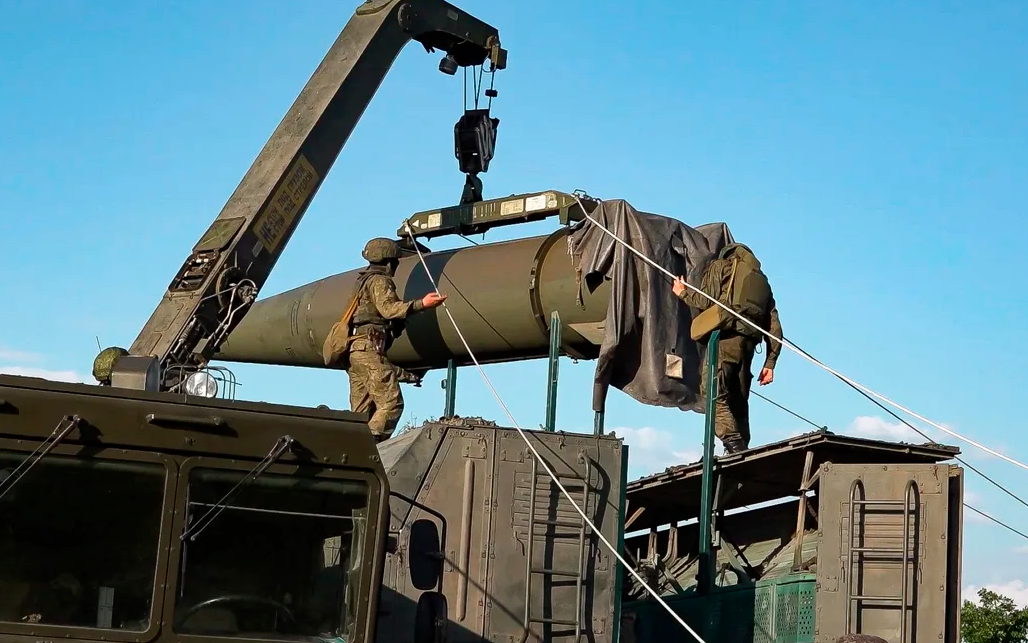
Russia’s latest nuclear exercises are not merely military drills. They are political theatre, strategic messaging and psychological warfare combined into one carefully calibrated operation designed to remind NATO that the Ukraine war is no longer confined to conventional battlefields alone.
Over three days, Moscow mobilised around 64,000 personnel, hundreds of missile systems, submarines, aircraft and strategic assets across Russia and Belarus in one of its largest nuclear readiness exercises in recent years. The scale alone was significant. But what made the exercises particularly alarming was not just the launch of nuclear-capable systems like the Yars intercontinental ballistic missile, the Zircon hypersonic missile, the Sineva submarine-launched ballistic missile or the deployment drills involving Iskander systems in Belarus. It was the broader geopolitical timing behind them.
The exercises unfolded amid rising tensions between Russia and NATO over Ukraine, increasing drone warfare around the Baltic region and growing fears inside Moscow that the war is gradually moving closer to direct confrontation between nuclear powers.
President Vladimir Putin attempted to balance firmness with restraint. Standing alongside Belarusian President Alexander Lukashenko and Russia’s military leadership, Putin repeated that nuclear weapons remain an “exceptional and extreme measure of last resort.” At the same time, however, he emphasised that Russia’s nuclear triad must remain a reliable guarantor of the sovereignty of the Russia-Belarus Union State.
This dual messaging has become central to Russian strategy since the start of the Ukraine war. Moscow constantly seeks to project two realities simultaneously: first, that it does not seek nuclear war; second, that it is fully prepared to escalate if it believes Russia’s strategic survival is threatened.
That ambiguity itself is part of the deterrence doctrine.
The drills also exposed how dramatically Belarus has transformed from a buffer state into an active extension of Russia’s nuclear posture. Russian tactical nuclear systems have already been stationed inside Belarus for some time, but these exercises went further by openly rehearsing the delivery, concealment and operational preparation of nuclear munitions on Belarusian territory.
For NATO’s eastern flank, this changes the strategic geography of Europe.
Belarus borders Poland, Lithuania and Latvia, placing Russian nuclear-capable systems directly adjacent to NATO territory. The deployment of Iskander-M missile systems and Oreshnik hypersonic capabilities inside Belarus significantly compresses NATO response timelines in any future escalation scenario.
At the same time, the Baltic theatre itself is becoming increasingly volatile.
Moscow accuses Baltic NATO members of allowing Ukrainian drones to transit through or operate near their territory against northern Russian targets. NATO denies the accusations, while Baltic states counterclaim that Russia itself is manipulating drone trajectories for provocation purposes. The situation has created a dangerous atmosphere where miscalculation could rapidly spiral beyond Ukraine.
Particularly sensitive is Kaliningrad, Russia’s heavily militarised exclave wedged between Lithuania and Poland. Lithuanian Foreign Minister Kestutis Budrys recently suggested NATO must demonstrate that it could penetrate Kaliningrad if necessary. The Kremlin responded by describing the remarks as “verging on insanity.”
Such exchanges may sound rhetorical, but they reveal how quickly the language of deterrence in Europe is hardening.
The broader strategic picture is even more troubling.
Russia’s updated nuclear doctrine in 2024 reportedly lowered the threshold for nuclear use under scenarios involving large-scale conventional attacks supported by nuclear states. In practical terms, Moscow is signalling that deeper Western involvement in Ukraine could potentially trigger responses previously considered unthinkable.
This is why the exercises involved the full nuclear triad: land-based intercontinental ballistic missiles, submarine-launched systems and strategic aviation assets. The participation of Borei-class nuclear submarines, MiG-31 aircraft armed with Kinzhal hypersonic missiles and long-range strategic missile forces was intended to demonstrate that Russia retains credible second-strike capability despite the prolonged Ukraine conflict.
At another level, these drills also reveal Moscow’s deeper anxiety.
Despite battlefield advances in some sectors of Ukraine, Russia understands that the war has evolved into a broader confrontation with the collective West economically, technologically and strategically. NATO’s military-industrial production is increasing. European states are raising defence spending. Finland and Sweden joined NATO. Poland is rapidly militarising. Germany is rebuilding military capabilities after decades of restraint.
From Moscow’s perspective, the strategic environment around Russia has fundamentally deteriorated.
This explains why Russia increasingly relies on nuclear signalling as a tool not just of deterrence but of geopolitical compensation. Nuclear power remains the one domain where Russia still unquestionably stands alongside the United States as a superpower. Russia possesses the world’s largest nuclear arsenal, estimated at around 4,400 deployed and stockpiled warheads, compared with roughly 3,700 for the United States. China, despite its rapid expansion, remains significantly behind both.
At the same time, Russia and China are now openly coordinating criticism of American missile defence architecture, particularly Trump’s proposed “Golden Dome” shield. Moscow and Beijing argue that such systems threaten strategic stability by undermining nuclear deterrence balances.
Yet behind all the military posturing lies a dangerous paradox.
Neither NATO nor Russia appears to want direct war. But both sides are increasingly preparing psychologically and structurally for the possibility that escalation may eventually become unavoidable. The more the Ukraine war drags on, the more nuclear signalling becomes normalised inside European security calculations.
That may be the most dangerous shift of all.
During the Cold War, nuclear deterrence operated within relatively stable communication channels and mutually understood red lines. Today’s geopolitical environment is far more fragmented, emotional and unpredictable. Drone warfare, cyber operations, hypersonic systems, AI-assisted military decision-making and constant information warfare have compressed reaction times and increased the risk of accidental escalation.
Russia’s exercises therefore should not simply be dismissed as sabre-rattling. Nor should they automatically be interpreted as preparation for imminent nuclear conflict.
They are something more complex: a strategic reminder that the Ukraine war has already transformed the European security order into its most unstable condition since the Cuban Missile Crisis.
The real danger is not necessarily that either side deliberately chooses nuclear war. The real danger is that Europe is gradually returning to a security environment where nuclear confrontation becomes psychologically imaginable again.