

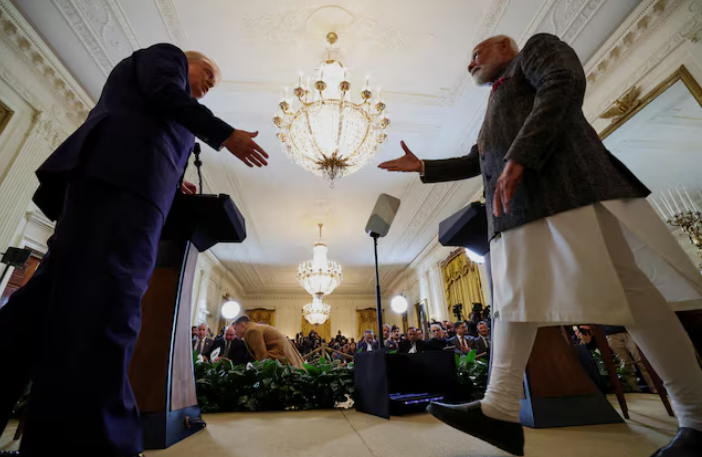
The expected meeting between Indian Prime Minister Narendra Modi and United States President Donald Trump on the sidelines of the G7 summit comes at a moment when India-US relations are experiencing one of their most complicated phases in recent years. For more than two decades, successive governments in New Delhi and Washington have worked to build a strategic partnership that transcended changes in leadership, political ideology and temporary diplomatic disputes. Yet recent events have exposed uncomfortable questions about the balance of power within that relationship and about India’s willingness to defend its interests when confronted by a volatile American administration.
The immediate backdrop to the anticipated Modi-Trump meeting is deeply troubling. US military operations connected to the conflict involving Iran reportedly resulted in attacks on vessels carrying Indian crew members, leading to the deaths of Indian sailors and provoking outrage within India. New Delhi summoned the American chargé d’affaires twice and lodged formal diplomatic protests. The Ministry of External Affairs publicly expressed concern about attacks on commercial shipping and demanded that due note be taken of India’s objections.
Ordinarily, the death of a country’s citizens in military actions carried out by a strategic partner would dominate diplomatic exchanges. It would trigger demands for accountability, detailed explanations and visible gestures of respect towards the affected nation. Yet there is a growing perception within sections of India’s strategic community that New Delhi’s response has been remarkably restrained. The concern is not simply about the loss of Indian lives. It is about the broader pattern that has emerged in the relationship over the past year.
The central question confronting Indian policymakers is whether strategic partnership has gradually evolved into strategic dependency. For years, India’s foreign policy establishment proudly promoted the doctrine of strategic autonomy. India maintained relations with competing power centres, engaged with the United States while preserving defence ties with Russia, participated in Western-led initiatives while strengthening BRICS and the Shanghai Cooperation Organisation, and avoided becoming formally aligned with any geopolitical bloc. This balancing act allowed India to maximise its diplomatic flexibility and protect its national interests.
Recent developments, however, have tested that doctrine.
The first major challenge emerged during the India-Pakistan crisis. Following military exchanges between the two nuclear-armed neighbours, President Trump repeatedly claimed credit for brokering a ceasefire. Pakistan openly welcomed these claims. India consistently rejected them, insisting that the ceasefire resulted from direct military communication between New Delhi and Islamabad. Yet despite India’s public objections, the Trump administration continued presenting itself as the decisive mediator.
For New Delhi, this was not merely a matter of diplomatic vanity. India’s longstanding position has been that disputes involving Kashmir and relations with Pakistan are strictly bilateral matters. Any suggestion of third-party mediation directly contradicts a principle that has guided Indian diplomacy for decades. The fact that Washington continued advancing this narrative without facing meaningful consequences raised questions about India’s leverage in the relationship.
The second challenge came from Trump’s trade agenda. Despite describing India as a strategic partner and a key pillar of the Indo-Pacific framework, the administration continued applying tariff pressure and pursuing investigations into Indian trade practices. Negotiations over an interim trade agreement repeatedly stalled. Instead of receiving preferential treatment as a trusted partner, India often found itself treated as just another target in Washington’s broader economic confrontation with trading partners.
The third and perhaps most sensitive challenge involves Pakistan itself. Trump’s growing engagement with Pakistan’s military leadership has attracted significant attention in New Delhi. The American president’s willingness to publicly engage with Pakistan’s military establishment while simultaneously presenting himself as a mediator in South Asian affairs has generated unease among Indian policymakers. Many in India view this development as a reversal of years of diplomatic effort aimed at convincing Washington that Pakistan’s military establishment should not be treated as an indispensable regional partner.
Against this backdrop, the deaths of Indian sailors assume greater symbolic importance. They are no longer an isolated incident. They become part of a broader narrative in which India’s concerns appear repeatedly subordinated to larger American strategic calculations.
This is where criticism of the Modi government’s approach gains traction.
For much of the past decade, Modi invested heavily in cultivating a personal relationship with Trump. The imagery was powerful. Massive rallies, public embraces, carefully choreographed appearances and repeated references to personal chemistry created the impression that the relationship between the two leaders would translate into concrete strategic advantages for India.
Personal diplomacy undoubtedly has value. International politics is often influenced by trust and rapport between leaders. However, personal relationships cannot substitute for national interests. They cannot replace institutional leverage, economic power or strategic bargaining capacity.
Critics argue that the Modi government has become overly invested in preserving the appearance of a close relationship with Trump, even when circumstances demand a firmer response. They point to the contrast between India’s assertive rhetoric on sovereignty and its cautious approach whenever disputes involve Washington.
The challenge for New Delhi is that excessive accommodation carries risks of its own. Strategic partnerships endure when both sides respect each other’s interests. If one partner consistently absorbs diplomatic costs while the other pursues its objectives without adjustment, perceptions of imbalance inevitably emerge.
None of this means that India should seek confrontation with the United States. Such a course would be self-defeating. The US remains India’s largest trading partner, a critical source of technology, investment and defence cooperation, and an important counterweight to China’s growing influence in Asia. The logic underpinning India-US cooperation remains strong.
The issue is not whether India should work closely with America. The issue is how.
A mature partnership requires candour. It requires the ability to disagree without jeopardising broader cooperation. Washington itself routinely disagrees with allies ranging from Germany and France to Japan and South Korea. These disagreements do not destroy alliances because they occur within a framework of mutual respect.
India should seek a similar relationship, one based on confidence rather than deference.
At the G7 summit, Modi faces an opportunity to demonstrate that strategic partnership does not require silence. The deaths of Indian sailors deserve serious discussion. The vulnerability of Indian seafarers operating in conflict zones deserves attention. The implications of regional instability for India’s energy security deserve prominence. The issue of third-party mediation in India-Pakistan relations deserves clarity.
More broadly, India must communicate that cooperation cannot be a one-way street. If Washington expects India to play a larger role in Indo-Pacific security, supply-chain resilience and technological partnerships, it must also demonstrate sensitivity to Indian concerns.
The irony is that a more confident India would ultimately strengthen the partnership rather than weaken it. Strong relationships are built on reciprocity, not dependency. Strategic autonomy was never about maintaining equal distance from all powers. It was about ensuring that India’s choices remained India’s own.
As Modi and Trump prepare for their first face-to-face meeting after a turbulent year, the real test is not whether they can produce another round of friendly photographs or diplomatic slogans. The real test is whether India can reassert the principle that has guided its foreign policy for decades: friendship with major powers should enhance national sovereignty, not dilute it.
The coming meeting may help stabilise relations. It may advance trade negotiations. It may restore some of the momentum that has been lost over the past year. But unless New Delhi demonstrates a willingness to defend its interests with the same confidence it displays in cultivating partnerships, questions about the balance of the relationship will persist.
A strategic partnership is most valuable when both sides feel respected. That is the challenge facing India today, and it is the challenge Modi must address when he sits across from Trump at the G7 summit.
Note:
It would bring much greater clarity about the real situation to Indian citizens if Prime Minister Modi were to organise open press conferences with free and independent media during his foreign visits. Rather than relying primarily on carefully managed public relations events, cultural performances and public spectacles, such engagements would allow journalists to ask difficult and unscripted questions on key diplomatic, economic and security issues.