

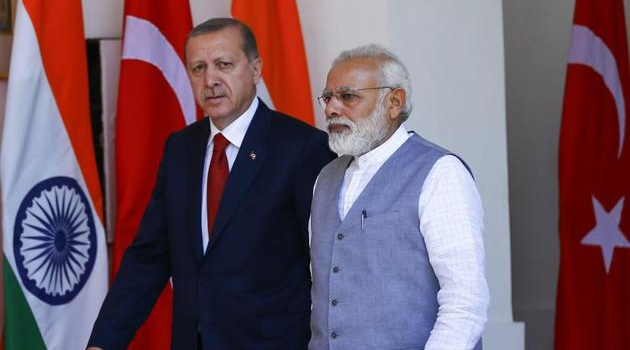
For much of the past decade, relations between Türkiye and India have been viewed through the narrow prism of Ankara’s ties with Pakistan and disagreements over Kashmir. Every diplomatic exchange, every statement, and every disagreement has been interpreted through the lens of South Asian rivalries. Yet Turkish Foreign Minister Hakan Fidan’s remarks at the IISS Shangri-La Dialogue in Singapore offer an alternative vision, one that is both pragmatic and strategically mature. His message was simple: Türkiye and India should not allow a single disagreement to define an entire relationship. Instead, they should place contentious issues “in parentheses” and focus on areas where cooperation serves their national interests.
The significance of Fidan’s statement extends beyond diplomacy. It reflects a broader geopolitical reality that is reshaping Eurasia, West Asia and the Indo-Pacific. As the international system becomes increasingly fragmented by great-power competition, countries are discovering that absolute alignment is neither possible nor desirable. Nations now cooperate with one set of partners in some sectors while competing with them in others. Türkiye itself maintains complex relationships with Russia, the United States, the European Union, Iran and China. India follows a similar approach, working simultaneously with Washington through the Quad, with Moscow on defence cooperation, and with BRICS partners on Global South initiatives. In such an environment, demanding complete political agreement before pursuing cooperation is increasingly unrealistic.
The deterioration in India-Türkiye relations following the India-Pakistan conflict of May 2025 demonstrated the limitations of allowing third-party issues to dominate bilateral relations. New Delhi reacted strongly to Ankara’s criticism of Indian military operations and its support for Pakistan’s demand for an international investigation into the Pahalgam terrorist attack. Yet the broader picture was often overlooked. Türkiye had been among the first countries to condemn the attack on civilians in Pahalgam, describing it as a heinous act of terrorism. The subsequent diplomatic dispute emerged not because Türkiye supported terrorism, but because Ankara and New Delhi interpreted the crisis through different strategic lenses.
What makes Fidan’s intervention noteworthy is his attempt to separate Türkiye’s historical relationship with Pakistan from its potential partnership with India. Ankara’s ties with Islamabad are deeply rooted in history, extending back to the late Ottoman era and strengthened during Pakistan’s early nation-building years. These connections are unlikely to disappear. However, as Fidan argued, maintaining strong relations with one country should not automatically preclude meaningful engagement with another. International politics is filled with examples of states successfully managing such complexities. India itself maintains close defence ties with Russia despite Moscow’s strategic partnership with China. The United States maintains relationships with countries that often disagree with each other. Strategic maturity lies in managing contradictions rather than being paralysed by them.
The timing of Fidan’s remarks is particularly important because they coincide with tentative efforts by both countries to rebuild diplomatic channels. The decision by India to host the 12th round of Foreign Office Consultations in New Delhi, bringing Turkish Deputy Foreign Minister Berris Ekinci to India for the first such talks in four years, signals recognition on both sides that prolonged diplomatic estrangement serves neither country. Such engagements may appear technical, but they often serve as the foundation upon which broader political reconciliation is built.
The strategic logic for improved relations is compelling. India and Türkiye are not peripheral actors. Together they represent nearly 1.5 billion people, possess economies exceeding $4 trillion combined, and occupy critical geographic positions linking Europe, West Asia, Central Asia and the Indo-Pacific. Both seek greater influence in a multipolar world. Both advocate reforms in global governance institutions. Both aspire to play larger roles in shaping the future of the Global South. These overlapping ambitions create opportunities that extend far beyond bilateral trade figures.
Economically, the relationship remains significantly underdeveloped relative to its potential. Bilateral trade fluctuates around $10 billion annually, a modest figure considering the size of both economies. By comparison, India’s trade with the Gulf states exceeds $200 billion annually, while Türkiye’s trade with the European Union surpasses $200 billion. The gap suggests that political disagreements have prevented both countries from fully exploiting commercial opportunities.
Infrastructure presents one of the most promising areas for cooperation. Turkish companies rank among the world’s most experienced construction and engineering firms. Türkiye consistently places among the top countries globally in terms of international contracting projects. Indian infrastructure development ambitions, including logistics corridors, smart cities, ports and industrial zones, create natural opportunities for Turkish expertise and investment. As India pursues its goal of becoming a developed economy by 2047, access to global infrastructure capabilities will become increasingly important.
Energy cooperation offers another avenue. Türkiye has evolved into one of Eurasia’s most important energy transit hubs, connecting producers in Central Asia, the Caucasus and West Asia with European markets. India, meanwhile, remains one of the world’s fastest-growing energy consumers. Both countries share interests in energy security, diversification and connectivity. As discussions continue around transport corridors linking South Asia with Europe through West Asia, cooperation between Ankara and New Delhi could become strategically significant.
The geopolitical landscape further reinforces the need for dialogue. West Asia is undergoing profound transformation. The Gaza conflict, tensions involving Iran, uncertainty in Syria, evolving Gulf dynamics and the emergence of new connectivity projects are reshaping regional politics. India has become increasingly dependent on West Asia for energy supplies, trade routes and expatriate employment. Türkiye remains one of the region’s most influential political and military actors. Meaningful discussions between the two countries are therefore not a diplomatic luxury but a strategic necessity.
Cultural ties provide an additional foundation for rebuilding trust. Long before contemporary geopolitical disputes emerged, Indian and Turkish societies maintained centuries of commercial, cultural and intellectual interaction. In recent years, these connections have acquired new forms. Turkish destinations such as Istanbul, Antalya and Cappadocia became increasingly popular among Indian tourists. Turkish television series developed significant audiences across South Asia. Bollywood productions filmed in Türkiye exposed millions of Indian viewers to Turkish culture and landscapes. Cultural engagement often survives political turbulence and can serve as a stabilising factor during periods of diplomatic strain.
Multilateral institutions also provide opportunities for cooperation. India’s growing role within BRICS and the Shanghai Cooperation Organisation intersects with Türkiye’s interest in expanding its engagement with emerging non-Western platforms. Both countries increasingly speak about strategic autonomy, multipolarity and strengthening the voice of developing nations in international affairs. While their approaches may differ, their objectives often overlap.
Yet the greatest argument for a strategic reset lies in the changing structure of global politics itself. The emerging international order is no longer defined by rigid alliances. Instead, it is characterised by flexible partnerships built around specific interests. Countries that insist on viewing relationships through a single issue risk limiting their strategic options. Countries that can compartmentalise disagreements gain greater diplomatic flexibility and economic opportunity.
This is ultimately what Fidan was advocating in Singapore. His call was not for India to abandon its concerns regarding Türkiye’s relationship with Pakistan. Nor was it a request for Türkiye to alter its historical partnerships. Rather, it was an appeal for both sides to recognise that mature powers can disagree on some issues while cooperating on others.
For India and Türkiye, the choice is increasingly clear. They can remain trapped within the political disputes of the past, allowing external issues to dictate bilateral relations. Or they can acknowledge that as two major regional powers operating in an increasingly unstable world, they have far more to gain from engagement than from estrangement. The future of the relationship will depend on whether New Delhi and Ankara can transform Fidan’s metaphor into diplomatic reality: placing disagreements in parentheses while focusing on the larger strategic opportunities that lie beyond them.