

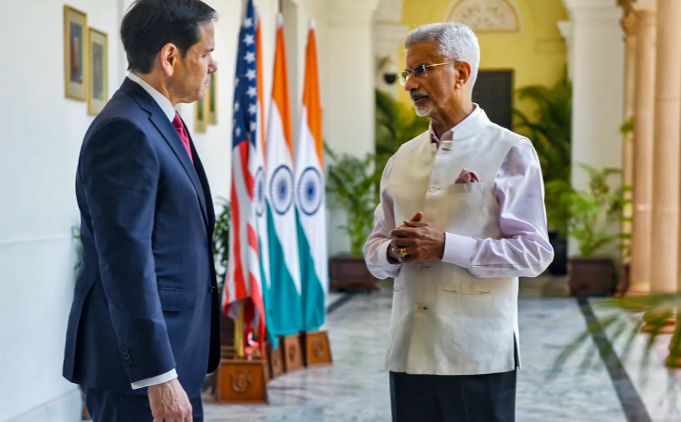
The signing of the India–United States Critical Minerals Framework on May 26, followed immediately by the Quad’s decision to mobilise up to US$20 billion for critical minerals supply chains, marks one of the most consequential geoeconomic developments involving India in recent years. It is not merely a mining agreement. It is part of a wider strategic effort by Washington, Tokyo, Canberra and New Delhi to reduce vulnerabilities created by the extraordinary concentration of global mineral processing in China.
For much of the past two decades, critical minerals remained a largely technical issue discussed by geologists, industrial planners and defence procurement agencies. Today they have become a geopolitical issue comparable to energy security in the twentieth century. Rare earths, lithium, cobalt, nickel, graphite and other strategic minerals now sit at the centre of the global competition over electric vehicles, semiconductors, artificial intelligence infrastructure, renewable energy systems, aerospace technologies and advanced military platforms.
The reality confronting policymakers is stark. China currently accounts for roughly 70 per cent of global rare earth mining and nearly 90 per cent of global processing capacity. Even where minerals are mined elsewhere, they often travel through Chinese refining and separation facilities before entering global manufacturing chains. This dominance gives Beijing significant influence over industries that increasingly define economic and military power.
Recent Chinese export restrictions on several strategic minerals have reinforced concerns across Western capitals and major industrial economies. Supply chain disruptions demonstrated how a single country’s dominance in processing can affect everything from defence production and telecommunications to electric vehicles and renewable energy infrastructure. It is within this context that India has emerged as a potential partner in the search for more resilient supply chains.
However, the growing excitement surrounding India’s role requires careful examination. The central question is not whether India can contribute to an alternative supply chain. It can. The more important question is whether India can meaningfully challenge China’s dominance. The answer is far more complicated.
India possesses significant mineral potential. Government assessments identify reserves of around 30 critical minerals, including lithium, cobalt, graphite, nickel, copper, titanium, tungsten, vanadium and niobium. The country also possesses substantial rare earth resources concentrated primarily in monazite-rich coastal sands stretching across Odisha, Andhra Pradesh, Tamil Nadu and Kerala. Official estimates place India’s monazite reserves at more than 13 million tonnes, containing over 7 million tonnes of rare earth oxides. These figures position India among the world’s important holders of rare earth resources. Yet possessing reserves and dominating supply chains are two very different things.
China’s advantage was not built solely on geology. It was built through decades of investment across the entire value chain. Beijing developed mining operations, refining capacity, separation technologies, metallurgical expertise, magnet manufacturing and downstream industrial ecosystems simultaneously. This integrated approach created a position that is extraordinarily difficult to replicate.
The rare earth story illustrates this clearly. While many countries possess rare earth deposits, only a handful possess the industrial infrastructure required to separate and process them economically. The most valuable part of the supply chain is not necessarily extraction. It is refining, metallurgy and advanced manufacturing. This is where China remains overwhelmingly dominant.
India’s challenge therefore is not primarily finding minerals beneath the ground. It is creating the industrial ecosystem required to transform those minerals into strategic products.
For decades, India’s rare earth sector remained constrained by regulatory structures originally designed for nuclear security rather than commercial development. Because monazite contains thorium, extraction and processing fell under highly restrictive atomic minerals regulations. While these controls served legitimate strategic purposes, they also limited private investment, slowed commercial development and reduced the competitiveness of India’s rare earth industry.
New Delhi now appears determined to change that. The government has launched rare earth corridors across eastern and southern India while increasing support for domestic processing and magnet manufacturing. In late 2025, India approved approximately US$800 million to boost domestic rare earth magnet production, aiming to reduce import dependence and strengthen industrial resilience. This reflects an important recognition that future competition will be determined not by ownership of raw materials alone but by control over advanced manufacturing capabilities.
The India-US framework should therefore be understood as a long-term industrial strategy rather than a short-term geopolitical response. Its significance lies not simply in mineral extraction but in the possibility of attracting investment into refining facilities, processing plants, recycling operations, research centres and advanced manufacturing hubs.
The Quad initiative further expands this vision. The commitment to mobilise up to US$20 billion across mining, processing and recycling represents one of the most ambitious attempts yet to build alternative critical mineral supply chains outside Chinese control. Importantly, the framework is designed not merely around extraction but around the entire supply chain. This includes project financing, export credit support, insurance mechanisms, industrial partnerships and recycling initiatives.
The inclusion of recycling is particularly significant. As global demand for batteries, electronics and renewable technologies accelerates, urban mining and mineral recovery from waste streams may become nearly as important as traditional mining. Countries that master recycling technologies could reduce dependence on new extraction while strengthening supply security.
India also brings another advantage often overlooked in discussions focused solely on resources. It offers scale. Few countries combine a large domestic market, expanding industrial capacity, skilled engineering talent and growing geopolitical alignment with major Western economies. For investors seeking alternatives to China, market size matters. India can potentially provide not only minerals and processing capacity but also a substantial consumer and manufacturing base.
Yet optimism should not obscure reality. Even under favourable conditions, India is unlikely to replace China within the next decade. China’s rare earth reserves remain substantially larger. Chinese companies possess extensive overseas mining assets across Africa, Latin America and Asia. Most importantly, China maintains deep expertise in separation technologies, metallurgy and magnet production that took decades to build.
The more realistic objective is not replacement but diversification.
In strategic terms, success would mean creating a world in which critical mineral supply chains no longer depend overwhelmingly on a single country. It would mean building multiple centres of production, processing and innovation capable of reducing vulnerability to political disruptions or economic coercion.
This is where India can play a transformative role. Not as a substitute for China, but as one of the principal pillars of a more diversified global system.
The broader geopolitical implications are equally important. The critical minerals race is increasingly becoming a contest over future technological leadership. Whoever controls access to strategic minerals and their processing will possess significant influence over artificial intelligence systems, electric vehicle production, defence technologies, renewable energy infrastructure and semiconductor manufacturing.
In that environment, critical minerals are becoming as important as oil was during the last century.
For India, the challenge is therefore larger than mining policy. It is an industrial, technological and strategic project that will require sustained investment, regulatory reform, international partnerships and long-term planning. The agreements signed in May 2026 provide an opening. Whether that opening becomes a genuine strategic transformation will depend on how effectively India moves from resource potential to industrial capability.
The race is no longer about who possesses the minerals. It is about who controls the supply chains. China understood that decades ago. India is now attempting to do the same. The outcome will help shape the balance of economic and technological power across the coming decades.