

The summit in Turkistan was not just another regional gathering wrapped in symbolism and ceremonial speeches. What emerged from the meeting of the Organisation of Turkic States was something far more ambitious: an attempt to transform a cultural and linguistic bloc into a technologically connected Eurasian power centre capable of influencing trade routes, energy corridors, digital infrastructure and geopolitical stability across one of the world’s most strategically contested regions.
For years, the Organisation of Turkic States remained largely viewed as a platform centred on shared identity, historical ties and cultural diplomacy among Turkey, Azerbaijan, Kazakhstan, Kyrgyzstan and Uzbekistan. But the latest summit in Kazakhstan revealed that the organisation is now evolving into something much broader. Artificial intelligence, cybersecurity, digital logistics, satellite technology, supply chains, energy security and transcontinental connectivity are rapidly becoming the new pillars of Turkic cooperation.
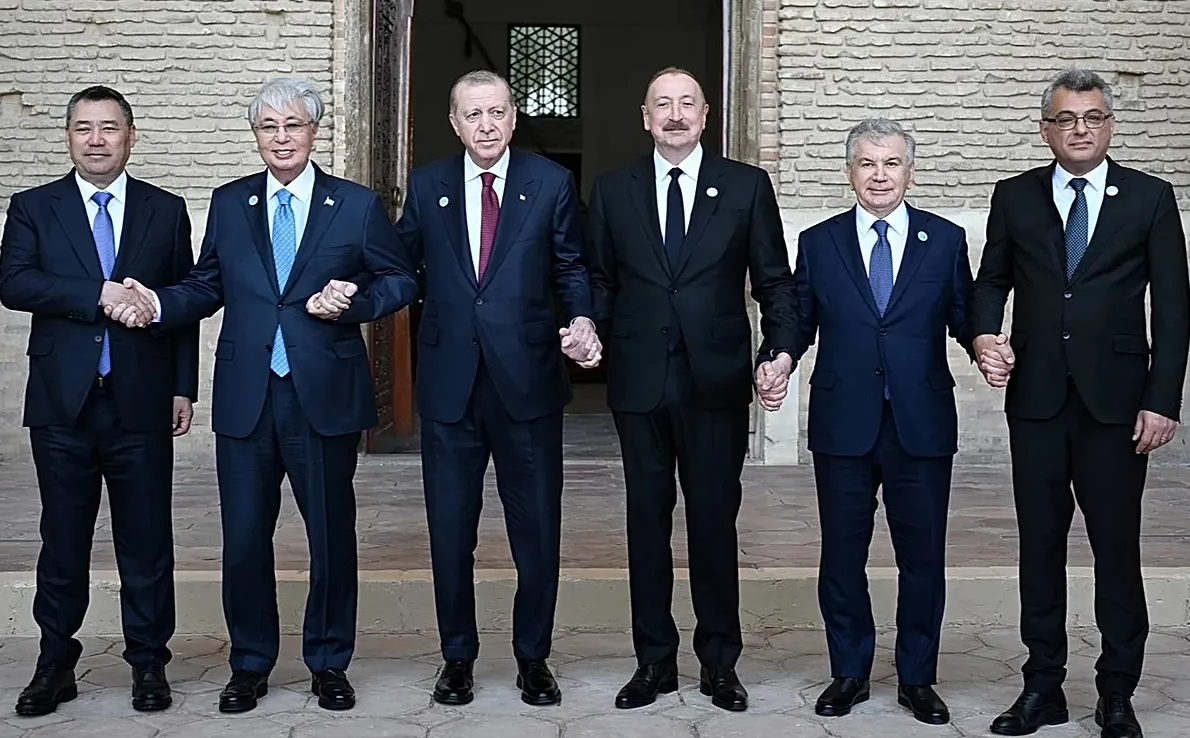
Held in Turkistan, the spiritual heart of the Turkic world, the summit carried heavy symbolism. The image of the leaders standing hand in hand before the mausoleum of Khoja Ahmed Yasawi was carefully crafted to project unity, continuity and civilisational confidence at a moment when much of the global order appears fractured by war, sanctions, economic instability and declining trust in international institutions.
Yet beneath the symbolism, the summit was deeply strategic.
Kazakhstan’s President Kassym-Jomart Tokayev repeatedly stressed that the OTS is “not a geopolitical project” and “not a military organisation”. That clarification itself reflected growing international scrutiny over the organisation’s expanding influence across Eurasia. Tokayev attempted to frame the alliance as a platform for economic integration, digital transformation, innovation and humanitarian cooperation rather than as a bloc aimed against Russia, China, Europe or the West.
But regardless of official denials, the geopolitical implications are becoming impossible to ignore.
The Organisation of Turkic States now sits across some of the most important transport and energy routes connecting East Asia, Central Asia, the Caucasus, West Asia and Europe. As the war in Ukraine disrupted traditional Eurasian corridors and instability around the Strait of Hormuz threatened global energy flows, the strategic value of Central Asian connectivity has increased dramatically. The Middle Corridor, also known as the Trans-Caspian International Transport Route, is no longer viewed as a secondary trade route. It is increasingly being discussed as an alternative Eurasian artery linking China and Southeast Asia to Europe through Kazakhstan, Azerbaijan, Georgia and Turkey while bypassing Russia and unstable maritime chokepoints.
This explains why transport, logistics and digital integration dominated the summit almost as much as artificial intelligence itself.
The OTS leadership is now attempting to merge physical infrastructure with digital infrastructure into a single strategic vision. Uzbekistan’s President Shavkat Mirziyoyev proposed the creation of a “Digital Turkic Corridor” designed to connect regional data centres, logistics systems and digital communications infrastructure into a unified technological space.
At the same time, the organisation is moving to harmonise customs systems, cargo permits and logistics platforms through initiatives such as the E-Permit system, which aims to simplify cross-border freight movement across Turkic states. This may appear technical on the surface, but it reflects a much larger ambition: creating a Eurasian economic space that can operate with increasing autonomy amid global fragmentation.
Artificial intelligence emerged as the summit’s defining theme because the Turkic states clearly understand that future geopolitical influence will not depend only on pipelines, ports and railways. It will also depend on data, computing infrastructure, cybersecurity and technological capacity.
Tokayev proposed a network of AI centres and a joint Turkic IT hub, while Kazakhstan’s digital development ministry highlighted the country’s growing role in online governance and digital public services. Uzbekistan unveiled its “Five Million AI Leaders” initiative focused on training future generations for the digital economy, while also proposing joint venture funds for startups and regional innovation projects.
The summit also discussed cybersecurity coordination, satellite cooperation and cross-border digital infrastructure. Kazakhstan, Turkey and Azerbaijan are jointly developing a CubeSat scientific satellite expected to launch next year, while Azerbaijan confirmed that the Trans-Caspian fibre-optic cable project connecting Azerbaijan and Kazakhstan is approaching operational status.
That project may ultimately become one of the most strategically important outcomes of the summit.
The fibre-optic corridor is not simply about internet connectivity. It is part of a larger attempt to position the Turkic region as a future digital bridge between Europe and Asia. Kazakh officials openly stated that the infrastructure could attract global technology giants and hyperscale computing operators into the region. In practical terms, the Turkic world is attempting to become not only an energy and transport corridor, but also a data corridor.
This reflects a broader transformation underway across Eurasia.
For years, Central Asia was viewed mainly through the lens of raw materials, hydrocarbons and geography. Today, the region increasingly sees itself as a technological and logistical connector capable of leveraging its geographic position between China, Russia, West Asia and Europe.
At the summit, Turkish President Recep Tayyip Erdoğan directly linked the Middle Corridor to the instability surrounding the Strait of Hormuz and wider regional crises. His remarks reflected growing concern that global trade and energy routes are entering a prolonged period of disruption where alternative corridors will become critical strategic assets.
Azerbaijan’s President Ilham Aliyev perhaps delivered the summit’s most revealing statement when he declared that the Turkic world must evolve into “one of the influential geopolitical power centers of the 21st century.”
That sentence captured the real significance of the gathering.
The OTS is no longer behaving like a purely symbolic cultural organisation. It is gradually institutionalising itself through digital integration, infrastructure coordination, trade harmonisation, technological cooperation and strategic connectivity planning. The organisation’s combined economic potential reportedly reached $2.4 trillion in 2025, giving it growing weight across Eurasia.
The transformation is still incomplete and major challenges remain. The member states maintain different foreign policy orientations, economic structures and geopolitical calculations. Russia, China, the European Union and the United States will all closely watch how far Turkic integration evolves. There are also unresolved regional tensions, infrastructure bottlenecks and financial limitations that could slow the organisation’s ambitions.
But what happened in Turkistan matters because it showed that the Turkic states are beginning to think strategically as a bloc in a rapidly fragmenting world.
As global institutions weaken, wars reshape supply chains and technological competition accelerates, the Organisation of Turkic States appears determined to ensure that the Turkic world does not remain on the sidelines of the emerging Eurasian order.