

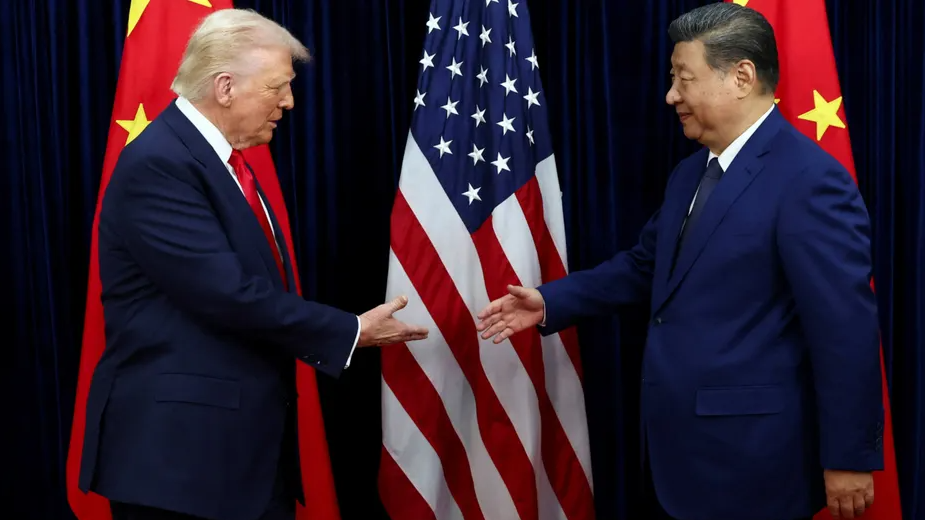
When Donald Trump arrives in Beijing and stands beside Xi Jinping under the cameras, the world will see diplomatic theatre. Handshakes, state banquets, carefully measured smiles, and familiar phrases like “cooperation”, “mutual respect” and “stability” will dominate headlines. But behind that carefully managed atmosphere, both sides understand this meeting is about something much larger than ordinary diplomacy.
This summit is not simply about trade, tariffs or even Taiwan alone. It is about the balance of power inside an international system that is already beginning to shift. The old American dominated order is facing an emerging China that no longer behaves like a rising power trying to fit into Western structures. Beijing increasingly acts like a state preparing for a world where American dominance becomes weaker, fragmented and less predictable.
Trump arrives in Beijing carrying pressure from multiple fronts. Iran remains unstable, the Strait of Hormuz continues threatening global energy flows, Europe is increasingly uncertain about Washington’s long term consistency, and Taiwan remains the most dangerous geopolitical flashpoint in Asia. Inside the United States itself, political polarisation, inflation concerns, debt pressure and approaching midterm elections continue shaping strategic calculations in Washington.
Xi Jinping enters this summit differently. China does not think in election cycles. Beijing thinks in decades. While American administrations change tone every four years, the Chinese state spent years preparing for a long strategic confrontation with the United States that would eventually become economic, technological and industrial rather than purely military. That difference in mindset now shapes almost every aspect of this rivalry.
The biggest misunderstanding in much of the Western world is the assumption that China wants to replace the United States exactly the way America replaced previous global powers. Beijing’s strategy is more patient and more calculated than that. China does not necessarily seek to become the world’s military policeman. It does not want endless foreign occupations or ideological wars. What China wants is to reduce American centrality in the international system while making itself economically unavoidable.
That strategy is already visible across Africa, Asia and parts of Latin America. The Belt and Road Initiative may no longer dominate headlines like before, but Chinese infrastructure, ports, industrial investments, telecom systems, mining agreements and logistics corridors are deeply rooted across multiple continents. While Western powers debated sanctions, governance and political conditions, China focused on roads, railways, energy projects, rare earth access and industrial capacity.
In many African countries today, Chinese involvement is no longer viewed as temporary foreign investment. It has become part of the economic structure itself. Countries increasingly look toward Beijing not necessarily because they align politically with China, but because China arrives with financing, infrastructure and long term industrial engagement while the West often appears inconsistent, distracted or politically conditional.
Ironically, Trump’s second presidency may have accelerated this geopolitical transition. Trump remains one of the toughest American presidents economically toward China through tariffs, sanctions and technological restrictions. Yet at the same time, his confrontational approach toward NATO allies, Europe and multilateral institutions weakens the broader Western cohesion that once limited Beijing’s strategic space.
China benefits from Western fragmentation, but Beijing also fears instability. This is where many analysts misunderstand Xi Jinping’s priorities. China spent decades integrating itself into the global trading system. Its manufacturing economy still depends heavily on exports, maritime trade routes and stable energy flows. Beijing may welcome a strategically weaker America, but it does not welcome global chaos that threatens economic growth itself.
That is why Iran becomes central in this summit. China buys most of Iran’s oil exports and remains Tehran’s largest economic lifeline. This gives Beijing leverage that Washington cannot completely ignore. At the same time, China also needs the Strait of Hormuz open because prolonged disruption directly threatens Chinese energy security and export stability.
Trump publicly claims he does not need Xi Jinping’s help on Iran, but reality is more complicated. Washington understands China has the ability to pressure Tehran economically if Beijing decides regional stability matters more than strategic balancing against the United States. The real question is not whether China has leverage over Iran. The real question is what Beijing wants in exchange for using it.
And Beijing always negotiates with long term calculations in mind.
That brings the conversation directly to Taiwan, the most sensitive issue in the entire relationship. Taiwan is no longer simply about territory or nationalism. It is about semiconductors, artificial intelligence, technological supply chains and control over future industrial infrastructure. Whoever dominates advanced chip production gains enormous leverage over the global economy of the next generation.
China views reunification as historical inevitability. The United States views Taiwan as a strategic barrier preventing Chinese dominance in East Asia. Taiwan itself increasingly feels trapped between two superpowers whose competition grows more dangerous every year.
Under previous American administrations, strategic ambiguity worked because allies believed Washington’s commitments were fundamentally stable even if intentionally unclear. Under Trump, uncertainty itself has become part of the geopolitical equation. Beijing notices that carefully. China understands it does not necessarily need immediate military action if long term political and psychological pressure gradually weakens Taiwan’s confidence in outside support.
This summit therefore is not really about solving problems. It is about managing the direction of competition before confrontation becomes uncontrollable. There will likely be economic agreements, symbolic business deals and carefully worded statements about stability. Trump arrives in Beijing alongside major American corporate and technology figures because both sides still understand economic interdependence has not disappeared despite the rivalry.
But beneath the trade discussions, something much deeper is happening. The world is entering a phase where military power alone no longer guarantees dominance. Industrial depth matters. Supply chains matter. Rare earth control matters. Artificial intelligence matters. Semiconductors matter. Energy corridors matter. Shipping routes matter. China prepared for this reality earlier than much of the West expected.
And perhaps Beijing’s greatest strategic advantage today is patience. Xi Jinping is negotiating for the next twenty years. Trump still operates inside an American political system shaped by elections, media battles, economic pressure and internal division. That asymmetry matters more than temporary headlines or diplomatic optics.
The Beijing summit will probably not produce dramatic breakthroughs. Taiwan will remain unresolved. Iran will remain unstable. Trade tensions will continue. Strategic distrust will remain deep. But this meeting still matters because both powers are quietly attempting to define the limits of confrontation before the rivalry enters a far more dangerous stage.
The old American dominated order no longer operates with the same confidence it once had. China knows it. Washington knows it. And increasingly, the rest of the world knows it too.