

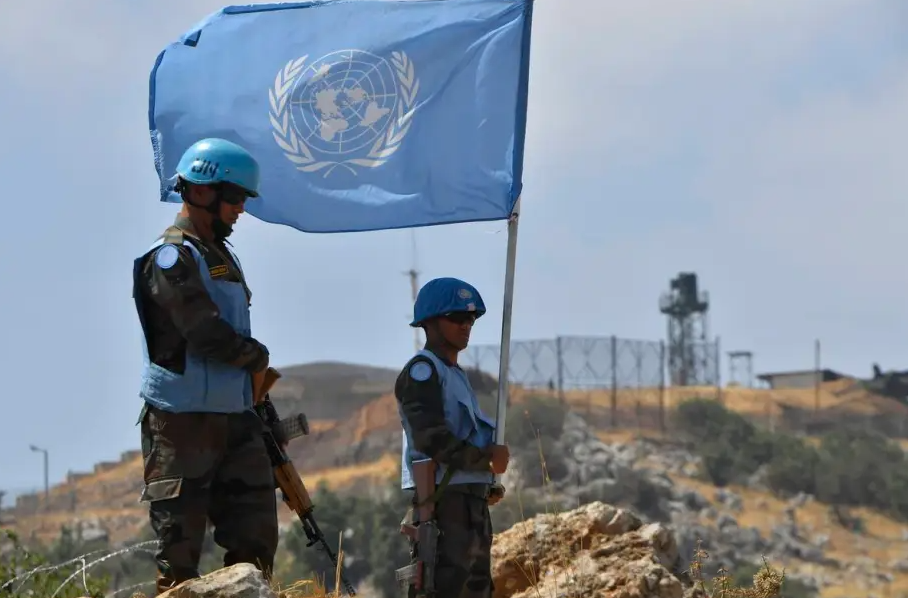
The European Union is quietly preparing for what may become one of the biggest security transitions in the eastern Mediterranean since the 2006 Lebanon war. Behind the diplomatic language coming out of Brussels lies a growing recognition that the current structure of the United Nations Interim Force in Lebanon, better known as UNIFIL, may be approaching its political and operational end in its present form.
What is now emerging is not simply a discussion about replacing one peacekeeping force with another. It is the beginning of a broader European attempt to redesign its role in Lebanon while adapting to a far more dangerous regional environment shaped by the Israel–Hezbollah confrontation, instability after the Iran war, pressure on maritime routes, and growing doubts about the future reliability of traditional UN peacekeeping structures.
EU foreign policy chief Kaja Kallas confirmed after the recent meeting of EU defence ministers in Brussels that Europeans are willing to establish a mission aimed at concretely helping the Lebanese Armed Forces. She made it clear that discussions are already underway regarding what comes after UNIFIL’s mandate eventually expires.
But despite headlines suggesting Europe is preparing to “replace” UNIFIL, officials inside Brussels are saying something very different behind closed doors. European diplomats and military officials are increasingly admitting that there is neither the political appetite nor the military capacity to recreate a full-scale UN-style buffer force deployed across southern Lebanon. Instead, the model under consideration is radically different.
The future European role would focus less on static peacekeeping and more on training, intelligence coordination, institutional strengthening, monitoring mechanisms, logistics support, and military assistance to the Lebanese Armed Forces. The objective is becoming openly political as well as military: strengthen the Lebanese state enough to gradually reduce the operational space of Hezbollah.
Kallas herself framed it bluntly when she stated that “the stronger we make the Lebanese armed forces, the weaker we make Hezbollah.”
That sentence alone explains the strategic direction now taking shape inside Europe.
For decades, UNIFIL functioned as a stabilising mechanism along the Blue Line between Lebanon and Israel. Established in 1978 and dramatically expanded after the 2006 war under United Nations Security Council Resolution 1701, the mission was designed to prevent escalation while supporting the deployment of Lebanese state authority south of the Litani River.
In reality, however, the mission increasingly became trapped between multiple forces it could neither fully confront nor fully control. Hezbollah retained influence and operational freedom in large parts of southern Lebanon. Israel repeatedly accused the mission of failing to prevent Hezbollah entrenchment near the border. Meanwhile, peacekeepers themselves became increasingly exposed to both Israeli military operations and attacks by armed non-state actors.
Recent months have pushed that fragile arrangement closer to collapse. UN personnel have reportedly been killed and wounded by Hezbollah explosive devices while other incidents involved Israeli shelling impacting or landing near UN positions in southern Lebanon. European capitals now privately acknowledge that the environment which once allowed traditional peacekeeping no longer exists.
Inside Brussels, the phrase increasingly repeated by officials is direct and unusually stark: “UNIFIL as we know it is dead.”
That does not necessarily mean the total disappearance of the United Nations presence from Lebanon. UN officials, including peacekeeping chief Jean-Pierre Lacroix, have already suggested that a smaller UN mechanism could remain in some form after the current structure winds down. Discussions in New York are reportedly examining future mechanisms linked to monitoring the Blue Line, implementing Resolution 1701, and assisting the redeployment of Lebanese forces south of the Litani River.
But the era of large European contingents stationed deep in southern Lebanon under classical UN peacekeeping doctrine appears increasingly difficult to sustain politically.
At the centre of this transition stands Guido Crosetto and the government of Giorgia Meloni. Italy, currently one of the largest contributors to UNIFIL, has emerged as the main driver of a post-UNIFIL framework. Rome’s position reflects a growing European calculation that if Europe withdraws completely from Lebanon, it risks leaving a strategic vacuum that could quickly be filled by escalation, regional proxies, or direct confrontation between Israel and Hezbollah.
Crosetto has repeatedly warned about the risks facing Italian peacekeepers and reportedly threatened troop withdrawal unless the UN adjusted the mission’s rules of engagement. At the same time, Italy has intensified diplomatic coordination both with the UN and with Washington regarding Lebanon’s future security architecture.
What Europe appears to want now is influence without full exposure.
This is where the discussion becomes strategically important.
The new European approach is not about defending southern Lebanon directly. It is about building a Lebanese state structure capable of gradually asserting monopoly control over security institutions while reducing dependence on both Hezbollah and external actors. That explains why Brussels is examining tools such as the Common Security and Defence Policy and the European Peace Facility, mechanisms already used to finance military training, logistics and equipment transfers.
The EU is also increasingly aligning its Lebanon policy with broader regional calculations. Following the regional escalation linked to Iran, instability across the Red Sea, and fears surrounding maritime energy routes, European officials are viewing Lebanon not as an isolated crisis but as part of a larger security corridor stretching from the eastern Mediterranean to the Gulf.
At the same time, Europe faces a difficult contradiction.
On one hand, European leaders insist they support Lebanese sovereignty and state institutions. On the other, the practical implementation of that strategy inevitably intersects with Israel’s long-standing demand that Hezbollah’s military infrastructure near the border be dismantled or severely weakened.
That creates an uncomfortable reality for Beirut.
The Lebanese Armed Forces are being asked to become stronger precisely in areas where Hezbollah historically maintained dominance. Yet Lebanon itself remains politically fragmented, economically exhausted, and highly vulnerable to external pressure. Any aggressive attempt to forcibly alter internal military balances could destabilise the country further rather than strengthen it.
This is why many European diplomats are avoiding the language of confrontation publicly while still designing policies clearly intended to shift the balance over time.
Meanwhile, another factor is shaping European thinking: the uncertainty surrounding long-term American engagement in the region. Under Donald Trump, Washington’s approach toward alliances, peacekeeping, and Middle Eastern commitments has become increasingly transactional and unpredictable. That uncertainty is pushing Europe toward greater independent security involvement around the Mediterranean.
The irony is that Europe may now be entering a role it long avoided. For years, European states preferred operating under the umbrella of UN legitimacy while relying indirectly on American strategic backing. But as the regional order fragments, Europe is gradually being forced to act more openly as a geopolitical security actor rather than merely a humanitarian or diplomatic one.
Whether it succeeds is another question entirely.
Lebanon remains one of the most complicated security environments in the world. Hezbollah is not simply an armed faction. It is deeply embedded politically, socially, and militarily. Israel remains determined to prevent any re-emergence of military threats near its northern border. Iran continues viewing Lebanon as part of its regional deterrence network. And Europe itself lacks both unified strategic vision and sustained military projection capability compared to the United States.
For now, what is happening is less a clean transition and more the beginning of an uncertain restructuring.
UNIFIL may not disappear overnight. A smaller UN presence may survive. European training missions may expand. New monitoring structures may emerge. But the old model of heavily deployed international peacekeepers standing between Hezbollah and Israel while hoping deterrence holds is visibly eroding.
And Brussels knows it.