

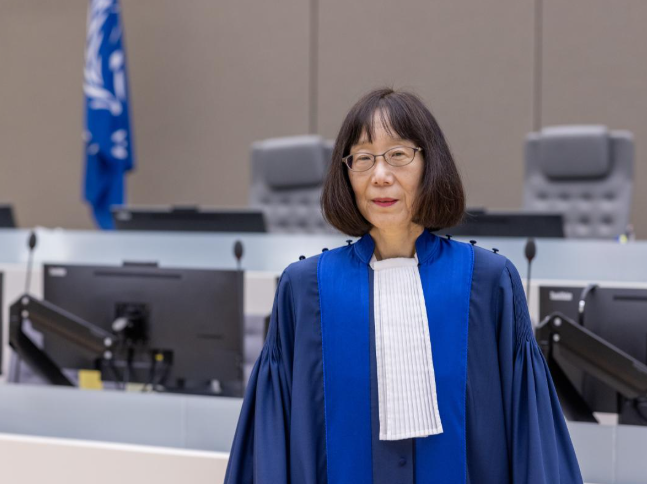
Tomoko Akane was born on 28 June 1956 in Aichi Prefecture, Japan. Her professional journey developed within Japan’s criminal justice system, where she spent more than three decades working as a public prosecutor before entering international judicial service. Her career has taken her through criminal investigations, high-profile prosecutions, legal education and international cooperation programmes. Over time, she became involved in efforts to strengthen judicial institutions and develop criminal justice systems across Asia and other regions. Her appointment to the International Criminal Court (ICC) in 2018 marked a significant transition in her career, eventually leading to her election as the Court’s president in 2024.
Akane studied law at the University of Tokyo, graduating in 1980. She subsequently attended Japan’s Legal Training and Research Institute between 1980 and 1982, completing the professional training required to enter the legal profession. In 1982, she was appointed as a public prosecutor, beginning a career that would span several district and higher prosecutorial offices. She later pursued postgraduate studies in the United States, obtaining a master’s degree in criminal justice from Jacksonville State University in Alabama in December 1990. Her international academic experience added to her understanding of criminal justice systems beyond Japan and became relevant to her subsequent work in legal cooperation.
Her early prosecutorial assignments took her through the district public prosecutors’ offices in Yokohama, Tsu and Nagoya. Between 1982 and 1989, she handled criminal investigations and prosecutions involving violent offences, including homicide and robbery, as well as economic and white-collar crimes. After further assignments in Sendai and Tokyo, she developed experience in cases involving financial misconduct, organised crime and corruption. In the late 1990s, she worked on major economic and financial crime cases in Tokyo, including investigations involving companies and public officials. These assignments provided her with experience across different stages of criminal proceedings, from investigation and prosecution to appeals.
Akane’s career gradually expanded beyond courtroom work into international legal cooperation and professional training. Between 1996 and 1999, she served as a professor at the Asia and Far East Institute for the Prevention of Crime and the Treatment of Offenders (UNAFEI), a United Nations affiliated institution based in Japan. She returned to the institute as deputy director from 2002 to 2005, helping organise international seminars and training programmes for criminal justice practitioners. These programmes addressed subjects such as human rights, organised crime, terrorism and the treatment of offenders. Her responsibilities included working with legal professionals from different countries, particularly across Asia, and supporting the development of criminal justice institutions.
Between 2005 and 2008, Akane taught at Nagoya University Law School and Chukyo University Law School, where she was involved in the practical education of future judges, prosecutors and lawyers. Her academic responsibilities included teaching criminal law and procedure, as well as supervising moot court exercises. She subsequently returned to government service, becoming director of the International Cooperation Department of the Ministry of Justice’s Research and Training Institute in January 2009. In this position, she organised legal assistance projects, primarily for Asian countries, and contributed to programmes intended to strengthen legal institutions and professional training.
In October 2010, she became Chief Prosecutor of the Hakodate District Public Prosecutors Office, overseeing investigations and prosecutions across its jurisdiction. The office handled approximately 6,000 cases annually, and she provided direction and guidance to more than 80 prosecutors and their assistants. In April 2012, she returned to the Supreme Public Prosecutors Office, where her responsibilities included advising specialised prosecution divisions dealing with financial and organised crime. She also participated in legislative discussions concerning revisions to Japan’s Juvenile Act and other criminal laws. Her work increasingly combined prosecutorial experience with legal policy and institutional development.
Akane’s international responsibilities expanded further in 2013, when she became director of UNAFEI, overseeing its programmes and international activities. In July 2014, she was appointed Director-General of the Research and Training Institute of Japan’s Ministry of Justice. She held this position until June 2016, supervising legal research, professional training and international technical assistance programmes. In April 2016, she was also appointed Ambassador for International Judicial Cooperation by Japan’s Ministry of Foreign Affairs. The role involved promoting international cooperation in the field of justice and supporting the development of legal institutions in other countries. Japan subsequently nominated her as a candidate for election to the International Criminal Court.
On 4 December 2017, Akane was elected as one of the judges of the International Criminal Court by the Assembly of States Parties to the Rome Statute. She formally began her nine-year judicial term on 11 March 2018, becoming one of the Japanese representatives on the Court. She initially served in Pre-Trial Chamber II, dealing with situations and cases involving Afghanistan, Ukraine, Darfur, Uganda, Kenya and several other countries. Her judicial responsibilities included examining legal and evidentiary matters at the pre-trial stage. She was also assigned to Trial Chamber X in the case against Al Hassan Ag Abdoul Aziz Ag Mohamed Ag Mahmoud, arising from the situation in Mali. This period brought her extensive prosecutorial background into the work of an international criminal tribunal.
On 11 March 2024, the judges of the ICC elected Akane as President of the Court for the 2024 to 2027 term. She became the first Japanese national to hold the position. The presidency carries responsibilities extending beyond judicial proceedings, including the administration of the Court, oversight of the Registry, external relations and coordination among its different organs. The President also represents the institution in its engagement with states and international organisations. Upon her election, Akane identified institutional cooperation, dialogue with states and the security and well-being of Court personnel as priorities for her leadership.
Her presidency has coincided with growing political and institutional pressure on the ICC. In February 2025, following the issuance of a United States executive order seeking sanctions against Court officials, Akane issued a statement defending the institution’s independence and impartiality. She argued that attempts to influence judicial officials through coercive measures threatened the Court’s ability to carry out its mandate. The issue became more immediate on 18 August 2026, when the United States designated Akane for sanctions under its executive order concerning the ICC. Washington cited her involvement in the Court’s efforts to investigate, arrest, detain or prosecute individuals without the consent of their countries of nationality. The ICC rejected the designation, describing it as an attack on the independence of an impartial judicial institution.
On 2 November 2026, Akane addressed the United Nations General Assembly through a prerecorded video to present the Court’s annual report. The address came after the United States had also imposed sanctions against the ICC itself in October. She reaffirmed that the Court would continue carrying out its judicial mandate independently and impartially, on the basis of law and evidence. She also highlighted the importance of cooperation from member states in executing arrest warrants and ensuring that judicial proceedings could advance. Her intervention reflected the institutional challenges facing the Court as it seeks to maintain international cooperation while dealing with political pressure and sanctions.
Tomoko Akane’s professional journey has encompassed more than four decades of work in criminal prosecution, legal education, international cooperation and judicial administration. Her experience in Japan’s prosecutorial system provided the foundation for her later responsibilities in international criminal justice. Her work with UNAFEI and the Ministry of Justice also gave her a long-standing role in strengthening legal institutions and professional cooperation across national borders. As President of the International Criminal Court, she now leads an institution dealing with some of the most serious crimes under international law while facing questions over its authority, independence and relationship with states. Her tenure has therefore placed her at the centre of wider debates about international accountability and the role of law in global affairs.
Tomoko Akane’s Quote
“The pursuit of justice is a shared responsibility.”
7 September 2026, EL PAÍS interview