

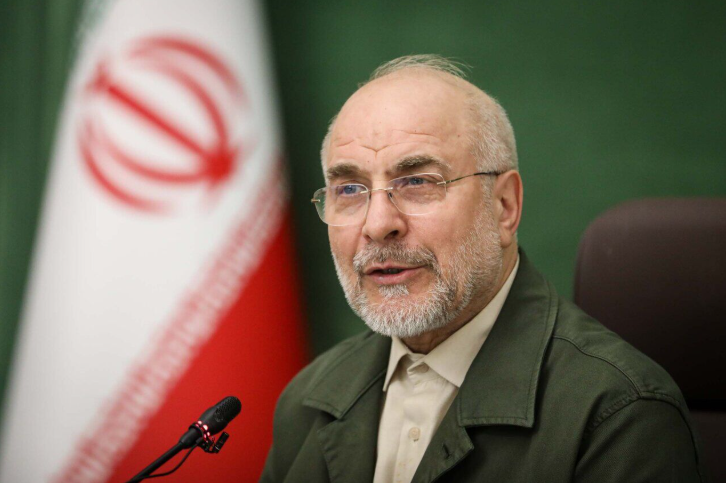
Mohammad Bagher Ghalibaf was born on 23 August 1961 in Torghabeh, near Mashhad, in Iran’s northeastern Khorasan region. He grew up during the final years of the Pahlavi monarchy and came of age during the 1979 Islamic Revolution, a period that transformed Iran’s political institutions and brought a new generation of revolutionary figures into public life. His early involvement in the political and security environment of the Islamic Republic shaped the direction of his career. Unlike politicians whose influence developed through party organisation or parliamentary activity, Ghalibaf built his initial standing through military service, eventually moving into policing, municipal administration and national politics.
Following the 1979 Revolution, Ghalibaf became involved with the Basij, a volunteer paramilitary organisation established under the new revolutionary authorities. In 1980, at the age of 19, he joined the Islamic Revolutionary Guard Corps (IRGC) as the Iran-Iraq War began. The eight-year conflict provided the setting for his early advancement. He served in several military formations and gradually assumed command responsibilities, including leadership roles associated with the Imam Reza Brigade and the Nasr Division. His experience during the war placed him within a generation of IRGC officers whose subsequent careers extended into Iran’s political, security and economic institutions. His brother Hassan was also killed during the conflict.
After the war ended in 1988, Ghalibaf continued his rise within the Revolutionary Guard. In 1994, he was appointed head of the Khatam al-Anbiya Construction Headquarters, the IRGC’s engineering and construction organisation. The appointment brought him into the field of post-war reconstruction, where military-linked institutions became increasingly involved in major infrastructure projects. He remained in the position until 1997, gaining experience in the management of large development operations and the economic activities associated with the Revolutionary Guard. This period also marked the beginning of his involvement in areas extending beyond conventional military responsibilities.
In 1997, Supreme Leader Ayatollah Ali Khamenei appointed Ghalibaf commander of the IRGC Air Force. He held the position until 2000 and also undertook pilot training in France, eventually obtaining qualifications to fly Airbus aircraft. His military career entered a politically sensitive phase during the student demonstrations of July 1999, when protests at Tehran University developed into a wider challenge to the government of President Mohammad Khatami. Ghalibaf was among the senior Revolutionary Guard commanders who signed a letter warning Khatami against allowing the protests to continue. He later acknowledged his own involvement in confronting demonstrators. The episode became a significant part of the public record surrounding his role in Iran’s security establishment.
In 2000, Ghalibaf was appointed chief of Iran’s national police, placing him in charge of an institution responsible for domestic law enforcement and public security. His tenure lasted until 2005. He oversaw efforts to modernise police operations and equipment, while the force remained involved in the state’s response to demonstrations and political unrest. The appointment further broadened his administrative experience and strengthened his position within the country’s governing establishment. By the end of his term, he had served in senior military and security positions for more than two decades.
Ghalibaf entered electoral politics in 2005, contesting the presidential election but failing to secure the presidency. Mahmoud Ahmadinejad won the election, and Ghalibaf subsequently moved into municipal administration. Tehran City Council selected him as mayor of the capital in September 2005. He remained in the position for three consecutive terms, serving until 2017. His administration oversaw major urban development projects, including the expansion of the metro network, road infrastructure and other public facilities. He also promoted Tehran’s international municipal engagement and became involved in regional networks of city governments. His supporters highlighted infrastructure development and administrative efficiency, while critics raised allegations concerning municipal property transactions and the distribution of development benefits. These allegations remained a recurring issue during his political career.
Alongside his administrative responsibilities, Ghalibaf pursued higher academic qualifications. He studied human geography and later obtained a master’s degree and a doctorate in political geography from Tarbiat Modares University in Tehran. His doctoral research examined the development of local institutions in contemporary Iran. He subsequently became associated with the University of Tehran as an academic in political geography and published work on local government and geopolitical subjects. His academic interests ran parallel to his administrative career, particularly during his years as mayor.
His ambitions for national leadership continued through several presidential campaigns. After his unsuccessful attempt in 2005, he contested the 2013 election, finishing behind Hassan Rouhani. In 2017, he entered the presidential race but withdrew in favour of Ebrahim Raisi, consolidating support behind the conservative candidate. He made another attempt in the 2024 election, which followed the death of President Ebrahim Raisi in a helicopter crash. Ghalibaf was among the approved candidates but did not advance to the presidency, as Masoud Pezeshkian won the runoff election. Despite these unsuccessful campaigns, his years in the IRGC, national police and Tehran municipality had established him as a prominent figure within Iran’s conservative political establishment.
A major transition in Ghalibaf’s career came in February 2020, when he was elected to the Islamic Consultative Assembly, commonly known as the Majlis, representing Tehran. On 28 May 2020, lawmakers elected him Speaker of Parliament, succeeding Ali Larijani. He was subsequently re-elected each year, including for a seventh consecutive term on 25 May 2026. As speaker, he presides over parliamentary proceedings and occupies a senior position in Iran’s legislative structure. His background in the Revolutionary Guard and executive administration has also given him connections across several important state institutions.
Ghalibaf’s public role expanded further during the confrontation involving Iran, the United States and Israel in 2026. Following the escalation of the conflict and the loss of several senior Iranian officials, he became increasingly visible in the country’s diplomatic and political response. In April, he led an Iranian delegation to Islamabad for talks with the United States, placing him at the centre of efforts to address the conflict and its consequences. His involvement brought together his experience in the security establishment and his position as parliamentary speaker. In May, he was also reported to have been appointed Iran’s special envoy to China, adding another dimension to his diplomatic responsibilities.
On 11 November 2026, Ghalibaf spoke to Al Jazeera about Tehran’s conditions for ending the conflict and the prospects for further negotiations with Washington. He said Iran had conveyed a seven-point proposal through mediators and was awaiting an official response from the United States. His remarks addressed sanctions, frozen Iranian assets, the regional ceasefire and arrangements concerning the Strait of Hormuz. The interview underscored his continuing role as head of Iran’s negotiating team at a time when the country’s security and diplomatic priorities remain closely connected.
Mohammad Bagher Ghalibaf’s career has encompassed military command, internal security, urban administration, electoral politics and parliamentary leadership. His rise has been closely connected to the institutions established after the 1979 Revolution, particularly the Islamic Revolutionary Guard Corps, while his later responsibilities have brought him into the centre of Iran’s domestic governance and international engagement. After several unsuccessful presidential campaigns, he has remained a prominent figure in the country’s political establishment. His current position as Speaker of Parliament and head of Iran’s negotiating team places him at the intersection of legislative authority, security policy and diplomacy.
Mohammad Bagher Ghalibaf’s Quote
“Until we are certain that the rights of the Iranian people have been secured, we will not approve any agreement.”
1 June 2026, referring to Iran’s conditions for an agreement with the United States