

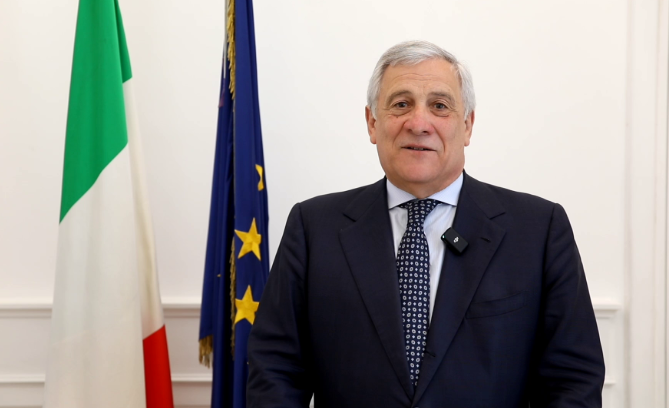
Antonio Tajani was born on 4 August 1953 in Rome, Italy. He grew up in a family shaped by military service and education. His father was an officer in the Italian Army, while his mother taught Greek and Latin. His early years included a period living in France, where his family accompanied his father during his assignment connected with NATO. Tajani’s professional journey would eventually combine journalism, military service, European politics and national government. Unlike many politicians whose careers begin within party structures, he first established himself as a journalist before entering public office and becoming one of the prominent figures in Italy’s centre-right political establishment.
Tajani studied law at Sapienza University of Rome, graduating with a degree in jurisprudence. Before entering politics, he completed military service as an officer in the Italian Air Force. He attended a specialised air-defence course at Borgo Piave in Latina and subsequently joined the NATO Air Defence Ground Environment, gaining experience in military coordination and air-defence systems. His time in the armed forces was an early part of his professional life, although journalism would become his principal occupation before his political career took shape.
In 1980, Tajani began his career as a professional journalist. He initially worked as a parliamentary reporter and news presenter for Rai Radio 1, Italy’s public broadcaster. He later became the Rome editor of Il Giornale, working closely with its prominent editor Indro Montanelli for approximately a decade. His reporting also took him abroad as a special correspondent in Lebanon, the Soviet Union and Somalia. These assignments exposed him to international conflicts, political transitions and developments beyond Western Europe. His experience in the media gave him familiarity with parliamentary affairs and international reporting before he moved into political organisation.
Tajani’s political involvement preceded his formal entry into national and European institutions. During his younger years, he was associated with the Monarchist Youth Front, reflecting an early interest in Italy’s political debates over its constitutional identity. His major political transition came in the early 1990s through his association with Silvio Berlusconi and the formation of Forza Italia. He became one of the founding members of the party in 1994 and served as its regional coordinator in Lazio from that year until 2005. In the first Berlusconi government, formed in 1994, he was appointed spokesperson for the Prime Minister. This position brought him into the centre of Italy’s new centre-right political movement.
In 1994, Tajani was elected to the European Parliament for the first time, beginning a long association with European institutions. He became involved in the European People’s Party and participated in discussions concerning the future structure of the European Union. As a member of the Convention on the Future of Europe, chaired by former French president Valéry Giscard d’Estaing, he contributed to the discussions that produced the draft European Constitution. His work increasingly focused on European integration, institutional development and the relationship between the EU and its citizens. He also served as a councillor in Rome City Council between 2002 and 2004, maintaining a connection with local administration alongside his European responsibilities.
A major advancement in Tajani’s career came in May 2008, when he was appointed European Commissioner for Transport in the Commission led by José Manuel Barroso. He worked on transport policy, infrastructure connectivity and passenger rights, supporting the development of trans-European transport networks and common European standards. In February 2010, he moved to the position of European Commissioner for Industry and Entrepreneurship and became a Vice-President of the European Commission. His portfolio included industrial competitiveness, support for small and medium-sized enterprises, entrepreneurship and reindustrialisation. He promoted initiatives such as the Late Payments Directive and the Entrepreneurship 2020 Action Plan, seeking to improve the operating environment for European businesses. He remained in the Commission until 2014.
In the 2014 European Parliament elections, Tajani returned as a Member of the European Parliament and was subsequently elected First Vice-President. His responsibilities included parliamentary security, interfaith dialogue and the development of the House of European History. He also continued his work within the European People’s Party, where he held a senior leadership position. During this period, he was involved in debates on European institutional reform, migration, security and the future of the Union. His experience in the European Commission and Parliament had by then given him a substantial role in the EU’s political and administrative framework.
On 17 January 2017, Tajani was elected President of the European Parliament, succeeding Martin Schulz. He held the office until July 2019, becoming one of the Italian politicians to lead the EU’s directly elected legislative institution. During his presidency, he promoted discussions on the future of Europe and organised a series of high-level parliamentary debates involving heads of state and government. His tenure also addressed the European Union’s response to migration, terrorism, economic challenges and relations with neighbouring regions. He advocated a stronger European role in defence and sought to increase the Parliament’s engagement with citizens. In the 2019 European elections, he was re-elected as a member of the Parliament.
After his presidency, Tajani continued to hold responsibilities within the European Parliament. From 2019 to 2022, he chaired its Committee on Constitutional Affairs and the Conference of Committee Chairs. These positions involved parliamentary work on institutional questions, legislative coordination and the constitutional framework of the European Union. Within Forza Italia, he also became increasingly prominent in the party’s organisational leadership. He was appointed national coordinator in February 2021 and continued to serve as one of its principal representatives as the party prepared for a new phase following Berlusconi’s return to the centre of political debate.
Following the formation of Giorgia Meloni’s government, Tajani was appointed Deputy Prime Minister and Minister of Foreign Affairs and International Cooperation on 22 October 2022. The appointment marked his return to Italy’s national executive after decades spent primarily in European institutions. His responsibilities included managing Italy’s diplomatic relations, representing the country in international organisations and coordinating foreign policy with its European and Atlantic partners. On 15 July 2023, following the death of Silvio Berlusconi, Tajani was unanimously elected National Secretary of Forza Italia, taking on the leadership of the party he had helped establish nearly three decades earlier.
As foreign minister, Tajani has worked on Italy’s relations with Europe, the United States, the Mediterranean and Africa. He has supported Ukraine’s sovereignty and territorial integrity following Russia’s full-scale invasion, while maintaining Italy’s participation in European and NATO initiatives. He has also promoted the Mattei Plan, the Italian government’s framework for cooperation with African countries, which focuses on energy, infrastructure, agriculture, education and investment. Tajani has presented the initiative as a partnership based on mutual interests and practical cooperation. His diplomatic agenda has also included the conflicts in West Asia, the protection of Italian citizens abroad and the expansion of economic and commercial relations.
In November 2026, Tajani represented Italy at the G7 Foreign Ministers’ meeting in Paris, where discussions included the war in Ukraine, international crises, artificial intelligence and the growing threat of hybrid attacks. He had proposed placing recent cyberattacks suspected of being linked to pro-Russian groups on the meeting’s agenda. The issue had also become personal after he reported that his own information had been published on the dark web, an incident he associated with the campaign of cyber threats directed at Italian officials. Tajani called for greater coordination among G7 countries to address such threats, while distinguishing the activities of pro-Russian hackers from any direct attribution to the Russian government.
Antonio Tajani’s career has encompassed journalism, military service, European institutional leadership and national government. His years as a correspondent and editor preceded a political journey that took him through the European Parliament, the European Commission and the presidency of the Parliament. His return to Italy’s executive as Foreign Minister and Deputy Prime Minister placed him at the centre of the country’s international engagement, while his leadership of Forza Italia added a major domestic political responsibility. He remains a prominent figure in Italian and European politics, combining experience in EU institutions with the diplomatic responsibilities of Italy’s foreign minister.
Antonio Tajani’s Quote
“We must keep the relationship between Europe and the USA alive, but with dignity and head-on.”
10 March 2025, interview with Corriere della Sera