

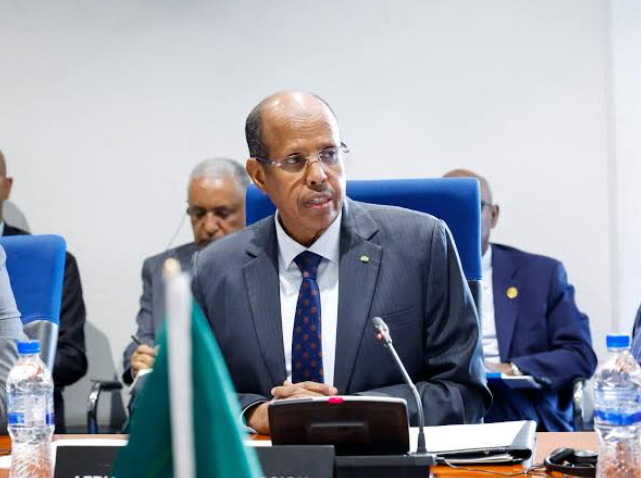
Mahmoud Ali Youssouf is a Djiboutian diplomat who spent two decades directing his country’s foreign policy before becoming Chairperson of the African Union Commission in March 2025. His career has been closely connected to Africa’s diplomatic engagement, regional cooperation and multilateral institutions. From representing Djibouti in the Arab world to leading its foreign ministry and subsequently assuming the highest executive position within the African Union Commission, he has built a career around diplomacy and international relations.
Youssouf was born in Djibouti in 1965. He completed his early education in his home country before pursuing further studies abroad. His academic journey took him to the United Kingdom, Canada and France, where he developed an educational foundation in languages, management and international affairs. He obtained a management degree from Université Laval in Canada in 1990 and later completed a master’s degree in Applied Foreign Languages, specialising in English and Arabic, at Université Lumière Lyon 2 in France in 1995. His training also included studies and professional qualifications in translation, international relations and public management. He is fluent in French, English, Arabic, Afar and Somali, a combination that has supported his engagement across African, Arab and international diplomatic circles.
Youssouf entered Djibouti’s Ministry of Foreign Affairs during the early 1990s, when the country was consolidating its diplomatic relationships and strengthening its engagement with international organisations. Between 1993 and 1995, he served as Deputy Director of the Directorate for International Organisations. He subsequently became Director of the Department of the Arab World from 1996 to 1997, overseeing diplomatic relations and cooperation with Arab countries. These assignments provided him with experience in multilateral diplomacy and regional affairs before he moved into ambassadorial responsibilities.
In 1997, he was appointed Djibouti’s Ambassador Extraordinary and Plenipotentiary to Egypt and Permanent Representative to the League of Arab States. He held the position until 2001 and also served as Djibouti’s non-resident ambassador to several countries, including Sudan, Lebanon, Syria and Turkey. His Cairo assignment placed him within the diplomatic environment of the Arab League and gave him direct exposure to regional negotiations and intergovernmental cooperation. During this period, he developed relationships with diplomatic institutions that would later become important to his ministerial career.
In 2001, Youssouf returned to a senior position within Djibouti’s foreign ministry as Minister Delegate for International Cooperation. He held the post until 2005, coordinating international cooperation programmes and participating in bilateral and multilateral negotiations. His responsibilities involved strengthening partnerships with foreign governments and international organisations, while advancing Djibouti’s development and diplomatic priorities. The position also prepared him for the broader responsibilities he would assume as the country’s foreign minister.
On 22 May 2005, Youssouf was appointed Minister of Foreign Affairs and International Cooperation of Djibouti under President Ismaïl Omar Guelleh. He also served as the government’s spokesperson. His appointment marked the beginning of a nearly two-decade tenure during which he became one of the longest-serving foreign ministers in Africa. He remained in the position until April 2025, giving him extensive experience in managing diplomatic relationships across the Horn of Africa, the Arab world, Europe, Asia and other international regions.
During his ministerial tenure, Djibouti’s strategic location at the entrance to the Red Sea and near the Bab el-Mandeb Strait remained central to its foreign relations. The country occupies an important position along maritime routes connecting the Indian Ocean with the Mediterranean through the Suez Canal. Youssouf’s diplomatic responsibilities therefore involved engagement with regional and international powers that maintained economic, security and military interests in the Horn of Africa. Djibouti’s relationships with neighbouring Ethiopia, Somalia and Eritrea, as well as its engagement with Gulf countries and international partners, formed important parts of his foreign policy portfolio.
His regional responsibilities extended beyond Djibouti’s bilateral relationships. Youssouf chaired the Council of Ministers of the League of Arab States on two occasions, in 2007 and 2017. He also served as Chairperson of the Council of Ministers of the Organisation of Islamic Cooperation in 2012. During the latter period, he chaired the OIC Contact Group on Mali, engaging with an international effort addressing instability in the Sahel. He also held responsibilities within the Intergovernmental Authority on Development (IGAD), strengthening his experience in the regional diplomatic mechanisms concerned with the Horn of Africa.
Institutional development within Djibouti’s foreign ministry became another significant part of his work. In 2012, he led a major restructuring of the Ministry of Foreign Affairs and International Cooperation, intended to improve coordination and strengthen its capacity to manage contemporary diplomatic challenges. He also established the Institute for Diplomatic Studies in the same year. The institution was designed to train Djiboutian diplomats and develop expertise in international affairs. It also provided a platform for research and discussion on emerging diplomatic issues. These initiatives reflected his interest in building the institutional capacity needed to sustain Djibouti’s international engagement beyond individual diplomatic appointments.
Youssouf’s diplomatic experience also involved regional conflict resolution and mediation. His work through the Arab League, OIC and IGAD brought him into contact with negotiations concerning instability in the Horn of Africa and the Sahel. Djibouti itself has participated in several regional peace initiatives, including efforts to support dialogue and political reconciliation in neighbouring countries. His experience in these forums became an important part of the professional background he presented during his campaign for the African Union Commission leadership.
In April 2024, Djibouti nominated Youssouf as its candidate for Chairperson of the African Union Commission. The election was contested by Kenya’s former Prime Minister Raila Odinga and Madagascar’s former Foreign Minister Richard Randriamandrato. The contest attracted considerable attention because the new chairperson would be responsible for directing the Commission during a period of continuing conflicts, institutional reform and growing geopolitical competition across Africa. On 15 February 2025, at the 38th Ordinary Session of the Assembly of Heads of State and Government in Addis Ababa, Youssouf secured the required two-thirds majority after several rounds of voting. The African Union formally announced his election on 16 February. He became the first Djiboutian to hold the position.
Youssouf assumed office on 13 March 2025, succeeding Chad’s Moussa Faki Mahamat, who had served two consecutive terms. The Chairperson of the African Union Commission serves as the organisation’s chief executive officer and legal representative, with responsibility for its administration, finances, institutional coordination and diplomatic representation. The position also involves working with member states, regional economic communities and international partners to advance the African Union’s objectives. His mandate runs for four years and is renewable once.
In May 2025, he outlined his administration’s priorities during a high-level media briefing. He placed peace and security at the centre of Africa’s development agenda, calling for stronger conflict prevention mechanisms, improved early warning systems and greater operational readiness of the African Standby Force. He also highlighted the need to address terrorism, violent extremism and unconstitutional changes of government. His broader agenda included institutional reform, economic self-reliance, digital innovation and a stronger African voice in international affairs. These priorities were presented within the framework of Agenda 2063, the African Union’s long-term development blueprint.
One of the central challenges facing his leadership has been the persistence of armed conflicts across the continent. Sudan’s civil war, instability in the Sahel and violence in eastern Democratic Republic of the Congo have placed considerable pressure on African diplomatic and security mechanisms. Youssouf has called for stronger preventive diplomacy and greater coordination between the African Union, regional organisations and international partners. In September 2026, he co-chaired a high-level meeting of the Quad and Quintet on Sudan with a senior US official. He called for an immediate humanitarian truce and cessation of hostilities as a pathway towards a durable ceasefire, while emphasising the need for an inclusive, Sudanese-owned political process that preserves the country’s unity and sovereignty.
His approach to continental security has also involved strengthening the African Peace and Security Architecture. In September 2025, he outlined three priorities at a meeting of the African Union Peace and Security Council on the margins of the United Nations General Assembly. These included improving early warning systems through artificial intelligence and big data, reforming the African Standby Force with stronger police and civilian components, and building national capacities for conflict prevention. The proposals reflected an effort to move beyond responses to active conflicts and strengthen the institutions responsible for anticipating and preventing crises.
Economic and financial independence has emerged as another important theme of his leadership. African countries continue to face substantial financing constraints, rising debt burdens and dependence on external development assistance. Youssouf has argued for stronger domestic resource mobilisation, improved continental financial institutions and a greater role for African capital in development. At a September 2025 global economic summit, he called for reform of the international financial system, including sustainable debt solutions and stronger African representation in global financial decision-making. He also supported the development of an African Credit Rating Agency as part of wider efforts to address concerns surrounding the continent’s access to international capital.
Regional economic integration has remained closely connected to his development agenda. The African Continental Free Trade Area offers a framework for expanding intra-African trade, strengthening industrial capacity and developing regional value chains. Youssouf has emphasised the need to accelerate its implementation alongside investment in transport, energy and digital infrastructure. He has also highlighted the importance of connecting the African Union’s regional economic ambitions with practical benefits for businesses, workers and communities across member states.
Relations with the United Nations have formed another important dimension of his responsibilities. On 13 May 2026, he convened the Tenth African Union-United Nations Annual Conference with UN Secretary-General António Guterres in Addis Ababa. The discussions reaffirmed cooperation between the two organisations on peace and security, human rights, sustainable development and the implementation of Agenda 2063 and the United Nations 2030 Agenda. The meeting also addressed the growing impact of armed conflicts, humanitarian emergencies, poverty, inequality and climate change. It demonstrated the importance of maintaining institutional cooperation between the African Union and the wider multilateral system.
Youssouf has also placed emphasis on Africa’s representation in global governance. He has argued that the continent should have a stronger role in shaping international decisions, particularly within institutions dealing with peace, security, finance and development. The African Union’s longstanding demand for reform of the United Nations Security Council remains an important part of this agenda. His diplomatic experience within the Arab League, OIC and other international forums has informed his efforts to strengthen Africa’s collective voice in multilateral negotiations.
In 2026, the African Union’s agenda under his Commission leadership continued to address institutional reform, sustainable financing, youth empowerment and the implementation of Agenda 2063. At the 39th Ordinary Session of the Assembly in February, Youssouf emphasised the importance of financial self-reliance as external funding becomes less predictable. The summit also adopted the year’s continental theme on sustainable water availability and safe sanitation systems. Although the annual rotating Chairperson of the African Union is a separate position held by a head of state, the Commission under Youssouf’s leadership has responsibility for supporting the implementation of the Union’s continental programmes and decisions.
Beyond his formal diplomatic positions, Youssouf has maintained an interest in community development. His curriculum vitae records his involvement in the establishment of the village of Sourat in 2017, including housing, a school, a mosque, water infrastructure and solar power facilities. It also records initiatives to improve access to drinking water and support local education. These activities represent a different dimension of his public work, extending beyond the international responsibilities that have defined most of his career.
Mahmoud Ali Youssouf’s professional journey reflects a progression from diplomatic administration and ambassadorial service to national foreign policy leadership and continental institution-building. His long tenure as Djibouti’s foreign minister provided him with experience across African, Arab and international institutions. His election as Chairperson of the African Union Commission brought that experience to a position with responsibility for coordinating the organisation’s political, economic and institutional priorities.
As Chairperson of the African Union Commission, Youssouf faces the task of strengthening continental cooperation at a time when Africa is confronting persistent conflicts, financial constraints and intensifying international competition. His stated priorities place peace, institutional reform, economic self-reliance and Africa’s global representation at the centre of his leadership. The extent to which the Commission can translate these objectives into coordinated action and measurable progress will shape the significance of his tenure.
Mahmoud Ali Youssouf’s Quote
“Africa is certainly part of the Global South, but Africa has its own distinctive character and identity.”
14 February 2026, 39th African Union Summit