

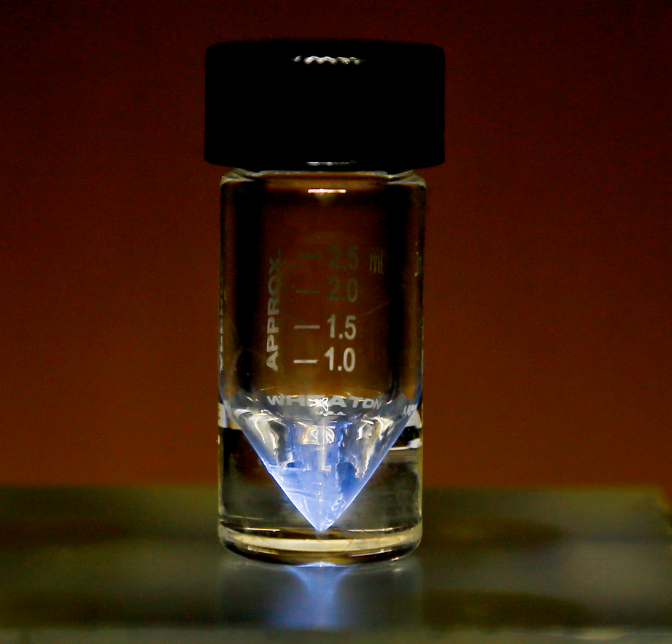
Actinium (Ac, atomic number 89), the first element of the actinide series and the namesake of the entire 5f-block, is a silvery-white, highly radioactive metal that glows in the dark with an eerie blue light. Named from the Greek aktis (“ray” or “beam”) for its intense radioactivity, actinium was discovered in 1899 by André-Louis Debierne (and independently in 1902 by Friedrich Otto Giesel) as a decay product of uranium. It is one of the rarest naturally occurring elements (~0.0002 ppm in the crust) and exists primarily as a trace impurity in uranium ores, produced via the decay of uranium-235.
No bulk metallic actinium has ever been isolated for practical use; the largest samples ever prepared are measured in milligrams. Every isotope is radioactive, and even microgram quantities emit enough radiation to cause visible luminescence and significant self-heating.
1. Hidden Features: Intense Radioactivity, Actinide Prototype, and Blue Glow
Actinium’s electron configuration [Rn] 6d¹ 7s² marks the beginning of the 5f series, where f-electrons start to participate in bonding.
- Fierce Radioactivity & Self-Luminescence All 30+ known isotopes are radioactive. The most important are ²²⁷Ac (half-life 21.77 years, beta and alpha decay) and ²²⁵Ac (half-life 10.0 days, alpha emitter). A single gram of ²²⁷Ac produces ~12 watts of decay heat and glows bright blue from ionization of surrounding air and its own decay products. This “actinium glow” was one of the first visual demonstrations of radioactivity observed by the Curies.
- +3 Oxidation State Dominance Actinium behaves as a classic trivalent actinide, forming Ac³⁺ ions in solution that are highly hydrolyzable and form strong complexes. Its chemistry closely mirrors lanthanum (its lighter homolog) but with vastly greater radioactivity—making it the prototype for studying the early actinide series.
- Decay Chain Powerhouse ²²⁷Ac heads the actinium decay series (4n+3), ultimately ending at stable lead-207. ²²⁵Ac starts a shorter chain that ends at bismuth-209. These chains produce multiple alpha-emitting daughters, delivering high linear energy transfer (LET) radiation over short distances—ideal for targeted cancer therapy.
- Nuclear & Relativistic Traits Relativistic effects begin to appear in actinium, contracting 7s and 6d orbitals and influencing its redox behavior. Actinium is the heaviest element whose +3 state is overwhelmingly dominant with no significant higher oxidation states under normal conditions.
2. Covert Uses: Cancer Therapy & Fundamental Actinide Research
Actinium has no bulk applications due to extreme radioactivity and scarcity, but its isotopes are among the most valuable in modern medicine and nuclear science.
- Targeted Alpha Therapy (TAT) Revolution ²²⁵Ac is currently the most promising alpha-emitting radioisotope for cancer treatment. When attached to antibodies or peptides (e.g., PSMA-617 for prostate cancer, lintuzumab for leukemia), its four alpha decays deliver lethal radiation directly to tumor cells while sparing healthy tissue. Clinical trials (especially with ²²⁵Ac-PSMA-617) show remarkable results in metastatic castration-resistant prostate cancer. Global supply is extremely limited, driving major production efforts at Oak Ridge, CERN, and accelerator facilities.
- Neutron Sources & Research ²²⁷Ac mixed with beryllium produces intense neutron sources via (α,n) reactions, used in oil-well logging and scientific instruments.
- Fundamental Chemistry Benchmark Actinium serves as the lightest true actinide for studying 5f-orbital involvement, relativistic effects, and separation chemistry. Every new coordination complex or spectroscopic measurement of Ac³⁺ refines models for heavier actinides (thorium through lawrencium).
- Historical Role Early samples of actinium were used by the Curies and others to study radioactivity itself—contributing directly to the discovery of the actinide series concept.
In summary, actinium isn’t just the first actinide—it’s the intensely radioactive beacon that glows blue from its own decay, the gateway element to the entire 5f series, and the rising star of targeted alpha therapy that is currently transforming cancer treatment.
What’s your favorite actinium fact—the eerie blue glow, its breakthrough role in prostate cancer therapy, or simply being the element that gave its name to the entire actinide series? Drop it below!