

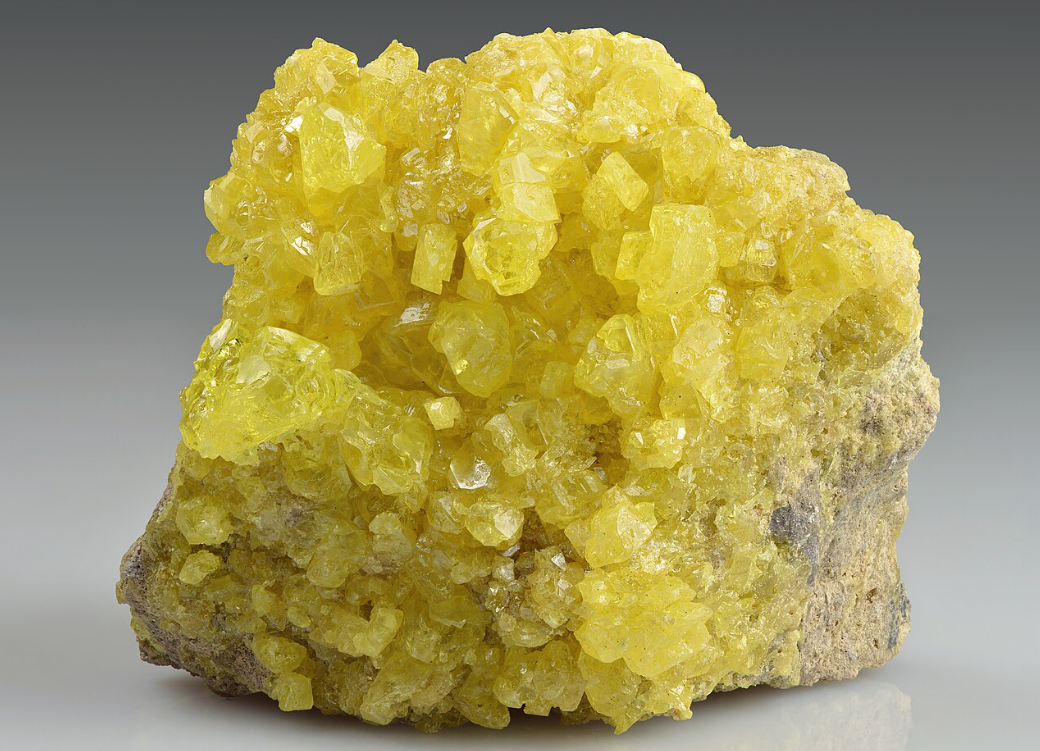
Sulfur (S, atomic number 16), the bright yellow nonmetal in group 16 (below oxygen and above selenium), has been known to humanity since antiquity—called brimstone (“burning stone”) in the Bible and used in alchemy, medicine, and warfare. Its characteristic rotten-egg smell (from hydrogen sulfide) and vivid yellow color make it instantly recognizable. Sulfur is the tenth most abundant element in the universe and the fifth most abundant in Earth’s crust (~0.048% by mass), occurring native as yellow crystals, in sulfide ores (pyrite, galena, sphalerite), and as sulfate minerals (gypsum, anhydrite).
Once extracted by mining volcanic deposits or the Frasch process (hot-water melting underground sulfur), most sulfur today is recovered as a byproduct of natural gas and crude oil desulfurization—making it one of the few elements whose production is tied directly to energy markets.
1. Hidden Features: Allotropic Diversity, Catena Power, and Biological Essentiality
Sulfur’s electron configuration [Ne] 3s² 3p⁴ gives it six valence electrons and a strong tendency to form chains and rings.
- Allotropes & Plastic Sulfur The most common form is rhombic sulfur (yellow crystals, stable below 95.5 °C). Monoclinic sulfur forms above that temperature. Rapid cooling of molten sulfur produces “plastic sulfur”—a rubbery, amorphous mass of long S₈ chains that slowly reverts to rhombic crystals over days or weeks, demonstrating sulfur’s ability to catenate (form long chains) like carbon.
- Crown-Shaped S₈ Rings Elemental sulfur exists primarily as puckered S₈ rings in the solid state—giving it low density (2.07 g/cm³) and poor conductivity. Under high pressure, sulfur forms polymeric chains and even metallic phases.
- Extreme Reactivity in Compounds Sulfur burns with a blue flame to form sulfur dioxide (SO₂), a choking gas. It reacts vigorously with many metals (forming sulfides), halogens (S₂F₂, SCl₂), and hydrogen (H₂S, highly toxic). Sulfuric acid (H₂SO₄)—the “king of chemicals”—is produced in greater volume than any other industrial compound.
- Biological Sulfur Cycle Sulfur is essential for life: cysteine and methionine amino acids, disulfide bonds in proteins, coenzyme A, biotin, and glutathione all contain sulfur. Sulfur-metabolizing bacteria drive the global sulfur cycle, oxidizing or reducing sulfur compounds in oceans, soils, and volcanic vents.
- Volcanic & Planetary Sulfur Sulfur is abundant on Io (Jupiter’s moon)—where volcanic plumes eject sulfur dioxide and elemental sulfur, creating yellow-red surface deposits. Sulfur also appears in Martian soil and comets.
2. Covert Uses: Fertilizers, Batteries, Rubber, and Gunpowder Legacy
Global sulfur production exceeds 80 million tonnes/year (mostly as sulfuric acid), driven by fertilizer demand.
- Sulfuric Acid – The Workhorse Chemical ~60% of sulfur goes into H₂SO₄ production via the Contact process. Sulfuric acid is essential for:
- Phosphate fertilizer (superphosphate, ammonium phosphate)
- Petroleum refining (alkylation, desulfurization)
- Battery acid (lead-acid batteries)
- Steel pickling, dyes, explosives, and countless other processes
- Vulcanized Rubber & Tires Sulfur vulcanization (adding sulfur to natural rubber) creates cross-links that turn sticky latex into durable, elastic rubber—revolutionizing tires, hoses, seals, and footwear since Charles Goodyear’s discovery in 1839.
- Gunpowder & Pyrotechnics Black powder (75% potassium nitrate, 15% charcoal, 10% sulfur) uses sulfur to lower ignition temperature and speed combustion. Sulfur is still used in modern pyrotechnics, matches, and some propellants.
- Emerging Energy Storage Lithium-sulfur batteries promise 2–3× the energy density of lithium-ion due to sulfur’s high theoretical capacity (1675 mAh/g). Though cycle life remains a challenge, Li-S is a leading post-lithium candidate.
- Agriculture & Fungicides Elemental sulfur is a natural fungicide and pesticide (used since antiquity). It acidifies soil and controls mites and fungi in grapes, citrus, and other crops.
In summary, sulfur isn’t just the yellow brimstone of volcanoes and hellfire—it’s the element that vulcanizes rubber, feeds the world through fertilizers, powers batteries of the future, and has fueled explosives and alchemy for millennia.
What’s your favorite sulfur fact—the blue flame of burning sulfur, its role in making tires possible, the rotten-egg smell of H₂S, or its starring role in gunpowder and Li-S batteries? Drop it below!