

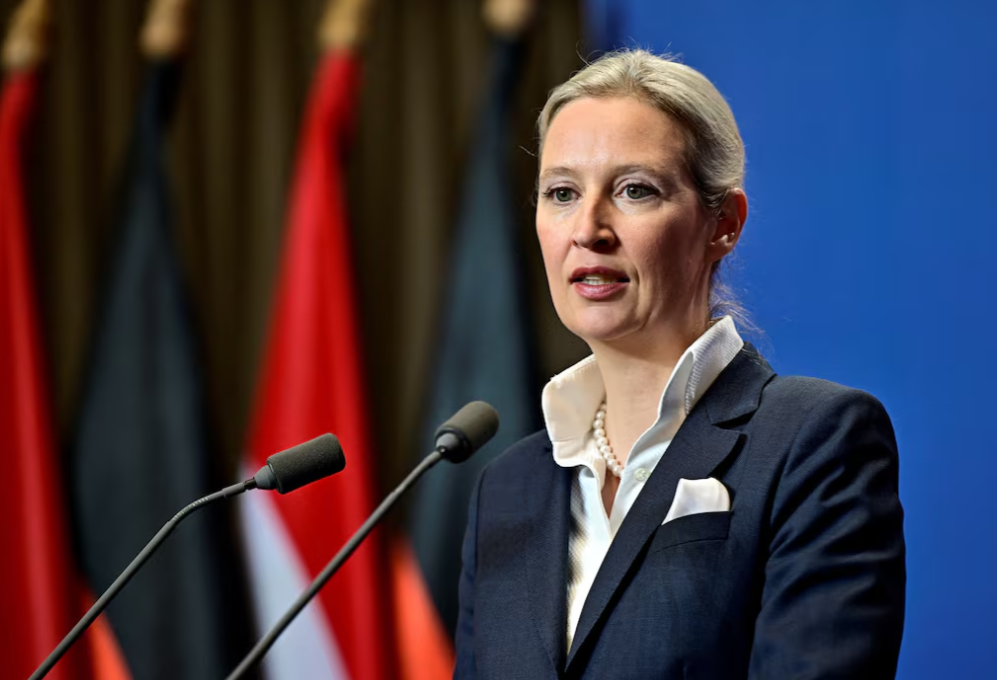
Alice Weidel has become one of the most prominent figures in contemporary German politics through her leadership of the Alternative for Germany (AfD), a party that has moved from its original Eurosceptic foundations into a broader nationalist and anti-immigration political movement. An economist by education and a former financial-sector professional, Weidel entered politics in 2013 and was elected to the German Bundestag in 2017. Her rise within the AfD has taken her from economic policy specialist to parliamentary group co-chair, national party co-chair and, in 2025, the party’s candidate for Chancellor. She now leads one of the largest opposition forces in the Bundestag, placing her at the centre of Germany’s increasingly contested political landscape.
Born on 6 February 1979 in Gütersloh, North Rhine-Westphalia, Weidel grew up in the town of Harsewinkel. She studied economics and business administration at the University of Bayreuth, completing her academic training with a doctorate in economics. Her professional career included positions in financial services and investment management, including work with Goldman Sachs and Allianz Global Investors. She also gained international experience in China, where she worked in the financial sector and developed proficiency in Mandarin. Before entering full-time politics, she worked in business consultancy and was involved in establishing and advising start-up companies. This background in economics and international finance later became an important part of her political profile, particularly in debates over taxation, public expenditure, European economic policy and Germany’s industrial competitiveness.
Weidel joined the AfD in 2013, shortly after the party was established. At that time, the organisation was primarily associated with opposition to the eurozone’s financial arrangements and criticism of European integration. She became involved in its economic policy development and gradually moved into senior party positions. Her political responsibilities expanded as the AfD broadened its agenda, particularly during the European migration crisis of 2015, when immigration and national identity became central themes in German political debate. Weidel emerged as one of the party’s most recognisable representatives, combining economic arguments with demands for stricter immigration controls, national sovereignty and changes to Germany’s relationship with the European Union. Her rise also coincided with a wider transformation of the AfD, whose political positioning increasingly attracted descriptions such as right-wing populist and far-right from major media organisations and political observers.
Her entry into the Bundestag in October 2017 marked a significant step in her political career. The AfD secured 12.6 per cent of the vote in the federal election, becoming the third-largest parliamentary force and entering the national parliament for the first time. Weidel was appointed co-chair of the AfD parliamentary group alongside Alexander Gauland, giving her a prominent role in shaping the party’s parliamentary strategy and public messaging. She became particularly visible in debates on government spending, migration, European integration and economic policy. In 2021, she continued in the parliamentary leadership alongside Tino Chrupalla, establishing a leadership partnership that would later extend to the national party organisation. Her parliamentary work increasingly positioned her as one of the principal figures articulating the AfD’s opposition to successive federal governments.
In June 2022, Weidel was elected one of the AfD’s national co-chairs, sharing the position with Tino Chrupalla. The appointment consolidated her influence over both the parliamentary group and the wider party organisation. Under their joint leadership, the AfD expanded its political presence amid public dissatisfaction over inflation, migration, energy costs and the government’s economic and climate policies. Weidel consistently criticised the direction of Germany’s energy transition, opposed restrictions on fossil-fuel use and called for a reduction in taxation and government expenditure. On Europe, she advocated a fundamental reform of the European Union and argued that member states should retain greater national decision-making powers. Her economic positions combine support for lower taxes and reduced state intervention with a political programme centred on national sovereignty and restrictive immigration policies.
The 2025 federal election became a defining moment in Weidel’s political career. The AfD selected her as its candidate for Chancellor, placing her at the forefront of its national campaign. The party secured 20.8 per cent of the vote and 152 seats in the 630-member Bundestag, finishing second and becoming the largest opposition parliamentary group. The result represented a substantial increase from its 2021 performance and marked the party’s strongest result in a German federal election at that time. However, the other major parties maintained their refusal to form a governing coalition with the AfD, leaving Weidel outside the government despite the party’s expanded parliamentary strength. The election nevertheless established her as a central figure in national opposition politics and gave her a much larger parliamentary platform from which to challenge the government’s policies.
Weidel’s political position has also been shaped by controversies surrounding the AfD’s ideological direction and its relationship with more radical elements within the party. She has defended the party against accusations of extremism and rejected descriptions that she considers politically motivated. At the same time, critics have raised concerns about the AfD’s rhetoric on immigration, national identity and Germany’s historical responsibilities. Her relationship with the party’s more radical figures has also attracted scrutiny, particularly as she has sought to maintain unity across its different factions. Her personal circumstances have drawn attention because she lives in a same-sex partnership with a Sri Lankan-born partner and has two children, while the AfD promotes positions on family and social policy that are often at odds with parts of the LGBTQ+ political agenda. This contrast has become a recurring subject in media coverage of her leadership and the party’s public identity.
In July 2026, Weidel and Chrupalla were re-elected as AfD national co-chairs at the party’s congress in Erfurt, confirming their continued leadership of the organisation. Weidel’s position within the party has been further strengthened by her role in the Bundestag, where she continues to serve as parliamentary group co-chair. Her political agenda remains focused on immigration restrictions, economic competitiveness, energy policy, national sovereignty and opposition to the established political parties. The AfD’s growing parliamentary presence has also intensified debate in Germany over the limits of political cooperation, the country’s democratic institutions and the future direction of its party system. Weidel’s leadership now involves managing internal differences while presenting the AfD as a national political alternative.
Across her political career, Weidel has moved from the professional world of international finance into the leadership of a party that has reshaped Germany’s parliamentary opposition. Her trajectory reflects both her personal advancement within the AfD and the wider transformation of German politics over the past decade. From her entry into the party in 2013 and election to the Bundestag in 2017 to her 2025 Chancellorship candidacy and re-election as national co-chair in 2026, she has steadily expanded her political responsibilities. Her leadership remains closely associated with the AfD’s positions on immigration, European integration, economic policy and national identity, as well as the continuing controversies surrounding the party’s ideological direction. As one of Germany’s most visible opposition politicians, Weidel occupies a significant place in the country’s ongoing political debate.
Alice Weidel`s Quote
“It was a fatal mistake to lure Ukraine into a hopeless confrontation with the unfulfillable promises of NATO and EU membership.”
27 February 2022, speech in the German Bundestag.