

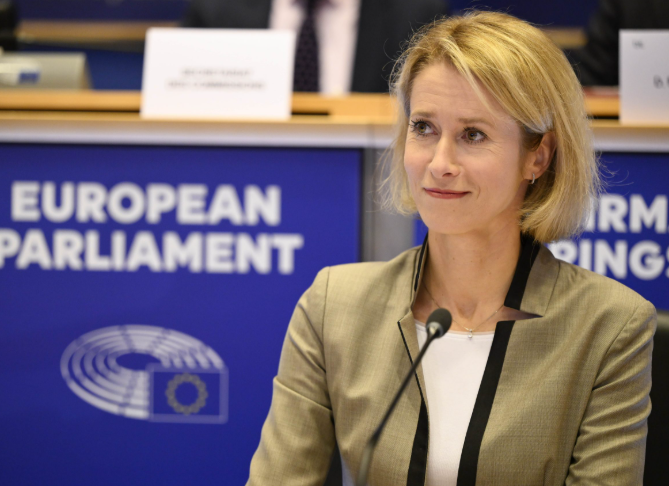
Kaja Kallas was born on 18 June 1977 in Tallinn, the capital of Estonia, during the final years of Soviet rule. Her family history and Estonia’s experience of Soviet occupation formed an important part of the environment in which she grew up. Her mother, Kristi, was among those whose family was deported to Siberia during the Soviet era. Her father, Siim Kallas, became a prominent figure in Estonia’s transition to independence, serving as president of the Bank of Estonia, founding the Estonian Reform Party and later becoming prime minister. He subsequently held senior positions within the European Commission. Kaja Kallas therefore grew up in a family familiar with public affairs, economic policy and the transformation of Estonia into an independent European state.
Kallas attended Tallinn English College before studying law at the University of Tartu, graduating in 1999. She went on to establish a professional career in law, specialising in competition law and working with businesses on legal and commercial matters. From 1998 to 2006, she worked at the law firm Tark & Co before becoming a partner at Luiga Mody Hääl Borenius, where she continued until 2011. Alongside her legal career, she developed an interest in business and economic policy, undertaking further studies at the Estonian Business School in 2007. Her professional experience gave her exposure to commercial regulation, corporate affairs and the practical relationship between government policy and private enterprise before she entered elected politics.
In 2011, Kallas joined the Estonian Reform Party and won election to the Riigikogu, Estonia’s national parliament. She became chair of its Economic Affairs Committee and later led the party’s parliamentary faction. Her early parliamentary work centred on economic questions, including competition, energy and the development of Estonia’s business environment. In 2014, she moved to the European Parliament after winning election as a member representing Estonia. During her four-year term, she worked within the Alliance of Liberals and Democrats for Europe political group, with particular attention to the digital single market, energy and consumer policy. Her experience in Brussels introduced her to the workings of European institutions and gave her a wider platform beyond Estonian domestic politics.
Kallas returned to Estonian national politics in 2018 and was elected leader of the Reform Party on 14 April that year. Under her leadership, the party won the largest share of votes in the 2019 parliamentary election, although it did not immediately form the government. She returned to the Riigikogu and became a leading opposition figure. The Reform Party subsequently won the 2023 parliamentary election, strengthening its position in national politics. Kallas’s rise also marked a significant personal milestone, as she became the first woman to serve as Estonia’s prime minister when she took office on 26 January 2021.
Her premiership coincided with major domestic and international challenges. The COVID-19 pandemic and its economic consequences formed part of the early period of her government, while Russia’s full-scale invasion of Ukraine in February 2022 brought European security to the forefront. Kallas became one of the most prominent European advocates of continued assistance to Ukraine and a firm approach towards Moscow. Her government supported military assistance for Kyiv and pursued closer cooperation with Estonia’s NATO and European Union partners. Domestically, her administration placed emphasis on strengthening Estonia’s defence capabilities, increasing military expenditure and improving national preparedness. Her government also faced difficult economic decisions involving taxation, public spending and the cost of living, as Estonia adjusted to the financial pressures created by the changing security environment.
Kallas’s political standing became more complicated in 2023 when reports emerged that a company partly owned by her husband, Arvo Hallik, had continued business operations in Russia after the invasion of Ukraine. The revelations prompted criticism because of her public position on Russia and raised questions about political responsibility and private business interests. Kallas defended herself by stating that she had not been involved in her husband’s company’s operations. The controversy placed pressure on her government and became a prominent issue in Estonian public debate. It formed part of a wider period in which her international reputation and domestic political position did not always move in the same direction.
On 15 July 2024, Kallas resigned as prime minister as she prepared to take up a senior European Union position. She had been nominated as the EU’s High Representative for Foreign Affairs and Security Policy, a role that also makes her a vice-president of the European Commission. After receiving approval through the European Union’s appointment process, she assumed office on 1 December 2024. The appointment moved her from leading the government of a small Baltic state to a position responsible for helping shape the foreign and security policy of a union comprising 27 member states. Her responsibilities include chairing meetings of EU foreign ministers, coordinating diplomatic positions and representing the Union in international affairs, while working to build consensus among governments that sometimes hold sharply different views.
As High Representative, Kallas has continued to place European security, support for Ukraine and relations with Russia among her central priorities. Her responsibilities extend beyond Eastern Europe, encompassing West Asia, Africa, the Indo-Pacific and the European Union’s relations with other international partners. The position requires her to reconcile national interests, diplomatic priorities and the collective decisions of member states. Unlike a national prime minister, she cannot determine the Union’s foreign policy alone, and her effectiveness depends on securing agreement among European governments while representing the bloc internationally.
Kaja Kallas’s career has taken her from legal practice and economic policy into national leadership and European diplomacy. Her experience includes service in the Estonian parliament, the European Parliament, the leadership of the Reform Party and the premiership of Estonia. Since December 2024, she has held one of the European Union’s principal foreign policy positions, placing her at the centre of debates over the continent’s security and international role. Her public life reflects both the influence of Estonia’s political transformation on her outlook and the transition from domestic leadership to the more complex task of coordinating diplomacy across Europe.
Kaja Kallas’s Quote
“For sustainable peace in Europe, we need to end the grey zones of security in Europe.”
3 May 2024, Address on Europe’s future, security and enlargement.