

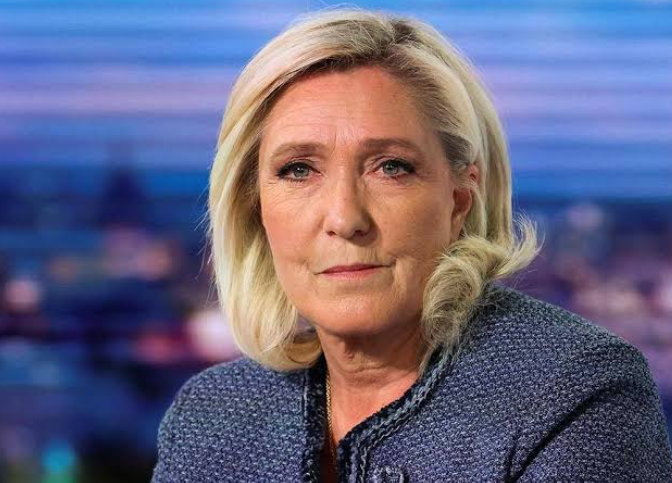
Marine Le Pen has spent more than three decades in public life, developing a career that has taken her from legal practice and regional politics to the leadership of one of France’s most prominent political parties. Born on 5 August 1968 in Neuilly-sur-Seine, she is the youngest of three daughters of Jean-Marie Le Pen, the founder of the National Front, and Pierrette Lalanne. Her upbringing placed her close to the political environment in which her father built his career, although her own professional path initially developed through the study of law. She attended Panthéon-Assas University in Paris, where she obtained qualifications in law and criminal law, before joining the Paris Bar in 1992. She subsequently practised as a lawyer, including work as a court-appointed defence lawyer. Her early professional experience gave her a background in legal procedure and public institutions before she moved into full-time party politics.
Le Pen formally joined the National Front in 1986, when she was eighteen. Her first responsibilities were connected with the party’s legal affairs, and she gradually became involved in its internal organisation. In 1998, she left legal practice to work in the party’s legal department, a transition that marked the beginning of her sustained political career. She entered electoral politics in the 1990s and secured her first regional council position in 1998. Her subsequent work within the party included membership of its political bureau and responsibility for developing its public profile. These early years were important in establishing her as more than the daughter of the party’s founder. She acquired experience in election campaigns, party administration and public communication while building a political identity within an organisation that had long been associated with her father.
Her electoral career expanded in the following decade. In 2004, she was elected to the European Parliament, where she served until 2017. She also held regional political responsibilities and developed a constituency base in northern France, particularly around Hénin-Beaumont. Her work in European institutions brought her into debates on immigration, European integration, trade and the powers of the European Union. These roles gave her experience beyond the internal structures of the National Front and placed her in direct contact with the legislative and political processes of the European Parliament. Her election to the European Parliament also provided a platform from which she could develop her profile across France and participate in wider European political debates.
In January 2011, Le Pen succeeded her father as president of the National Front. The change in leadership marked a new phase in the party’s development and in her own public responsibilities. She pursued a strategy intended to broaden its electoral appeal, including efforts to distance the organisation from some of the positions and controversies associated with its earlier leadership. A central part of this process was the party’s decision in 2018 to change its name from the National Front to the National Rally. The rebranding formed part of a wider effort to reshape its public presentation and establish a broader political presence. Le Pen remained its leading figure until 2021, when Jordan Bardella succeeded her as party president. She continued to exercise a central role in its political direction and became president of its parliamentary group in the National Assembly after the 2022 legislative election.
Le Pen contested the French presidential election for the first time in 2012, finishing third in the first round. She reached the second round in 2017, where she faced Emmanuel Macron, and returned to the runoff in 2022. Her 2022 campaign addressed purchasing power, immigration, public security, energy and France’s relationship with the European Union. She also placed considerable emphasis on household costs and economic concerns, seeking to present her programme as relevant to voters beyond the party’s traditional support base. Although she lost both presidential runoffs to Macron, her performance in 2022 represented a substantial increase on her previous result. The campaign also reinforced her position as a central figure in French electoral politics and gave the National Rally a larger parliamentary presence following the legislative election that year.
Her political programme has developed around several recurring areas of policy. Immigration and border controls remain prominent, alongside proposals concerning public security, national preference in certain areas of public policy, purchasing power and the cost of living. On the European Union, she has moved away from the earlier proposal to withdraw France from the euro and has increasingly presented her position in terms of reforming the Union and limiting the transfer of national powers to European institutions. Her economic positions have also included calls for tax reductions, support for domestic industries and measures intended to protect household incomes. These positions have evolved over time, reflecting changes in the party’s electoral strategy and the political issues that have shaped successive French elections. Her public profile has consequently extended beyond immigration, encompassing economic policy, institutional reform and France’s role within Europe.
The 2022 legislative election brought Le Pen into a more prominent parliamentary role. Elected to the National Assembly from Pas-de-Calais, she became president of the National Rally parliamentary group. She was re-elected in 2024, when the party and its allies secured a substantial number of seats but did not obtain an outright majority. Her responsibilities in the Assembly have involved coordinating the parliamentary group, presenting its positions during legislative debates and participating in the wider political contest between the government and opposition parties. Her parliamentary work has also given her a role distinct from that of a presidential candidate or party leader. It places her within the day-to-day legislative process, where political influence depends on parliamentary organisation, debate and the ability to negotiate support for specific proposals.
A major development in her recent career has been the legal case concerning the use of European Parliament funds to pay party staff. On 31 March 2025, a Paris criminal court found Le Pen guilty of misappropriating public funds and imposed a five-year ban on holding public office, with immediate effect, alongside a prison sentence and a fine. She appealed the judgment. On 7 July 2026, the Paris Court of Appeal upheld the conviction but reduced the sentence to three years, including one year under electronic monitoring, and shortened the period of ineligibility for public office. The revised ruling left her eligible to contest the 2027 presidential election, subject to the further legal proceedings. Le Pen announced that she would appeal to the Court of Cassation and confirmed her intention to run. The case remains an important part of her current political circumstances, with the final legal outcome still to be determined.
Marine Le Pen’s public career has developed through several distinct stages, from her education and work as a lawyer to regional representation, European parliamentary service, party leadership and national legislative politics. She has led the National Front and the National Rally through a period of organisational change, contested three presidential elections and established a sustained presence in the French National Assembly. Her political identity has been shaped by both the legacy of the party founded by her father and her own efforts to redefine its public image and electoral programme. The succession of Jordan Bardella to the party presidency also introduced a new division of responsibilities within the National Rally, while Le Pen retained her parliamentary role and presidential ambitions. Her place in French public life is therefore defined not by a single election or position, but by a long career spanning party organisation, electoral competition, legislative work and continuing legal proceedings.
Marine Le Pen’s Quote
“We cannot commit hara-kiri with the hope of hurting Russia.”
20 April 2022, Referring to sanctions on Russian energy imports.