

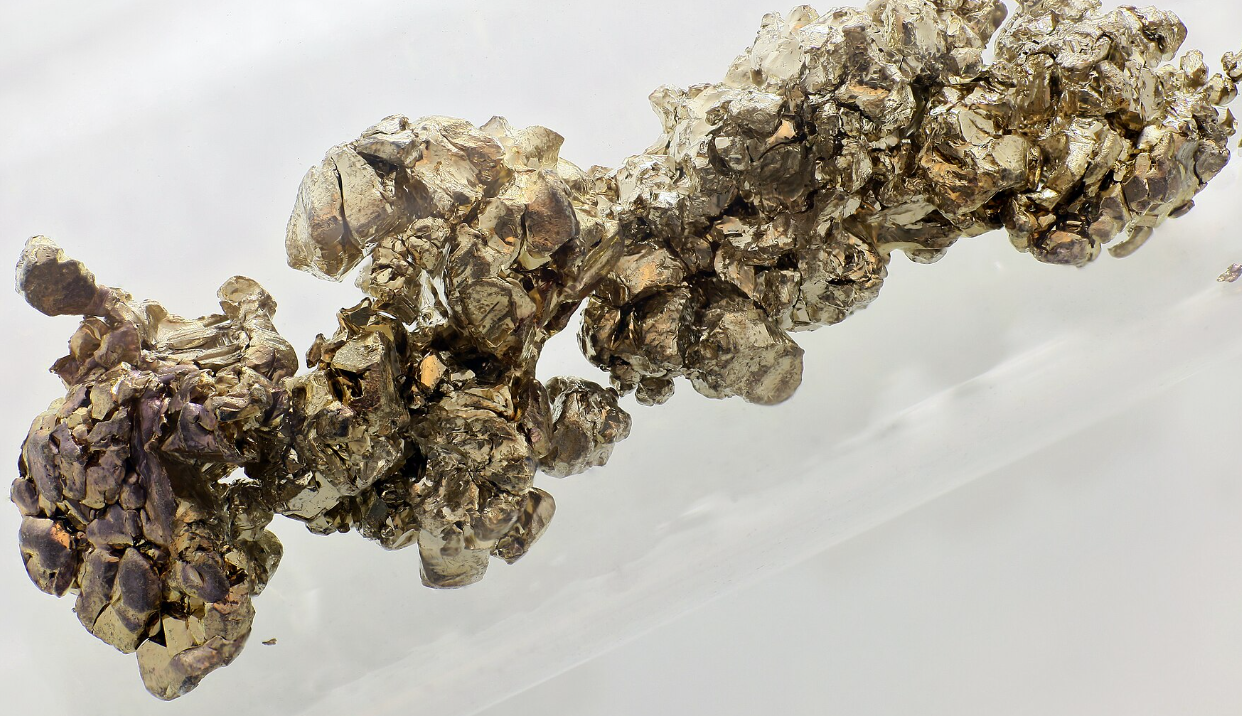
Strontium (Sr, atomic number 38), a soft, silvery-white alkaline earth metal in group 2 (below calcium and above barium), is best known for its brilliant crimson-red flame that has lit up fireworks, flares, and emergency signals for centuries. Discovered in 1790 by Adair Crawford and William Cruickshank in the mineral strontianite (named after the village of Strontian, Scotland), metallic strontium was first isolated in 1808 by Humphry Davy through electrolysis. Though chemically similar to calcium, strontium is far rarer in the crust (~370 ppm) and occurs mainly in celestine (SrSO₄) and strontianite (SrCO₃).
Despite its reputation for fireworks, strontium is quietly essential in modern medicine, electronics, and metallurgy—while one of its isotopes remains a key marker of both nuclear history and bone health.
1. Hidden Features: Crimson Flame, Bone-Mimicking Chemistry, and Radioactive Legacy
Strontium’s electron configuration [Kr] 5s² gives it classic group-2 behavior with some surprising twists.
- Iconic Crimson Flame Color Strontium salts produce the brightest, purest red flame of any element (wavelength ~640–660 nm). This is why strontium nitrate and strontium carbonate dominate red fireworks, signal flares, tracer bullets, and emergency roadside flares. The color is so distinctive that it is the international standard for “red” in pyrotechnics.
- Bone-Seeking Chemistry Strontium chemically mimics calcium (similar ionic radius and +2 charge). It is incorporated into bone hydroxyapatite, making it useful in osteoporosis treatment (strontium ranelate) and diagnostic imaging. However, radioactive ⁹⁰Sr is also bone-seeking, which is why it is a major concern in nuclear fallout—it concentrates in bones and can cause leukemia and bone cancer.
- High Reactivity with Water Strontium reacts vigorously with water to produce hydrogen gas and strontium hydroxide (Sr + 2H₂O → Sr(OH)₂ + H₂), though less violently than calcium’s heavier cousins. Freshly cut strontium rapidly tarnishes in air, forming a yellowish oxide/hydroxide layer.
- Isotopic Diversity Strontium has four stable isotopes (⁸⁴Sr, ⁸⁶Sr, ⁸⁷Sr, ⁸⁸Sr). The ⁸⁷Sr/⁸⁶Sr ratio is a powerful geochemical tracer used in:
- Dating ancient rocks (Rb-Sr method)
- Tracing migration of animals and humans (strontium isotope analysis in teeth and bones)
- Authenticating food and wine origins
- Radioactive ⁹⁰Sr Strontium-90 (half-life 28.8 years, beta emitter) is a high-yield fission product from nuclear weapons and reactors. It was one of the main long-term contaminants from atmospheric nuclear tests and Chernobyl/Fukushima, leading to strict global monitoring of milk and bones.
2. Covert Uses: Fireworks, Medicine, Electronics, and Nuclear Monitoring
Global strontium production is modest (~300,000–400,000 tonnes/year as carbonate), but its applications are highly specialized.
- Pyrotechnics & Military Signals ~60% of strontium goes into red fireworks, distress flares, tracer ammunition, and emergency beacons. Strontium nitrate is the preferred oxidizer because it burns cleanly and produces an intense, persistent crimson flame.
- Medical Applications
- Strontium ranelate treats osteoporosis by increasing bone formation and reducing resorption (approved in Europe and Asia).
- ⁸⁹Sr chloride (Metastron) is used for pain relief in metastatic bone cancer.
- ⁹⁰Sr is employed in ophthalmic applicators for pterygium treatment and in some vascular brachytherapy.
- Electronics & Displays Strontium titanate (SrTiO₃) is a high-dielectric-constant material used in tunable microwave devices, capacitors, and as a substrate for superconducting thin films. Strontium compounds also appear in ferrite magnets and some LED phosphors.
- Metallurgy & Alloys Small additions of strontium modify aluminum-silicon alloys (improving castability and strength) and are used in zinc galvanizing and steel desulfurization.
- Nuclear Forensics & Environmental Tracing The presence and ratio of ⁹⁰Sr serve as a fingerprint of nuclear events—used by the CTBTO and environmental scientists to track fallout and reactor releases.
In summary, strontium isn’t just the red-flame element of fireworks—it’s the bone-mimicking metal that treats osteoporosis, the isotopic tracer that reveals ancient migrations, the clean-burning oxidizer behind emergency signals, and the quiet sentinel that still monitors the legacy of nuclear testing.
What’s your favorite strontium story—the dazzling red fireworks, its medical use in bone cancer, or the way its isotopes reveal where people and animals came from thousands of years ago? Drop it below!