

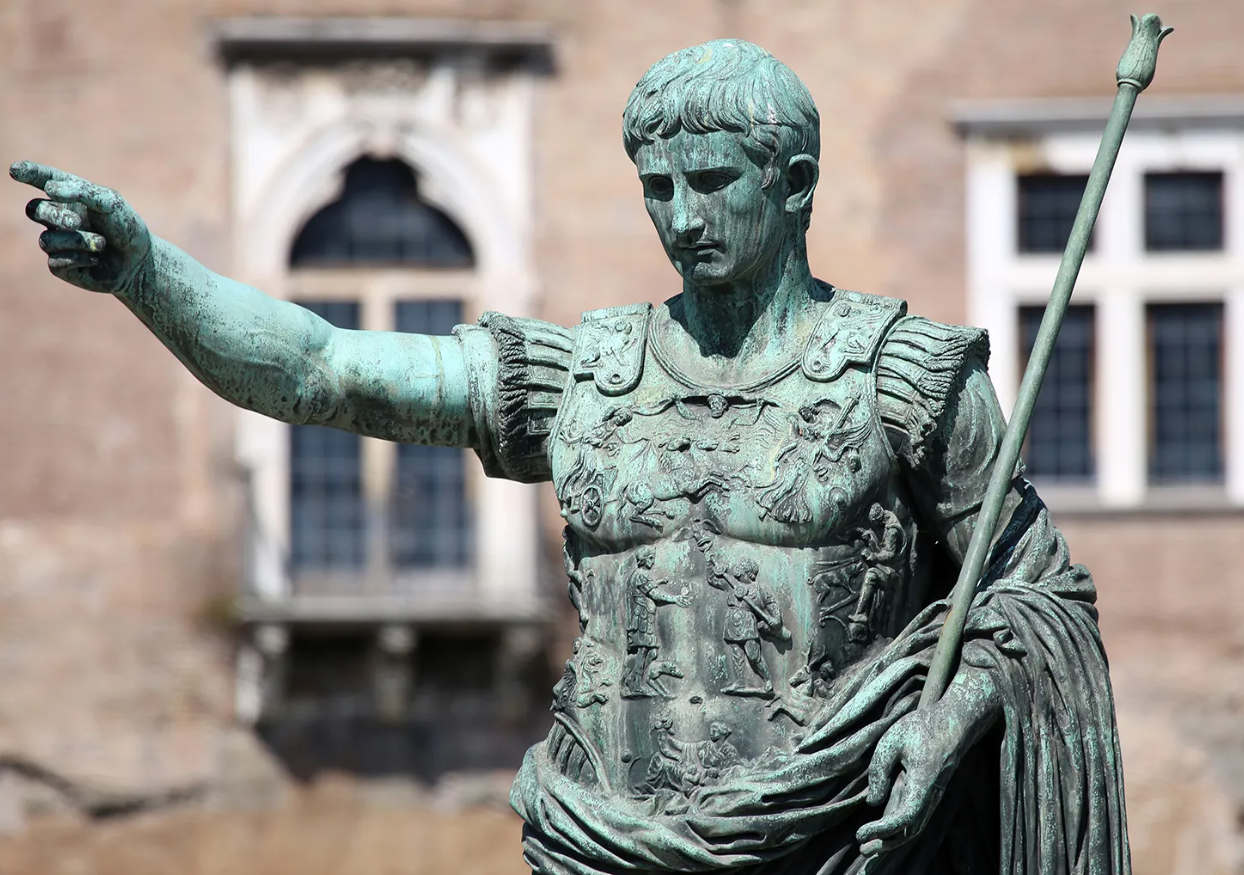
Augustus (63 BC – 14 AD) was the founder of the Roman Empire and its first emperor, ruling as princeps (first citizen) from 27 BC until his death. Born Gaius Octavius Thurinus (later Gaius Julius Caesar Octavianus, then Imperator Caesar Divi Filius Augustus), he transformed Rome from a fractured republic devastated by civil wars into a stable imperial system that ushered in the Pax Romana—a roughly 200-year era of relative peace and prosperity across the Mediterranean world. His reign marked the end of the Roman Republic and the beginning of the Roman Empire, blending republican traditions with autocratic control through shrewd politics, military reform, and masterful propaganda.
Early Life and Rise to Power
Augustus was born on 23 September 63 BC in Rome (or nearby Velitrae) to Gaius Octavius, a wealthy equestrian politician who served as proconsul of Macedonia, and Atia Balba Caesonia, niece of Julius Caesar. His father died when he was young; his mother remarried. Educated in rhetoric, philosophy, and Greek by tutors (including freedman Sphaerus), young Octavius showed early promise. At age 18, after Caesar’s assassination in 44 BC, he was named primary heir in Caesar’s will and posthumously adopted, taking the name Gaius Julius Caesar Octavianus. He boldly claimed his inheritance despite opposition from Mark Antony.
Octavian quickly raised legions, marched on Rome, and became consul at 19—the youngest ever. In 43 BC he formed the Second Triumvirate with Antony and Lepidus, wielding dictatorial powers to avenge Caesar. They carried out brutal proscriptions (executions and property seizures), killing hundreds of senators and equites, including Cicero. Victories followed: Philippi (42 BC) crushed Brutus and Cassius; Octavian later defeated Sextus Pompeius and sidelined Lepidus. The decisive Battle of Actium (31 BC), masterminded by his friend Marcus Agrippa, routed Antony and Cleopatra; Egypt’s annexation followed, providing vast wealth. By 27 BC, Octavian “restored” the Republic to the Senate while retaining supreme control—earning the title Augustus (“the revered one”) and princeps.
Political and Administrative Achievements
Augustus’s greatest innovation was the Principate: he maintained republican forms (Senate, consuls, assemblies) while holding lifelong powers—imperium proconsulare maius (superior military command), tribunicia potestas (tribune-like veto and sacrosanctity), and later pontifex maximus. He reduced the Senate from ~1,000 to 600 loyal members, conducted three empire-wide censuses, reformed taxation (ending corrupt tax-farming, introducing property-based levies and inheritance taxes), and created a professional standing army of 28 legions (~170,000 men) plus auxiliaries. He established the Praetorian Guard, urban cohorts for policing Rome, vigiles (fire brigade), and aerarium militare (military treasury). Provinces were divided: imperial ones under his legates, senatorial ones nominally independent but subject to his oversight. Egypt became his personal domain. These reforms brought stability after decades of chaos.
Socially, he passed moral legislation (Lex Julia de Maritandis Ordinibus and Lex Julia de Adulteriis, 18 BC) promoting marriage, legitimate children, and punishing adultery—ironically, his own daughter Julia was later exiled for violating them. He encouraged traditional Roman virtues, restored 82 temples, and revived old religious practices.
Military Achievements and Expansions
Augustus expanded the empire significantly: completing Spain’s conquest, annexing the Alps, Raetia, Noricum, Pannonia, and Dalmatia. Client kingdoms (e.g., Judea) buffered frontiers; he secured peace with Parthia via diplomacy (returning standards lost at Carrhae). The army was professionalized—fixed terms (20–25 years), pensions via land or cash, and loyalty sworn to him personally. Roads and the cursus publicus (postal system) improved communication. However, expansion had limits. The disastrous Battle of the Teutoburg Forest (AD 9), where Germanic tribes under Arminius annihilated three legions led by Varus, was a catastrophic setback. Augustus reportedly cried out in grief, “Varus, give me back my legions!” He halted further German conquests beyond the Rhine.
Building Projects and Cultural Patronage
Augustus famously boasted (in his Res Gestae): “I found Rome a city of brick and left it a city of marble.” He funded or oversaw the Forum of Augustus (with Temple of Mars Ultor), Theatre of Marcellus, Ara Pacis (Altar of Peace), Pantheon (by Agrippa), aqueducts, baths, and roads. He restored temples and public spaces, beautifying the capital. Culturally, he was a generous patron: Virgil’s Aeneid glorified his lineage (linking to Aeneas); Horace and Livy flourished under his support. He wrote poetry, an autobiography, and philosophical works himself (now lost). Games, festivals, and spectacles kept the populace content.
Personal Life, Appearance, Health, and Habits
Augustus married three times: first briefly to Claudia, then Scribonia (mother of his only biological child, Julia the Elder, in 39 BC), and finally Livia Drusilla (38 BC until his death)—a politically advantageous and reportedly loving union. He adopted heirs successively: nephew Marcellus (died 23 BC), son-in-law Agrippa (died 12 BC), grandsons Gaius and Lucius Caesar (both died young, AD 2–4), and ultimately stepson Tiberius (AD 4). Family tragedies plagued him: Julia’s exile for adultery (2 BC), Agrippa Postumus’s later banishment and probable execution. Rumors swirled of Livia’s influence or poisonings, though unproven.
Appearance (per Suetonius): Handsome and graceful, with clear bright eyes, slightly curly light-brown hair, a moderate nose, and fair complexion. He was short (about 5 ft 7–9 in / 1.70–1.75 m), possibly wearing platform shoes to appear taller; his teeth were wide apart and poorly kept, eyebrows met in the middle. Portraits were idealized as eternally youthful.
Health: Frail from youth—frequent illnesses, liver issues, and a near-fatal sickness in 23 BC. He suffered from skin conditions (“boils and ulcers”), bladder stones, and seasonal complaints. He managed them stoically but concealed vulnerabilities to project strength.
Daily Habits and Lifestyle (from Suetonius): Remarkably temperate and frugal. He lived in a modest Palatine house (not a palace), slept in the same simple bed for over 40 years, and dressed plainly (often in homespun clothes). Diet: coarse bread, small fishes, fresh hand-pressed cheese, green figs, and dates—ordinary Roman fare. He drank sparingly (rarely more than three cups of wine, often mixed with water). He was abstemious overall, melting down silver statues for coinage early on. He enjoyed reading, writing, and dice games in private. He rose early, worked diligently, and napped in the afternoon.
Personality, Character Traits, Likes, Dislikes, and Hidden Characteristics
Publicly, Augustus cultivated an image of pious, clement pater patriae (“father of the country”)—restorer of peace, morality, and tradition. Privately and historically, he was far more complex: a calculating, ruthless pragmatist in youth who evolved into a patient administrator.
Likes: Simple, unpretentious living; literature and poetry (he recited entire volumes aloud and patronized greats like Virgil and Horace); public spectacles and games (he attended enthusiastically and funded them lavishly); philosophy and rhetoric (studied them lifelong); gambling/dice with friends; and loyal companionship (he rewarded friends generously and tolerated minor faults).
Dislikes: Haste or rashness (“More haste, less speed” and “Better a safe commander than a bold” were favorite sayings); personal luxury or ostentation (he vetoed excessive honors for himself at times and enforced toga-wearing in the Forum); excessive ambition in others; and disloyalty (he demanded affection from friends even after death). He disliked dark cloaks in assemblies and once scolded Romans for them.
Hidden or Lesser-Known Characteristics:
- Ruthlessness masked by clemency: In youth (triumviral period), he was implacable—insisting on proscriptions, executing opponents without mercy, and even allowing Cicero’s death. Later, he spared many after Actium and prided himself on mercy. Seneca noted his early “hot temper” that he later regretted.
- Cunning manipulator: He hid absolute monarchy behind republican facades, used propaganda (coins, buildings, literature) to portray himself as divine heir and restorer, and controlled public image meticulously. Tacitus called him a subtle subverter of liberty.
- Physical and emotional vulnerabilities concealed: Short stature, chronic illnesses, and family heartbreaks (heirs dying young) were downplayed. He was superstitious/pious (consulted omens) yet pragmatic.
- Sexual rumors: Suetonius records early “shameless acts” (including alleged affairs with men and adultery), though he later enforced strict moral laws and lived monogamously with Livia.
- Frugality vs. generosity: Stingy personally but lavishly public-spirited (hundreds of millions spent on veterans, buildings, and games). He turned down stranger legacies but was sensitive about friends’ wills.
- Stoic discipline: Patient, constant with friends, and self-controlled; he avoided legacy-hunting and demanded equal treatment under law for his circle.
These “hidden” traits reveal a man who played a long game: brutal when necessary, merciful when advantageous, and always image-conscious.
Challenges, Setbacks, and “Fall”
Augustus had no dramatic “fall” like Caesar’s assassination—he died peacefully at 75. But his later years brought profound challenges. The Teutoburg disaster (AD 9) shattered his German ambitions and haunted him. Succession woes dominated: preferred heirs (Marcellus, Agrippa, Gaius, Lucius) died young, forcing adoption of the reluctant Tiberius. Daughter Julia’s scandals led to her exile; granddaughter Julia faced similar fate. Assassination plots and rumors (Livia poisoning figs?) circulated, though modern historians dismiss them. Health declined; he withdrew somewhat. His last words (per Suetonius): “Have I played the part well? Then applaud as I exit” (quoting a theatrical line), reflecting his lifelong performance of power. He died 19 August 14 AD in Nola; the Senate deified him as Divus Augustus.
Legacy
Augustus created the institutional framework for the Roman Empire that endured for centuries (and influenced later European monarchies). The Pax Romana brought prosperity, infrastructure, and cultural flowering. His Res Gestae (inscribed on monuments) shaped his narrative as benevolent ruler. Historians debate him: ancient sources (Suetonius, Tacitus) note hypocrisy and autocracy; modern views praise his administrative genius while acknowledging the human cost of his rise. He remains one of history’s most successful politicians—transforming chaos into enduring order without ever calling himself “emperor.” His system outlived him, though the Julio-Claudian dynasty later unraveled under less capable heirs.