

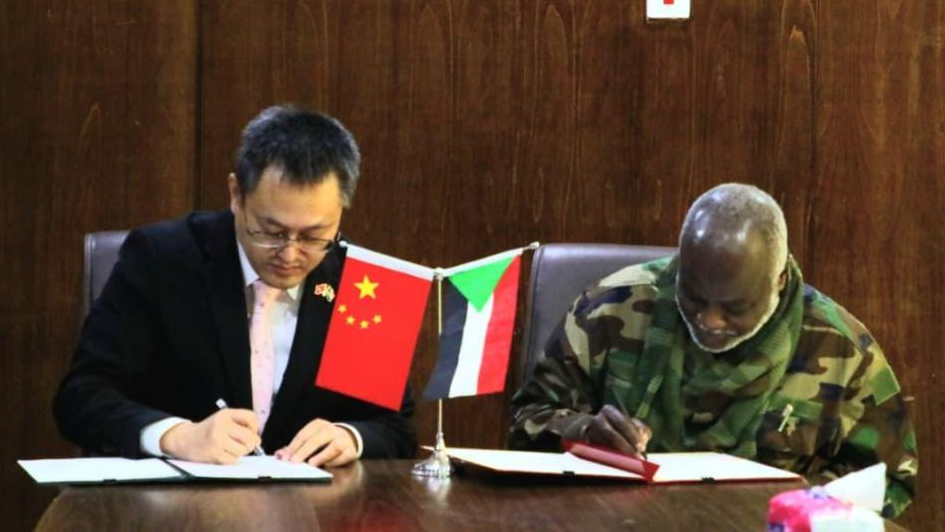
The signing ceremony held in the temporary coastal capital of Port Sudan over the weekend carried an economic weight that far exceeded its numerical parameters. On paper, the protocol signed between Sudanese Finance Minister Gibril Ibrahim and Chinese Chargé d’Affaires Zhang Tao is a modest transaction. Beijing agreed to cancel four interest free loans totaling approximately 344 million yuan, which translates to roughly fifty million dollars. In a world where sovereign debt write offs routinely run into the billions of dollars, this figure appears almost negligible. It represents less than one percent of Sudan’s staggering pre war external debt, which was estimated at fifty six billion dollars and has since climbed past sixty six billion dollars due to catastrophic accumulation of late penalties and interest. Yet, in the theater of international relations and inside the structural realities of a brutal civil war entering its fourth year, the deal is a strategic masterstroke for both Khartoum and Beijing.
The timing of this financial waiver is critical. Sudan is currently enduring one of the most severe humanitarian and institutional collapses of the modern era. Since April 2023, the war between the Sudanese Armed Forces, led by General Abdel Fattah al Burhan, and the paramilitary Rapid Support Forces, led by Mohamed Hamdan Dagalo, has shattered the social and economic fabric of the nation. According to United Nations estimates, the conflict has contracted the national economy by forty percent and set the country’s development metrics back by three decades. More than fourteen million people, representing a quarter of the total population, are internally or externally displaced. The civilian infrastructure is in ruins, with the World Health Organization reporting that less than fourteen percent of health facilities remain functional. In this atmosphere of systemic ruin, where the formal banking sector has fractured and ordinary households struggle to survive amidst hyperinflation, any form of external financial validation possesses massive political currency.
For the military led government in Khartoum, the Chinese waiver serves as a lifeline of diplomatic legitimacy at a moment of total isolation from the West. For years, Western powers have systematically tightened economic sanctions against the architects of the conflict. The United States and European Union have deployed a rolling strategy of freezing bank accounts, blacklisting front companies, and imposing travel bans on key military and political figures. In September 2025, the reach of these penalties extended directly to Finance Minister Gibril Ibrahim himself, who was placed on the United States Treasury sanctions list for his involvement in the conflict and alleged connections to regional actors like Iran. As Western capitals pull back and enforce a strict economic blockade, the Sudanese government has found its traditional avenues of fiscal management entirely closed. The willingness of Beijing to sit across the table in Port Sudan and formalize a debt write off sends a clear message to the international community that Khartoum is not entirely friendless.
This dynamic underscores a deep sense of frustration within the Sudanese leadership regarding Western financial policy. During his remarks at the ceremony, Ibrahim explicitly contrasted China’s persistent investment and engagement throughout the darkest periods of the war with the behavior of Western governments, which have largely withheld support or applied punitive measures. The irony is bitter for Khartoum. In 2021, Sudan was on the verge of a historic economic transformation. The country was moving steadily through the International Monetary Fund and World Bank Heavily Indebted Poor Countries initiative, positioned to have more than fifty billion dollars of its external debt permanently forgiven over a three year period. However, the military coup of October 2021 abruptly derailed that process, prompting international financial institutions to formally suspend the relief plan a year later. The grand promise of Western integration vanished, leaving the country exposed to economic shockwaves that multiplied exponentially when open warfare erupted in 2023.
The macroeconomics of the conflict have reduced the state to a shadow economy, heavily dependent on monetary expansion and informal trade networks. The collapse of the Sudanese pound tells the story of this fiscal ruin. Prior to the war, the currency traded at roughly 600 pounds to the US dollar. By June 2026, it has plummeted past the historic threshold of five thousand pounds to a single dollar. Because the government is unable to issue public debt bonds on international markets, the central bank has resorted to printing money to fund a widening deficit. National expenditures are projected to climb to nearly ten percent of gross domestic product in 2026, while revenues are expected to cover barely six percent. In such an environment, the formal state budget is less an instrument of economic planning and more a ledger of survival. The fifty million dollar waiver may be a drop in the ocean of total debt, but it directly relieves immediate accounting pressures between the Central Bank of Sudan and the China Development Bank, clearing a small portion of the state’s books.
From the perspective of Beijing, the decision to forgive these specific interest free loans aligns perfectly with a decades old diplomatic playbook that has solidified China as Africa’s primary trading partner for seventeen consecutive years. China frequently utilizes targeted loan forgiveness as a high impact, low cost tool of economic diplomacy, routinely timing these announcements to coincide with major leader level summits with African nations. Research from the Johns Hopkins China Africa Research Initiative illustrates the scale of this practice, revealing that Beijing forgave at least 3.4 billion dollars in similar interest free debts across the African continent between the years 2000 and 2019. It is important to distinguish between these smaller, state subsidized development loans and the massive commercial loans issued by Chinese state banks for major infrastructure projects. The larger commercial debts carry market interest rates and are rarely subject to outright cancellation, as they sit on the balance sheets of commercial entities rather than direct foreign aid ledgers. By erasing the smaller, interest free lines of credit, Beijing generates maximum goodwill and diplomatic leverage without incurring significant losses to its core commercial banking sector.
This calculated generosity grants China an outsized degree of influence in a territory of immense geopolitical value. Sudan sits at the critical geographical intersection of West Asia, North Africa, and sub Saharan Africa, bounded by the Red Sea coast where Port Sudan has become the de facto administrative hub for the embattled government. By maintaining deep institutional ties with Khartoum while Western powers retreat, China ensures that its long term strategic interests in the Horn of Africa remain protected, regardless of how the current civil war eventually resolves.
The history of China Sudan relations is deeply rooted in the politics of natural resources. Beginning in the mid nineties, when Western oil conglomerates pulled out of Sudan due to human rights concerns and early sanctions regimes, the China National Petroleum Corporation stepped into the vacuum. Beijing poured billions of dollars into developing the country’s southern oil fields and constructing the sophisticated pipeline networks required to transport that crude oil northward to the terminals at Port Sudan. This symbiotic relationship faced a profound structural disruption in 2011, when South Sudan voted overwhelmingly for independence, taking with it more than three quarters of the unified country’s oil reserves. The loss of these fields caused Chinese investment in the north to dry up substantially, though Khartoum still carries an outstanding debt to Beijing estimated at more than five billion dollars. The current war has placed additional strains on these legacy assets, culminating in the China National Petroleum Corporation requesting a formal exit from its remaining Sudanese operations in December 2025.
Despite the commercial withdrawal from active oil extraction, the geopolitical necessity of the relationship has not diminished. The signing of the debt waiver occurred simultaneously with a review of separate, active Chinese grants, including a 200 million yuan commitment from Beijing dedicated specifically to the rehabilitation of Sudan’s collapsing energy, water, and agricultural sectors. Chinese diplomats have expressed readiness to route further assistance through United Nations organizations, focusing on solar energy initiatives to power critical drinking water stations in highly contested regions such as Khartoum, Gezira, Sennar, and the Blue Nile states. This dual approach allows Beijing to maintain its stature as a constructive partner focused on humanitarian stabilization, while simultaneously cementing its position as the ultimate gatekeeper for future post war reconstruction contracts.
The strategic implications of this deal for the ongoing civil war are profound. The conflict has increasingly settled into a brutal war of attrition, where front lines have hardened into a de facto territorial division between the state military forces and the Rapid Support Forces. As the paramilitary forces launch long range drone attacks against strategic facilities in the capital region and threaten major logistics hubs like El Obeid in North Kordofan, the formal military government requires a continuous flow of resources to maintain its defense. By easing the immediate financial burdens on the central government and indicating a willingness to participate in the eventual rebuilding of destroyed infrastructure, China provides the military leadership with the psychological and material stamina needed to reject unfavorable peace terms.
The limits of Western economic leverage have become visibly apparent in this environment. The shadow economy of Sudan has proved remarkably resilient against traditional financial pressure, largely because the warring factions do not rely on traditional global banking mechanisms to sustain their operations. Instead, they have pivoted to regional black markets, informal value transfer networks, and trading partners outside the Western sphere of influence. When the United States or European Union blocks a conventional transaction, it merely accelerates the migration of Sudanese state commerce toward alternative financial ecosystems. By stepping forward with a debt waiver at this exact juncture, China validates this alternative path, signaling to other global south nations that isolation by the West does not mean total economic extinction.
Ultimately, the agreement signed in Port Sudan is an exercise in high stakes realism. For Sudan’s military elite, the fifty million dollars in erased debt is a valuable political token used to demonstrate international viability and mock the efficacy of Western sanctions. For Beijing, the waiver is a small, calculated expenditure from its foreign aid budget that preserves its long term strategic architecture along the Red Sea, retains its leverage over five billion dollars in remaining commercial debt, and ensures that whenever the guns fall silent, China will hold the first right of refusal for the multi billion dollar task of rebuilding the Sudanese state.