

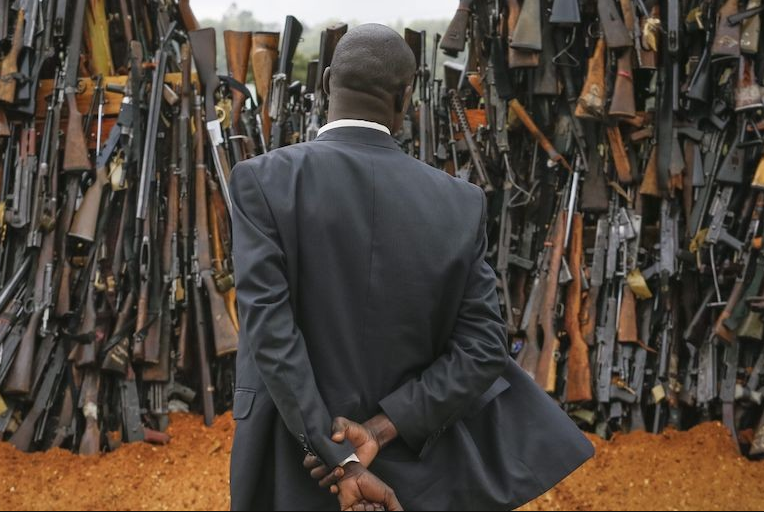
The paradox of peace in the African Great Lakes region is fundamentally bound to the sheer availability of small arms and light weapons. For decades, the constant, deadly hum of automatic rifles, light machine guns, and shoulder-fired rockets has fractured societies, displaced millions, and held hostage the massive economic potential of central and eastern Africa. In response, the African Union launched its ambitious “Silencing the Guns in Africa” project, aiming to foster a conflict-free continent. Yet, as conflict dynamics shift and Western security assistance increasingly comes attached to democratic or human rights benchmarks, a powerful alternative actor has stepped directly into the void. China is actively positioning its domestic model of zero-tolerance, total civilian disarmament, and absolute state monopoly over violence as a viable blueprint to stabilize the war-torn Great Lakes region.
Through high-profile initiatives, such as the comprehensive training program for Central and East African security officials at the People’s Public Security University in Beijing, China is transitioning from a purely economic actor to a foundational architect of global security governance. However, as Beijing attempts to map its internal domestic policing strategies onto the fluid, porous, and trans-border realities of African conflicts, a critical question emerges: Can an authoritarian, state-centric security apparatus truly silence the guns in Africa, or does it merely treat the surface symptoms of a much deeper institutional crisis?
To understand Beijing’s burgeoning role in African security governance, one must look past the technical parameters of weapons management to the overarching framework of Chinese foreign policy. Under the stewardship of President Xi Jinping, China has systematically rolled out the Global Security Initiative, a sweeping doctrinal push designed to reshape international norms around conflict resolution, national sovereignty, and law enforcement. For many years, Western observers characterized China’s engagement in Africa as purely mercantilist, focused squarely on securing oil, cobalt, copper, and agricultural goods while avoiding political entanglements. The Global Security Initiative shatters this outdated paradigm. By embedding small arms control within the Forum on China-Africa Cooperation Action Plans, Beijing is deliberately elevating its security footprint to match its massive economic stature.
This pivot is perfectly demonstrated by the Training-of-Trainers program held for delegates from Tanzania, Uganda, Burundi, the Democratic Republic of Congo, and Rwanda. Co-hosted with the United Nations, this initiative provides China with a vital mantle of multilateral legitimacy. It allows Beijing to project itself not as an ambitious unilateral hegemon, but as a responsible global stakeholder working collaboratively within the boundaries of the United Nations Charter and the African Union’s Agenda 2063. By utilizing an African-owned conceptual framework like “Silencing the Guns,” China ensures its security aid avoids the stigma of foreign imposition. It is a brilliant masterclass in strategic branding: offering state-to-state capacity building that respects local sovereignty while gradually normalising Chinese policing methodologies and institutional structures across a highly volatile continent.
While the diplomatic language coming out of Beijing emphasizes global public goods and shared human destinies, the underlying calculus remains deeply tethered to national interest. China’s economic exposure in the Great Lakes region, and specifically within the Democratic Republic of Congo, is staggering. Chinese state-owned and private enterprises dominate the extraction of copper and cobalt, essential raw materials that drive the global electric vehicle revolution, smartphone manufacturing, and renewable energy grids. The persistent instability of the Great Lakes region, where a complex tapestry of local militias, cross-border rebel groups, and porous frontiers constantly threaten mining concessions and supply routes, represents a direct hazard to Chinese state capital and the lives of Chinese nationals working abroad. If a rebel advance halts production at a multi-billion-dollar cobalt facility in Lualaba or Haut-Katanga provinces, the economic shockwaves are felt directly in industrial hubs across mainland China. Therefore, investing in the arms control capabilities of host governments is a proactive, preventative measure to safeguard supply chains. By fortifying the state security apparatus of these African nations, China seeks to construct a protective perimeter around its infrastructure investments, ensuring that the heavy machinery of extraction can operate unhindered by the chaos of localized insurgencies.
The core vulnerability of China’s security blueprint lies in the profound mismatch between its own domestic governance model and the structural realities on the ground in Africa. China boasts one of the lowest rates of gun-related violence in the world, achieved through an all-encompassing, top-down security model. In China, civilian firearm ownership is subject to a near-total ban, border controls are incredibly rigid, and the ruling apparatus exercises a pervasive, tech-enabled surveillance monopoly over society. Within this ecosystem, tracking and eliminating the illicit flow of weaponry is an exercise in total administrative control. This absolute state monopoly is virtually non-existent across the conflict zones of the Great Lakes and the Sahel. Many African governments in these regions suffer from severely limited state authority, unable to effectively police their own borders, let alone enforce a comprehensive domestic weapons ban. Frontiers are often arbitrary lines drawn on a map, effortlessly traversed by ethnic militias, cattle rustlers, and transnational arms traffickers.
Furthermore, the state itself is frequently a source of proliferation rather than its solution. In many regional proxy conflicts, governments have historically supplied arms and ammunition to non-state actor militias in neighboring territories to achieve geopolitical leverage. When the state security apparatus is complicit in the diversion of conventional weapons, or when poorly paid government soldiers routinely sell their own service rifles and ammunition to rebel factions on the black market, training programs focused purely on technical inventory management fail to address the core problem. Without deep institutional accountability, anti-corruption reforms, and a genuine political willingness among regional elites to halt proxy warfare, the technical skills imparted at elite academies in Beijing will struggle to translate into tangible stability on the ground.
The calculus of silencing the guns has been fundamentally altered by the rapid democratization of military technology. As African Union representatives have noted, the traditional focus on conventional small arms and light weapons is no longer sufficient to address the changing nature of modern conflict. The battlefields of Africa are experiencing a technological leap forward, characterized by the widespread introduction of autonomous and semi-autonomous weapons systems. In Somalia, the Sahel, and the Great Lakes, the sky is no longer the exclusive domain of state air forces. Militant networks and local militia groups are increasingly deploying commercial, off-the-shelf drones modified to carry improvised explosive devices, alongside low-cost “suicide drones.” These systems are utilized for sophisticated reconnaissance against United Nations peacekeepers and state military installations, vastly increasing the lethality of asymmetric warfare and exposing civilian populations to unprecedented risks.
This technological evolution presents an intricate challenge for China’s security assistance model. On one hand, China is a global superpower in drone manufacturing and surveillance technology, making it uniquely qualified to train African partners in counter-drone measures and electronic signals intelligence. On the other hand, the ease with which non-state actors can procure, adapt, and deploy these commercial technologies exposes the limits of traditional border and customs enforcement. A state-centric arms control model designed around tracking stamped serial numbers on assault rifles is ill-equipped to handle digital supply chains, modular components, and dual-use commercial technologies that can transform a hobbyist quadcopter into a precision-guided weapon of terror.
The expanding influence of China’s security model highlights a stark ideological divide between Beijing and Western capitals. Western security assistance programs, led by the United States and the European Union, typically operate on a framework of conditional aid. They frequently tie military financing, weapons transfers, and training to specific performance indicators, including human rights reforms, democratic governance, civil society inclusion, and community-based policing models. China’s approach, rooted firmly in its long-standing foreign policy doctrine of non-interference, offers an entirely different proposition. Beijing’s security assistance attaches no political strings regarding internal governance or human rights records. It treats the host government as the sole legitimate authority, prioritizing state-led, sovereignty-focused security governance over all else.
For African administrations navigating complex domestic insurgencies while facing intense criticism from Western capitals over democratic backsliding or military excesses, the Chinese model is extraordinarily attractive. It offers access to world-class technical expertise, tactical training, and hardware without the perceived paternalism or lecturing that often accompanies Western pacts. However, this lack of political conditionality carries significant long-term risks for regional stability. By reinforcing the hard security capabilities of central governments without simultaneously encouraging political dialogue, economic inclusivity, or governance reforms, the state-centric model risks turning state security forces into highly efficient instruments of internal political preservation. In a region where the state is often viewed by marginalized communities as an exclusionary or predatory entity, a security approach that focuses strictly on state capacity without addressing societal grievances can inadvertently inflame the root causes of rebellion, driving further cycles of radicalization and violent resistance.
Ultimately, China’s security engagement in Africa represents a highly sophisticated, multi-layered strategy that serves both to safeguard its massive economic investments and to systematically project its normative vision of security governance onto the global stage. By aligning its efforts with the United Nations and the African Union, Beijing successfully positions itself as a constructive, stabilizing alternative to traditional Western security leadership. Yet, the long-term efficacy of this model remains highly uncertain. Technical training in firearms tracking, ammunition storage, and border security is undeniably vital, but it operates merely at the structural surface of Africa’s conflict ecosystems. The illicit proliferation of weapons in the Great Lakes region is not simply a technical failure of inventory control; it is a direct symptom of porous borders, economic despair, pervasive state corruption, and deep-seated political rivalries that span across national frontiers.
If African governments are ready to match China’s technical assistance with a profound, unyielding political commitment to end proxy conflicts, reform their domestic security sectors, and stop the flow of state weapons to non-state actors, then Beijing’s training programs could serve as a valuable catalyst for peace. However, if the underlying structural drivers of violence are left unaddressed, China’s strict policing blueprint will act as little more than a temporary bandage on a deep, systemic wound. The guns in Africa will not be silenced by technical expertise alone; they will be silenced only when the socio-political incentives for picking them up are permanently dismantled.