

In the shadow of escalating tensions across West Asia, one inland body of water has quietly emerged as an enabler of prolonged conflict: the Caspian Sea. As the United States moves to enforce a naval blockade on Iranian ports and the Strait of Hormuz, choking Tehran’s primary oil export lifeline, and Israel conducts precision strikes on northern Iranian infrastructure, conventional thinking in Washington and Tel Aviv holds that economic isolation will force Iran to the table. But this assumption overlooks a northern corridor that Moscow has spent years strengthening. Far from a peripheral trade route, the Caspian now functions as a strategic sanctuary where Russia and Iran can sustain a war of attrition. The result could be a conflict that drags on for years, defying the swift and decisive outcome that blockade planners expect.
The geography is deceptively simple yet strategically decisive. The Caspian, the world’s largest inland sea, is bordered by five littoral states: Russia, Iran, Azerbaijan, Kazakhstan, and Turkmenistan. No external navies operate here. The 2018 Convention on the Legal Status of the Caspian Sea limits foreign military presence, a framework reinforced by cooperation among the coastal states. Turkmenistan has remained largely aloof but has not disrupted this balance. This closed system, roughly 600 miles from Iranian ports such as Bandar Anzali and Amirabad to Russia’s Astrakhan, places the maritime space largely beyond the reach of US carrier groups or Israeli submarines. What happens on the Caspian tends to stay there.
For years, this isolation has enabled a shadow logistics network that has already proven useful. Since Russia’s full scale invasion of Ukraine in 2022, Iranian and Russian vessels have engaged in dark shipping, switching off Automatic Identification System transponders, conducting ship to ship transfers, or making discreet port calls near Anzali and Astrakhan. Tracking data has shown repeated AIS gaps, echoing tactics used elsewhere to evade sanctions and surveillance. Cargo flows blur the line between civilian and military use: Iranian drones and munitions move north, while Russian wheat, oil, and other supplies move south. These exchanges form part of the International North South Transport Corridor, a network linking Russia’s Volga system through the Caspian to Iran and onward to the Persian Gulf.
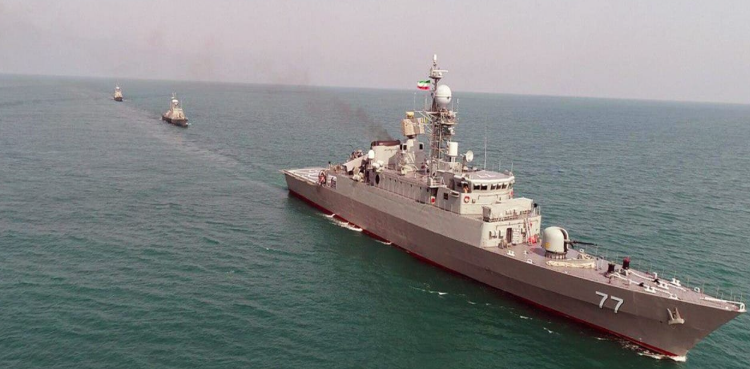
The real advantage lies in resilience. A US blockade of the Strait of Hormuz, through which roughly one fifth of global oil passes, would severely disrupt tanker traffic to and from Bandar Abbas and other southern ports. Insurers would pull back, prices would rise, and Iran’s export revenues would come under pressure. Tehran has long hinted at countermeasures, including mining the strait. At the same time, it has explored alternatives through Russia, Central Asia, and China. Here the Caspian becomes critical. Energy supplies, refined products, and dual use goods can still move, even if in smaller volumes. From Astrakhan, cargo can transfer to rail or river routes controlled by Russia. Iran’s northern fleet, based at Bandar Anzali, provides local security, while coordination with Russia has increased.
Recent developments highlight both the importance of this corridor and its flexibility. Strikes on infrastructure linked to Caspian logistics would be disruptive, but unlikely to shut the route down entirely. Traffic can shift to smaller vessels, nighttime movements, and less visible patterns. The enclosed nature of the Caspian makes sustained external monitoring difficult. Without cooperation from littoral states, real time oversight remains limited. Azerbaijan and Kazakhstan, while cautious and maintaining ties with multiple partners, have generally prioritised stability. Neither shows interest in opening the region to outside military involvement, and both benefit from continued connectivity.
Economically, the lifeline extends beyond military supply. Iran faces periodic fuel shortages and depends on imports to stabilise its energy system. Russian shipments have helped ease some of that pressure. For Moscow, the relationship works both ways, providing an outlet for trade and a partner willing to operate outside Western systems. Over time, this creates a degree of insulation. A prolonged standoff tends to favour the side that can maintain supply lines, even if imperfect. For Iran, the northern route offers that breathing space.
The Caspian cannot match the scale of Hormuz. That is true. But the issue is not replacement, it is continuity. Even limited flows can sustain essential imports and military needs. Incremental upgrades to ports, railways, and canals have improved the corridor’s reliability. Meanwhile, global markets react far more sharply to disruptions in Hormuz than to the slower movement of goods across the Caspian. Countries such as China and India, already buying discounted energy, also have reasons to keep these routes viable.
The broader implication is uncomfortable for US and Israeli strategy. Efforts to isolate Iran could end up reinforcing a Russia Iran alignment built around geographic depth and alternative trade routes. What begins as a contained pressure campaign risks evolving into a prolonged contest of endurance, with wider economic and political consequences. Regional players such as Azerbaijan, Kazakhstan, and Turkmenistan are unlikely to welcome escalation that draws in outside forces.
The Caspian is more than a trade route. It is a form of strategic insurance. By relying on geography and limited but resilient connections, Iran can reduce the impact of external pressure. For policymakers expecting quick results from maritime coercion alone, this presents a familiar problem: a conflict that proves harder to close than to start, sustained by a northern channel that remains largely out of reach.