

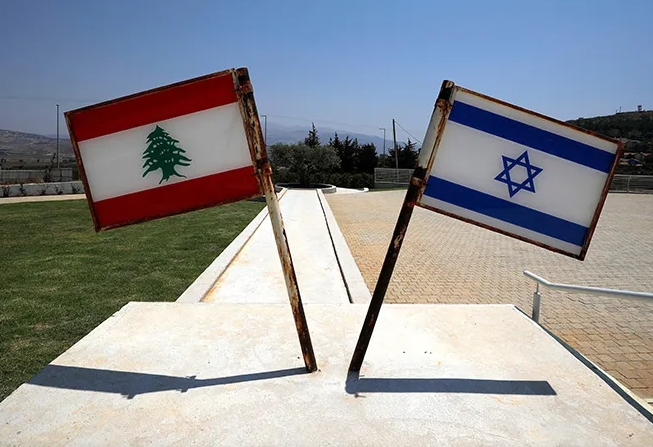
The latest ceasefire along the Israel–Lebanon border has once again brought a pause in fighting, but not a resolution. Diplomacy has returned to a familiar framework shaped by United Nations Security Council Resolution 1701. The core issue remains unchanged: how to reconcile Israel’s security demands with Lebanon’s insistence on sovereignty.
Israel’s position is driven by long-standing security concerns. Its leadership has made clear that a temporary ceasefire is not enough and that a longer-term agreement is needed to prevent repeated escalation. That objective is broadly understandable. However, the measures proposed to achieve it remain highly contentious.
The proposal to maintain a security buffer zone inside Lebanese territory is central to Israel’s approach. From Israel’s perspective, this would create distance between its northern border and potential threats. From Lebanon’s perspective, it is a direct violation of sovereignty and risks creating a prolonged situation of partial occupation. The same concern applies to the idea of keeping Israeli troops inside Lebanon, even on a temporary basis. In practical terms, this is seen not as stabilisation but as continued military presence on sovereign territory.
Israel’s demand for the complete disarmament of Hezbollah is consistent with the language of Resolution 1701, but its implementation is far more complicated. Hezbollah’s military strength did not emerge in isolation. Its armament is closely tied to a history of Israeli military actions in Lebanon and the wider region, including invasions, occupations and cross-border operations. This pattern has played a central role in shaping both the group’s rise and its continued justification for maintaining its arsenal. In that sense, Israeli military pressure is widely viewed as the primary driver behind Hezbollah’s armed posture. As a result, any attempt to address disarmament without addressing these underlying conditions is unlikely to succeed in practice.
Another major point of contention is Israel’s expectation of retaining the freedom to strike if Hezbollah re-arms. In its current form, this provision risks extending the conflict by allowing unilateral military action based on evolving assessments of threat. Without clearly defined limits, it makes Lebanese sovereignty conditional and open to interpretation. For such a condition to be part of a workable arrangement, it would need to be tied to a full Israeli withdrawal from Lebanese territory and credible assurances that future military action would not undermine Lebanon’s sovereignty.
The Lebanese government’s position is more direct. Its primary demand is full Israeli withdrawal from Lebanese territory, which it considers essential for restoring sovereignty. This aligns with international law and with the original intent of Resolution 1701. Lebanese officials have also stressed the need to maintain the sequence of ceasefire first, followed by negotiations, a process that has largely been established in the current phase.
Lebanon continues to call for the implementation of international law through a strengthened version of the 1701 framework. At the same time, there is recognition that the earlier model had clear limitations. It called for the disarmament of non-state actors but lacked effective enforcement mechanisms. It also did not fully account for the conditions that allowed groups like Hezbollah to retain their role.
Within Lebanon, the approach to Hezbollah reflects these constraints. The government has signalled that it prefers gradual stabilisation over direct confrontation. Officials argue that any sudden move to disarm the group without addressing the underlying driver of insecurity, particularly Israeli military pressure, could lead to internal instability. A phased approach is seen as more realistic, especially if supported by external guarantees.
Bridging the gap between these positions remains difficult. Israel is unlikely to scale back its security posture without clear guarantees. Lebanon is unlikely to accept any arrangement that compromises its sovereignty. Hezbollah, while not formally part of the negotiations, remains central to the outcome.
Diplomatic discussions have increasingly focused on sequencing. One option under consideration is a verifiable Israeli withdrawal combined with stronger international monitoring, potentially through an expanded role for the United Nations Interim Force in Lebanon. This could be followed by gradual steps to reduce tensions on both sides, including measures to prevent cross-border attacks and limit the presence of armed groups in sensitive areas.
Any revised framework would need stronger enforcement mechanisms than those provided under Resolution 1701, along with clearer timelines and reciprocal commitments. Disarmament, if it is to be addressed, would likely depend on credible assurances that Lebanon will not face renewed Israeli military action. At the same time, Israel would expect verifiable guarantees that its northern border will not be used for attacks.
The current ceasefire provides an opening, but the underlying issues remain unresolved. The central challenge is not simply negotiating terms, but addressing the conditions that sustain the conflict. Without that, any agreement risks becoming another temporary pause rather than a lasting solution.
Israeli aggression in the region is the primary cause of Hezbollah’s armament.