

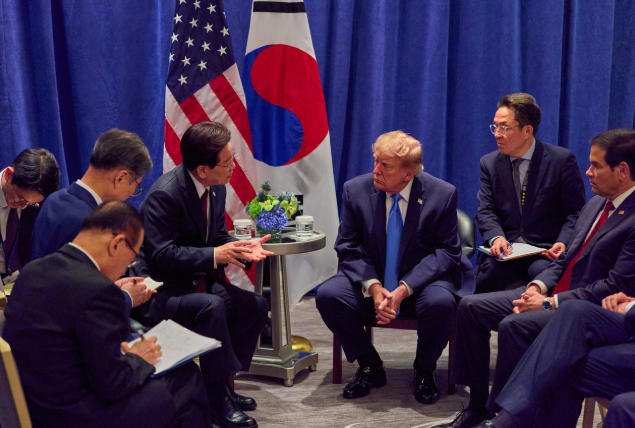
South Korea’s effort to reclaim wartime operational control from the United States has brought a longstanding question of national sovereignty into sharper focus at a time of intensifying strategic competition in East Asia. Seoul wants to establish 2028 as the target year for the transfer, but Washington remains reluctant to commit to a fixed deadline, insisting that military readiness and the evolving threat from North Korea must determine the timing. The disagreement extends beyond the technical requirements of a military handover. South Korea’s strategic importance to the United States, the growing challenge posed by China and the possibility of a wider regional conflict have made wartime command a question of military authority and geopolitical influence. The central issue is whether the two allies can reconcile Seoul’s demand for greater sovereign control with Washington’s determination to preserve a command structure it considers essential to regional security.
Wartime operational control, commonly known as OPCON, has remained under an American led framework since the outbreak of the Korean War in 1950. Under the current arrangement, designated South Korean military units would be assigned to the Combined Forces Command in the event of war, with the joint headquarters led by a US general. The exact composition of the forces involved remains classified, but the arrangement is understood to cover frontline army units and substantial elements of the air force and navy. It reflects the circumstances in which South Korea depended heavily on American military power to defend itself against the North Korean invasion. More than seven decades later, South Korea has developed into a major economic and technological power with modern armed forces and a substantial defence industry. Its demand to assume wartime command therefore reflects a broader expectation that its military authority should evolve alongside its national capabilities.
For Seoul, the transfer is a matter of sovereignty as well as military responsibility. President Lee Jae Myung has argued that South Korea must reclaim wartime operational control at an early date, maintaining that the country is fully capable of doing so. His position reflects the view that a state responsible for defending its territory should ultimately exercise command over its own forces during war. The existing arrangement does not mean that South Korea lacks control over its military in peacetime, nor would a transfer necessarily require American forces to leave the peninsula. Rather, it concerns who would lead the combined force if hostilities broke out and how the two allies would coordinate their military capabilities under the pressure of conflict.
Washington’s position rests on a different calculation. American military officials argue that the transfer must be conditions based rather than determined by a political timetable. The allies must be confident that South Korea can lead combined operations, that the necessary military capabilities are in place and that the command structure can respond effectively to North Korea’s evolving threats. General Xavier Brunson, who commands US Forces Korea and the Combined Forces Command, has stressed that the security environment has changed and that the allies must establish the necessary standards, capabilities and mission readiness before proceeding. North Korea’s recent missile launches and continuing military provocations have reinforced the American argument that the risks of a premature transition cannot be dismissed.
The difficulty is that Seoul and Washington appear to differ over how the conditions for the transfer should be applied. South Korea’s defence ministry has warned that changing or adding requirements could effectively move the goalposts and delay the handover indefinitely. From Seoul’s perspective, a process that remains dependent on shifting assessments cannot provide a credible path towards recovering wartime command. Washington, however, maintains that its responsibility is to ensure that the combined force can defend South Korea effectively, regardless of the political importance attached to a particular year. The disagreement exposes the tension inherent in a conditions based arrangement when the allies do not share the same assessment of military readiness or of the threats against which readiness must be measured.
China adds a wider strategic dimension to this dispute. South Korea occupies a critical position in Northeast Asia, close to Chinese territory and within a region where military competition increasingly shapes the calculations of Washington and Beijing. The United States does not regard its presence on the Korean Peninsula solely as a means of deterring North Korea. Its forces, military infrastructure and alliance relationships also contribute to its wider Indo Pacific posture. A change in the command structure could therefore have implications for how Washington coordinates its military planning with Seoul, particularly if a future crisis extends beyond the peninsula.
The concern is not necessarily that a South Korean led command would end the alliance or automatically remove American influence. Rather, Washington could worry that greater South Korean authority might reduce its ability to shape military decisions during a wider regional confrontation. Seoul, for its part, has reason to ensure that its forces are not drawn into circumstances that could expose the country to risks beyond its immediate security interests without an effective role in determining the response. The two countries may share a commitment to deterring North Korea while holding different views about how far their military cooperation should extend in a confrontation involving China. Wartime operational control consequently sits at the intersection of national sovereignty and the broader strategic objectives of the alliance.
The proximity of China to the Korean Peninsula reinforces the importance of these calculations. Chinese territory lies close enough for developments across the Yellow Sea and the surrounding region to have immediate military significance for South Korea. In a wider confrontation, the United States would seek to preserve its operational flexibility, while Seoul would have to consider the consequences of becoming directly involved in a conflict with a neighbouring major power. Such a scenario would create difficult choices for South Korean leaders, balancing the alliance with Washington against the risks of escalation and the country’s own national interests. The dispute over OPCON is therefore not simply about who commands the forces assigned to defend South Korea. It also concerns how the alliance would function if the two countries faced pressure to respond to a crisis whose implications extended beyond the Korean Peninsula.
North Korea remains the immediate security concern and the central justification for the current command framework. Its missile launches and other provocations demonstrate why the allies place such emphasis on operational readiness and coordination. A conflict would require rapid decisions, close cooperation between military services and effective coordination of American and South Korean forces. Washington argues that the transition must not weaken these capabilities. Seoul, meanwhile, maintains that it can assume command while continuing to rely on American support. The real test is whether a South Korean commander can lead the combined force effectively while preserving the integration and mutual confidence on which the alliance depends.
The debate has also exposed questions about the reliability of American support during a future conflict. South Korea’s defence minister, Kang Shin chul, recently referred to the possibility that Seoul might not necessarily be able to rely on Washington in every circumstance while discussing the transfer of command. His remarks were subsequently clarified by the defence ministry after they were interpreted as questioning American military capabilities and commitment. The episode nevertheless reflects the sensitivity surrounding the alliance at a time when the United States is engaged in other international security challenges.
The comparison with the US and Israel war against Iran has prompted questions in South Korea about how Washington would assess the costs of intervention if another major conflict erupted. However, the circumstances of a war on the Korean Peninsula would be distinct. Such a conflict could involve not only the United States and Japan but also China and Russia, increasing the possibility of a wider confrontation. The concern expressed in Seoul is not proof that Washington would abandon its ally, but it illustrates why South Korea wants a greater role in decisions affecting its own defence. An alliance can provide substantial military strength, yet questions about the timing, scale and political conditions of support remain relevant to the security calculations of every partner.
Within South Korea, the issue has become a point of political disagreement. During a parliamentary audit of the defence ministry, members of the conservative opposition People Power Party warned that the transfer could put national security at risk and urged caution. Defence Minister Kang rejected the suggestion that the handover would necessarily endanger the country, arguing that it should proceed when the conditions ensure mutual trust and effective cooperation, with a South Korean general commanding the combined force and the United States providing support. The exchange illustrates the competing concerns within Seoul. One side emphasises the risks of changing a command structure that has underpinned the alliance for decades. The other argues that the transfer should be judged by South Korea’s capabilities and the conditions agreed by both governments, rather than by an assumption that American leadership must remain indispensable.
Pressure for a firmer approach has also emerged within the ruling Democratic Party. Kim Byung joo, a lawmaker who advises the president on defence policy, has argued that South Korea should declare its intention to exercise wartime operational control independently if Washington continues to block progress. He has also called for legislation clarifying that the president’s authority as commander in chief should apply fully during both peacetime and wartime. Kang has rejected this approach, insisting that the transfer should be achieved through close consultations between the two allies and with mutual trust assured. His position reflects the government’s attempt to advance the sovereignty objective without turning the process into a unilateral confrontation with Washington.
The next round of bilateral defence consultations will therefore be important in determining whether the disagreement can be resolved. Seoul has been pressing for a target year and has indicated that the annual Security Consultative Meeting, which brings together the two countries’ defence chiefs, could provide an opportunity to announce progress. The meeting is usually held in November, although reports suggest that this year’s session may be postponed. The immediate challenge is to establish a credible timetable while resolving differences over military readiness. A transfer date without sufficient preparation could undermine confidence in the command structure, but a process without a clear endpoint risks frustrating South Korea’s demand for greater sovereign authority.
Ultimately, the OPCON dispute is a test of how the United States and South Korea understand their alliance in a changing strategic environment. Washington wants to preserve a military partnership capable of deterring North Korea and supporting its wider regional position. Seoul wants to ensure that its growing military capabilities are matched by the authority to direct its own forces in wartime. These objectives do not have to conflict, but reconciling them requires more than assurances of mutual trust. It requires agreement on the conditions for transfer, clarity about the remaining military requirements and a timetable that both governments regard as credible.
The central question is whether Washington can accept a South Korean led command without fearing a loss of strategic influence, and whether Seoul can reclaim wartime control while preserving the military integration on which its security continues to depend. An indefinite delay would deepen doubts in South Korea about the purpose of the existing arrangement, while a transfer driven primarily by political pressure could create avoidable military risks. The sustainable path lies in completing the agreed assessments and resolving the outstanding differences through bilateral consultation. The future strength of the alliance will depend not on the permanent retention of command by one country, but on whether both allies can defend the Korean Peninsula effectively while recognising South Korea’s legitimate claim to greater authority over its own wartime decisions.