

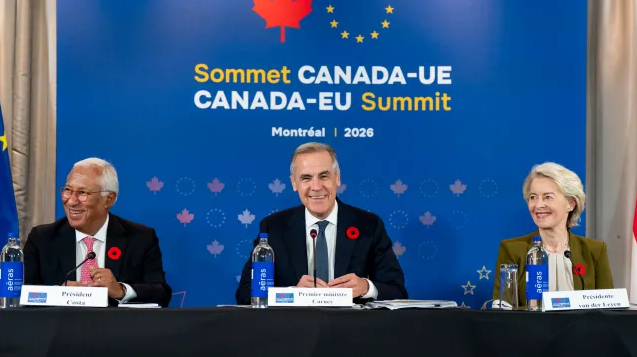
Canada’s proposed closer association with the European Union reflects a strategic calculation that extends far beyond trade. As Prime Minister Mark Carney seeks to reduce his country’s economic vulnerability to the United States, Ottawa is attempting to build stronger relationships with other major markets while preserving the commercial ties on which its economy remains heavily dependent. For the European Union, the initiative offers an opportunity to deepen cooperation with a resource rich, technologically advanced partner at a time when economic security, defence capabilities and access to critical technologies have become central to international competition. The proposed relationship could therefore mark an important development in transatlantic relations, although its eventual significance will depend on the substance of the commitments both sides are prepared to undertake.
At the Canada EU summit in Montréal on 29 and 30 October, Carney, European Commission President Ursula von der Leyen and European Council President António Costa launched the Alliance for the Future. The initiative aims to establish a closer economic and security relationship spanning trade, digital infrastructure, artificial intelligence, critical minerals, energy, defence, research and people to people exchanges. Carney said he expected to conclude negotiations in June on what he described as the EU’s first associate membership for a non member country. However, the joint declaration adopted by the leaders took a more measured approach. Rather than endorsing that designation, they agreed to define the concept of an ever closer association by their 2027 summit. This distinction is central to understanding the initiative. The political ambition is clear, while the institutional framework remains subject to negotiation.
The term associate membership has no established legal meaning within the EU’s existing framework, and its omission from the declaration reflects differences over how far the relationship should extend and what it should be called. Canada is pursuing a special form of association that would provide closer economic, technological and security cooperation without following the conventional path of EU accession. The challenge lies in determining whether such an arrangement can offer meaningful access to European markets, research programmes and security initiatives while maintaining obligations that member states consider acceptable. Any eventual agreement will need to define the rights and responsibilities involved, the limits of participation in European institutions and the mechanisms for resolving disagreements. Institutional clarity will be essential to ensure that the proposed designation corresponds with the actual benefits and commitments.
The timetable also requires careful interpretation. Carney intends to advance negotiations through meetings between Canadian ministers and European commissioners in March before pursuing an agreement in June. However, a target for concluding negotiations represents a political objective rather than a guarantee that every element will be settled within that period. The joint declaration sets 2027 as the deadline for defining the concept of an ever closer association, leaving room for a distinction between reaching political agreement on particular arrangements and establishing a comprehensive framework for the relationship. The coming months will demonstrate whether both sides can translate their shared strategic objectives into terms acceptable to their respective political institutions.
The economic logic behind the initiative is substantial. Canada and the EU already maintain a major trading relationship under the Comprehensive Economic and Trade Agreement, known as CETA. Provisionally applied since 2017, the agreement has removed many barriers to bilateral commerce, although ratification remains incomplete in some EU member states. The Alliance for the Future therefore builds upon an existing economic foundation and seeks to extend cooperation into areas where traditional trade arrangements alone offer limited protection against emerging vulnerabilities. Digital services, critical supply chains, advanced computing and strategic infrastructure have increasingly become essential components of economic resilience, making deeper cooperation a logical extension of the existing partnership.
The conclusion of substantive negotiations on a digital trade agreement represents one of the summit’s most tangible developments. The proposed agreement is intended to establish clearer rules for cross border data flows, electronic transactions and digital commerce, providing businesses with greater predictability when operating across the Atlantic. Its potential importance extends well beyond companies selling goods online. Modern businesses increasingly depend on digital services, cloud infrastructure and the movement of information across national boundaries. More compatible regulatory arrangements could reduce administrative barriers and make it easier for smaller firms to reach international customers. With negotiations concluded, the agreement will now require formal signature and approval procedures before it can enter into force.
The competition agreement negotiated alongside the digital trade arrangement serves a related purpose. Greater coordination between Canadian and European competition authorities could help address anticompetitive conduct that crosses national boundaries, particularly in markets where a small number of companies exercise substantial influence. The objective is to strengthen enforcement and support fairer conditions for businesses and consumers while retaining the independent legal systems of both jurisdictions. This cooperation will become increasingly relevant as digital platforms, financial services and technology companies expand their operations across multiple markets. Its effectiveness will ultimately depend on the ability of authorities to coordinate investigations and enforcement while preserving their respective legal responsibilities.
Critical minerals provide an even more direct explanation for the strategic partnership. Canada possesses significant natural resources that are essential to electric vehicles, advanced manufacturing, energy systems and defence industries. Europe, meanwhile, brings industrial expertise, investment capacity and a large market for technologies that depend on reliable mineral supplies. Canada and the European Investment Bank have concluded negotiations on an arrangement intended to facilitate European investment in Canadian critical resources, particularly critical raw materials. The wider initiative also envisages cooperation across extraction, processing, refining, manufacturing and recycling.
The strategic objective is to connect resource availability with industrial capacity. Possessing mineral deposits alone cannot create a secure supply chain. Extraction projects require substantial investment, while processing facilities, transport networks and refining capacity determine whether raw materials can be converted into valuable industrial inputs. If Canada succeeds in attracting investment across more stages of this value chain, it could generate greater economic returns while helping European industries diversify their sources of supply. For Europe, the partnership could reduce exposure to concentrated production and processing networks. However, diversification will require commercially viable projects, sustained investment, environmental safeguards and the capacity to deliver materials at competitive prices.
Energy cooperation follows a similar strategic logic. The summit declaration provides for a joint long term feasibility study on Canadian liquefied natural gas exports to Europe. This represents an exploratory commitment that will require further assessment before any export arrangement or new supply route can materialise. Infrastructure availability, transportation costs, market demand, financing and long term purchasing commitments will determine the commercial viability of potential projects. Canada could gain another market for its energy resources, while Europe could widen its options for securing supplies. Both sides have also committed to pursuing energy cooperation in accordance with their respective climate objectives. The practical challenge will be to reconcile energy security, commercial viability and decarbonisation through a sustainable approach.
The planned assessment of new undersea cables connecting Canada, Europe and Asia introduces another important dimension to the relationship. Digital sovereignty increasingly depends on the infrastructure carrying information across national boundaries. Undersea cables support international communications, financial transactions, cloud services and the operation of critical digital systems. Additional routes and landing points could improve resilience and reduce dependence on a limited number of existing connections. The summit declaration commits the partners to assessing potential routes, points of interconnection and industry participation, with security and repair readiness included in the planning. The announcement establishes a framework for evaluating infrastructure that could become increasingly important to their economic and security relationship.
Artificial intelligence and supercomputing offer another opportunity to deepen cooperation. Canada’s participation in the European High Performance Computing Joint Undertaking is intended to strengthen connections between Canadian and European computing resources and support closer integration of their research and artificial intelligence ecosystems. Access to advanced computing can improve scientific research and support developments in medicine, climate modelling, engineering and industrial design. It can also contribute to capabilities relevant to defence, cybersecurity and critical infrastructure. The broader initiative includes cooperation on semiconductors, quantum technologies, AI safety and governance, alongside possible participation in future European research programmes, including Horizon Europe. These measures could enable both sides to share expensive technological capabilities and expertise while strengthening their respective research ecosystems.
The significance of these arrangements lies in the relationship between technological capacity and national independence. A country may retain formal sovereignty while remaining heavily dependent on foreign providers for computing, communications, industrial components and essential digital services. Such dependence can restrict policy choices during a crisis or expose critical systems to external pressure. Canada and Europe are attempting to widen their strategic options by connecting research institutions, businesses and technological infrastructure. Although complete technological independence remains an ambitious objective, additional capabilities and alternative partnerships could strengthen their resilience and reduce their exposure to external disruptions.
Security cooperation is also expanding. Canada has already joined the EU’s Security Action for Europe initiative, creating opportunities for closer defence industrial cooperation. The Montréal summit added a working arrangement between Canadian border authorities and Frontex, the EU’s border and coast guard agency, while launching dedicated dialogues on the Arctic, foreign information manipulation and interference, climate security and transport. These initiatives establish mechanisms for practical cooperation on shared challenges while preserving the separate institutional responsibilities of both sides. Their purpose is to improve coordination, strengthen security capabilities and develop a more structured approach to emerging threats.
The Arctic gives this relationship particular strategic importance. Canada has direct responsibilities and substantial interests in the region, while European governments have growing concerns about its security, infrastructure and changing maritime environment. Cooperation on communications, transport, surveillance and the protection of critical infrastructure could connect Canadian regional expertise with European technological and industrial capabilities. Nevertheless, the launch of a dedicated dialogue represents an initial institutional step rather than a comprehensive common Arctic strategy. Different national priorities and the practical requirements of operating in the region will require sustained attention. The value of the initiative will depend on whether it produces operational capabilities and lasting coordination rather than remaining a diplomatic commitment.
The partnership also extends to education, professional mobility and financial services. Canada and the EU intend to begin negotiations towards deeper Canadian participation in Erasmus+, while exploring greater cooperation on skills, research mobility and opportunities for young people to study and work across the Atlantic. They will also examine links between their instant payment systems and further cooperation in financial markets. These measures may appear less consequential than critical minerals or defence, but they could strengthen the long term foundations of the relationship by connecting universities, businesses, financial institutions and professional communities. Their eventual benefits will depend on the scope of the agreements and the extent to which they reduce practical barriers to participation.
The immediate geopolitical pressure behind Carney’s initiative is the concentration of Canadian exports in the United States. According to the figures cited in the summit coverage, the United States accounted for 71.7 per cent of Canada’s merchandise exports in 2025. Such dependence creates a structural vulnerability because changes in American trade policy can affect Canadian producers, employment and investment across numerous sectors. Carney’s ambition to double exports to markets outside the United States over the next decade is therefore an effort to broaden Canada’s economic choices. A wider customer base would preserve the importance of the American market while reducing the consequences of disruption in any single trading relationship.
US President Donald Trump’s reported warning that the proposed arrangement could be considered a hostile act underscores the political sensitivity of this strategy. If closer Canada EU cooperation becomes entangled in disputes over tariffs and alliance loyalty, Ottawa could face additional pressure precisely when it is attempting to reduce its exposure to external decisions. Yet diversification should be understood as an expansion of economic choices rather than a separation from the United States. The geography, scale and integration of North American production make a rapid replacement of the American market unrealistic. Canada’s more practical objective is to develop alternative markets over time, allowing its businesses and government greater flexibility while preserving existing commercial relationships. The real test will be whether these new markets generate sustained commercial growth and meaningful economic opportunities.
Europe’s interests are substantial, although they follow a somewhat different strategic calculation. European governments want more secure access to critical materials, stronger defence industries, improved technological capacity and more resilient supply chains. Canada offers natural resources, research capabilities and a close political relationship. A deeper association could therefore strengthen European economic security while demonstrating the EU’s ability to develop differentiated partnerships with countries outside its membership. At the same time, European governments must protect the integrity of their existing institutions and ensure that any new arrangement has clearly defined limits. The disagreement over the term associate membership demonstrates that political support for closer cooperation does not automatically translate into consensus over its legal and institutional form.
The proposed arrangement could also establish a precedent for future relations between the EU and other non member countries. A flexible model might allow the bloc to deepen cooperation with partners that share particular economic or security interests without extending full membership. However, special privileges for Canada could raise questions about equal treatment, the obligations attached to participation and the expectations of other international partners. European institutions will need to distinguish between a tailored strategic association and a new category that implies access or influence beyond what member states intend to grant. The terminology will ultimately matter less than the institutional substance and political sustainability of the arrangement.
Canada faces its own strategic choices. Carney has presented the initiative as a means of strengthening sovereignty, yet closer integration can also require regulatory alignment, common standards and obligations that narrow certain policy options. This reflects an important dimension of contemporary sovereignty. National independence depends on more than freedom from international commitments. It also requires sufficient economic, technological and institutional capacity to make meaningful choices. The relevant consideration is whether the benefits of wider market access, research cooperation and security coordination outweigh the commitments involved, and whether those commitments remain transparent and accountable to the Canadian public.
The coming negotiations will determine whether the Alliance for the Future develops into a durable institutional framework or remains an ambitious political declaration. The March meetings and Carney’s June target provide immediate milestones, while the 2027 summit is intended to define the concept of an ever closer association. Meanwhile, the digital trade and competition agreements must complete the relevant formal procedures, while proposed energy and undersea cable projects require further assessment. The real measure of progress will be implementation, investment and demonstrable economic and strategic benefits rather than the number of announcements made at the summit.
Canada’s proposed association with the European Union ultimately reflects a broader transformation in how countries approach economic security. Trade, technology, energy and defence have become increasingly interconnected, as disruptions in one sector can produce consequences across several others. By linking these areas, Canada and Europe are seeking to expand their strategic options in a world where economic interdependence can generate both prosperity and vulnerability. Their initiative offers a framework for reducing exposure to external pressure, strengthening technological capabilities and developing alternative economic partnerships. Its success, however, will depend on the ability of both sides to convert political alignment into practical arrangements.
The decisive issue is whether the eventual agreement can deliver meaningful cooperation while maintaining institutional clarity and realistic expectations. Canada can build a closer relationship with Europe while retaining its distinct national identity and political sovereignty, just as the EU can establish deeper strategic partnerships without extending full membership to every country with which it shares common interests. What both sides require is an arrangement that translates political alignment into reliable economic access, technological capability and practical security cooperation. The Montréal summit has established the direction of this strategic undertaking. The negotiations ahead will determine whether that ambition develops into a workable model of international association or remains an expression of shared intentions during a period of growing transatlantic uncertainty.