

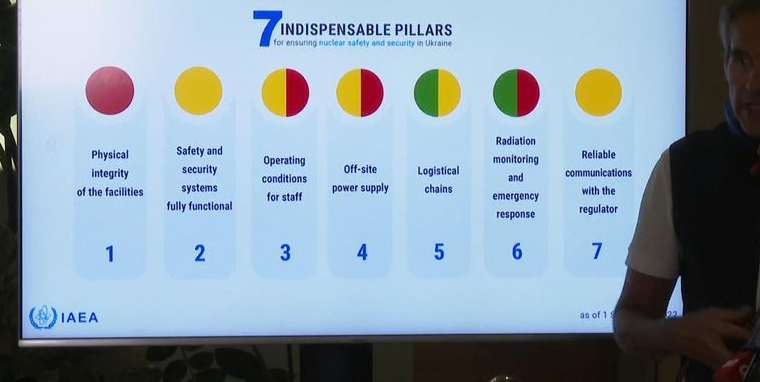
The safe operation of nuclear facilities depends on a set of fundamental principles that must be upheld at all times, regardless of political tensions, military conflicts or natural disasters. Recognising the unique risks posed to nuclear installations in crisis situations, the International Atomic Energy Agency (IAEA) outlined seven indispensable pillars of nuclear safety and security. These pillars serve as a practical framework for preventing nuclear accidents, protecting human life and the environment, and ensuring that nuclear facilities remain under safe and secure control. Together, they represent the minimum conditions required to maintain nuclear safety and security in any circumstance.
The Seven Pillars
- Physical integrity of nuclear facilities must be maintained
- Reactors, spent fuel pools, and radioactive waste storage facilities must not be damaged.
- Safety and security systems must remain fully functional
- All systems designed to prevent accidents or protect nuclear materials must operate continuously.
- Operating staff must be able to perform their duties without undue pressure
- Personnel must be able to make safety related decisions independently and safely.
- Secure off site power supply must be available
- Nuclear plants require reliable external electricity to run cooling systems and other critical equipment.
- Uninterrupted logistical supply chains and transportation
- Fuel, spare parts, equipment, and personnel must be able to reach and leave the site.
- Effective radiation monitoring and emergency preparedness
- Both on site and off site radiation monitoring systems must function, and emergency response plans must remain operational.
- Reliable communications with regulators and relevant authorities
- Plant operators must maintain continuous communication with national regulators, emergency services, and the IAEA when necessary.
The IAEA’s seven indispensable pillars are more than technical guidelines; they are essential safeguards against potentially catastrophic consequences. A failure in any one pillar can increase risks not only for the country concerned but also for neighbouring states and the wider international community. As nuclear facilities continue to operate in an increasingly complex security environment, adherence to these pillars remains critical for preventing accidents, maintaining public confidence and preserving international nuclear safety standards. Their importance is particularly evident during armed conflicts, where even a temporary disruption can have far-reaching humanitarian, environmental and geopolitical consequences.