

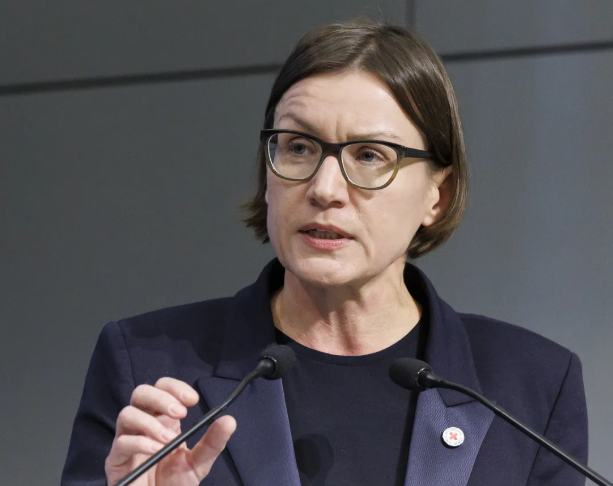
Mirjana Spoljaric Egger is a Swiss-Croatian diplomat whose career has taken her from Switzerland’s foreign service to senior positions within the United Nations and, ultimately, the presidency of the International Committee of the Red Cross (ICRC). Her professional journey has been shaped by multilateral diplomacy, international cooperation and humanitarian engagement. Since assuming the ICRC presidency in October 2022, she has represented an organisation working across some of the world’s most difficult conflict zones, advocating for the protection of civilians and respect for international humanitarian law.
Spoljaric studied philosophy, economics and international law at the University of Basel and the University of Geneva, completing a master’s degree. Her academic background brought together political, economic and legal perspectives that would later inform her work in international institutions. Between 2004 and 2006, she also served as a part-time lecturer in global governance at the University of Lucerne, giving her an additional academic connection to the study of international affairs.
She began her professional career in Switzerland’s public administration, working as a desk officer for international financial institutions at the State Secretariat for Economic Affairs. She subsequently joined the Swiss diplomatic service, including an assignment at the Swiss Embassy in Cairo, Egypt. These early responsibilities exposed her to international economic cooperation and the practical demands of diplomatic engagement. She later held several positions within the Swiss Federal Department of Foreign Affairs in Bern and served as counsellor and head of the political team at Switzerland’s Permanent Mission to the United Nations in New York. Her work increasingly centred on multilateral diplomacy and the coordination of Switzerland’s positions within international organisations.
Between 2010 and 2012, Spoljaric was seconded to the Office of the Commissioner-General of the United Nations Relief and Works Agency for Palestine Refugees in the Near East (UNRWA). Serving as a senior adviser, she worked on organisational development, management reforms and external relations. The assignment gave her direct exposure to an institution addressing the needs of Palestinian refugees across several parts of West Asia. It also added a humanitarian dimension to her earlier diplomatic and economic experience.
Her responsibilities within Switzerland’s foreign affairs establishment expanded further in the following years. She served as deputy head and subsequently head of the division responsible for the United Nations and other international organisations. In 2015, she became head of the division, representing Switzerland in multilateral processes and helping shape its policies and priorities across major United Nations bodies and international conferences. Her portfolio also included International Geneva and Switzerland’s role as a host country for international institutions. The position placed her at the centre of Switzerland’s engagement with the wider multilateral system.
In August 2018, United Nations Secretary-General António Guterres appointed Spoljaric as Assistant Secretary-General, Assistant Administrator of the United Nations Development Programme (UNDP) and Director of its Regional Bureau for Europe and the Commonwealth of Independent States. She formally began the regional director role in October that year. In this capacity, she led UNDP’s work across 17 countries and one territory, covering areas that included Central Asia, the Western Commonwealth of Independent States, the South Caucasus and the Western Balkans. Her responsibilities involved advancing the Sustainable Development Goals, supporting institutional development and addressing regional economic and governance challenges. The appointment marked a transition from representing the interests of a single country to overseeing development programmes across a broad international region.
Her experience in the United Nations system and Swiss diplomacy subsequently brought her to the forefront of international humanitarian leadership. On 25 November 2021, the International Committee of the Red Cross announced her election as its next president. The appointment was significant because she became the first woman elected to lead the organisation. She succeeded Peter Maurer and formally assumed the presidency on 1 October 2022, beginning a renewable four-year term.
As ICRC president, Spoljaric leads the organisation’s external relations and represents its humanitarian mission before governments, parties to armed conflicts and other international decision-makers. She also chairs the ICRC Assembly and Assembly Council, overseeing institutional strategy, governance and financial direction. Her responsibilities extend beyond public advocacy to ensuring that the organisation maintains the operational capacity and independence necessary to carry out its humanitarian mandate. The ICRC works to protect people affected by armed conflict and other situations of violence, facilitate humanitarian assistance and promote compliance with the Geneva Conventions.
One of the central priorities of her presidency has been strengthening respect for international humanitarian law. The rules governing armed conflict are intended to protect civilians, prisoners and wounded combatants while placing limits on the methods and means of warfare. However, continued violations in conflicts around the world have raised concerns about the effectiveness of existing commitments. Spoljaric has sought to make respect for these rules a more prominent political priority, arguing that humanitarian action cannot substitute for the responsibility of states and parties to conflict to comply with international law.
In September 2024, she launched the Global Initiative to Galvanize Political Commitment to International Humanitarian Law alongside Brazil, China, France, Jordan, Kazakhstan and South Africa. The initiative seeks to translate broad commitments to the Geneva Conventions into practical measures that improve compliance with the rules of war. It brings governments together to address issues such as civilian protection, the safeguarding of medical facilities and humanitarian access. The initiative became a defining element of her presidency, providing a diplomatic platform through which the ICRC could engage states on the implementation of humanitarian law rather than limiting its role to responding to violations after they occur.
Her leadership has also coincided with major humanitarian emergencies in Gaza, Ukraine, Sudan and other conflict-affected regions. During the Israel-Hamas war, the ICRC played a role in facilitating the release and transfer of hostages and detainees, as well as the return of human remains under negotiated arrangements. Spoljaric engaged directly with political leaders and parties involved in the conflict, including meetings with Israeli Prime Minister Benjamin Netanyahu and then-Hamas leader Ismail Haniyeh. The organisation’s work also involved efforts to facilitate humanitarian assistance and protect civilians. Its inability to visit hostages held in Gaza became a point of criticism, illustrating the limits of humanitarian organisations when parties to a conflict do not grant the necessary access.
The war in Ukraine has presented another major challenge for the ICRC. The organisation has worked to assist civilians affected by hostilities, support families separated by the conflict and address humanitarian concerns involving prisoners of war. Spoljaric’s diplomatic responsibilities have required engagement with the parties and other governments to preserve access for humanitarian operations. Such work has taken place amid competing political positions and repeated difficulties in securing agreement on humanitarian arrangements.
Beyond individual conflicts, she has sought to address the institutional challenges facing the ICRC. During her first term, she introduced changes to the organisation’s financial management and advanced a revised institutional strategy focused on areas where the ICRC has a distinctive capacity to deliver assistance and protection. These efforts have taken place at a time of growing humanitarian needs and financial pressure on international aid organisations. Her role has therefore involved balancing the ICRC’s global responsibilities with the resources required to sustain its operations.
In 2026, Spoljaric continued to place international humanitarian law at the centre of her diplomatic agenda. On 21 September, she addressed a high-level event during the 81st session of the United Nations General Assembly, emphasising that the responsibility to protect civilians rests with those who exercise political power. The ICRC’s global initiative also moved towards developing practical recommendations. On 3 November, the organisation reported that more than 160 states had developed practical steps to uphold humanity in war through the initiative.
Her work during November 2026 has also extended to the humanitarian implications of emerging military technologies. On 13 November, she called on states to ensure that the future of warfare is not handed over to machines, highlighting the need for international action on autonomous weapons systems. The issue reflects a wider concern that technological developments in warfare could outpace the rules and safeguards designed to protect human life. Her intervention placed the ICRC within an increasingly important international debate over the legal and humanitarian consequences of artificial intelligence and autonomous military systems.
Spoljaric’s career has thus moved through three interconnected areas of international engagement. Her years in Swiss diplomacy established her experience in negotiations and multilateral institutions. Her work at the United Nations expanded that experience into regional development and international policy. At the ICRC, she has taken on the responsibility of representing a humanitarian organisation whose mandate requires engagement with governments and armed actors while maintaining neutrality, independence and impartiality.
As president of the ICRC, Mirjana Spoljaric Egger occupies a position in which diplomacy and humanitarian responsibility meet. Her leadership has focused on strengthening the political commitment to international humanitarian law, maintaining the organisation’s ability to operate in conflict zones and addressing the humanitarian consequences of both conventional and emerging forms of warfare. Her presidency continues to unfold against a backdrop of prolonged conflicts and growing pressure on the international rules intended to preserve humanity during war.
Mirjana Spoljaric Egger`s Quote
“Every minute without a ceasefire agreement costs lives.”
30 August 2025, Statement on the proposed mass evacuation of Gaza City