
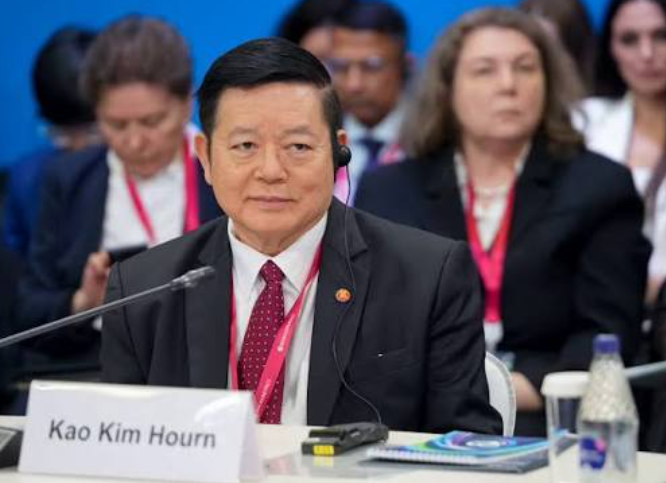
Dr. Kao Kim Hourn is a Cambodian scholar, diplomat and regional institutional leader who has spent much of his professional life advancing Cambodia’s international relations and strengthening the role of the Association of Southeast Asian Nations (ASEAN). His career has moved through academic research, government service, foreign policy and regional diplomacy. As the 15th Secretary-General of ASEAN, he has assumed responsibility for guiding the organisation through a period marked by geopolitical competition, economic uncertainty, regional security challenges and the expansion of its membership.
Born in 1966 in Koh Sotin District of Kampong Cham Province, Cambodia, Kao grew up during a turbulent period in the country’s history. His childhood was profoundly affected by the Khmer Rouge regime, which took power in 1975. His family experienced displacement, insecurity and the loss of relatives during the period of violence. After the fall of the Khmer Rouge, they spent several years in a refugee camp near the Thai border before eventually relocating to the United States in 1981. These experiences formed an important part of his early life and preceded his eventual involvement in Cambodia’s post-conflict reconstruction and international engagement.
He completed his secondary education at Herndon High School in Virginia in 1985 before pursuing higher studies in the United States. He earned a Bachelor of Arts in Asian Studies from Baylor University in 1989. He subsequently obtained two master’s degrees from Ohio University in 1991, one in International Affairs and another in Political Science. He completed his PhD in Political Science at the University of Hawaii at Manoa in May 2001. His academic training developed his interest in Southeast Asian politics, international relations and the regional institutions that shape cooperation among countries.
After returning to Cambodia in January 1993, Kao began working in research and policy development, focusing particularly on ASEAN and international affairs. He joined the Cambodian Institute for Cooperation and Peace, a think tank dedicated to regional cooperation, foreign policy and Cambodia’s position in international affairs. He worked there during the 1990s and became involved in discussions concerning Cambodia’s reintegration into regional institutions following decades of conflict. His research and policy work also examined Cambodia’s foreign policy and its relationship with neighbouring countries.
Cambodia’s accession to ASEAN in April 1999 became an important milestone in the country’s post-conflict diplomatic development. Kao contributed to the wider policy and institutional work surrounding Cambodia’s integration into the organisation. In August 2001, he joined the Royal Government of Cambodia and became Cambodia’s Senior Officials’ Meeting (SOM) Leader for ASEAN, a position he held until 2012. This role placed him within the diplomatic processes through which ASEAN member states coordinate positions, prepare ministerial meetings and advance regional cooperation.
In 2003, he established The University of Cambodia in Phnom Penh with the objective of expanding access to higher education, particularly for young Cambodians. He served as its founding president until October 2022. The institution developed academic programmes in areas including law, political science, international relations, business and technology. Alongside his government responsibilities, he continued to promote research, public policy discussions and educational opportunities. He also helped establish additional policy institutions and supported the development of Southeast Asian television and radio initiatives.
His government responsibilities expanded in 2004 when he became Secretary of State at Cambodia’s Ministry of Foreign Affairs and International Cooperation. He served two terms in the position, remaining in office until 2013. During this period, he was involved in Cambodia’s foreign policy coordination and its engagement with regional and international partners. His work included ASEAN-related negotiations, diplomatic consultations and the advancement of Cambodia’s participation in multilateral institutions.
One of his significant contributions to ASEAN’s institutional development came through his participation in the High Level Task Force on the Drafting of the ASEAN Charter. As Cambodia’s representative, he was involved in the negotiations and discussions that helped shape the organisation’s legal and institutional framework. The ASEAN Charter, which entered into force in December 2008, gave the organisation a formal legal personality and established a clearer framework for its institutions, decision-making processes and regional commitments. His involvement in this process reflected his growing role in the development of ASEAN as an institution rather than simply a forum for diplomatic consultation.
In 2010, Kao became a member of Cambodia’s Supreme National Economic Council, adding economic policy and development considerations to his existing diplomatic responsibilities. His professional interests also extended to regional research and public policy. He authored numerous books and articles on Cambodia, ASEAN and international affairs, while participating in academic and policy networks beyond the country. His work increasingly connected government diplomacy with research, education and institutional development.
In 2013, he was appointed Minister Delegate attached to the Prime Minister of Cambodia, a position he held for two terms until 2022. His portfolio included Foreign Affairs and ASEAN, allowing him to continue working on Cambodia’s regional diplomatic priorities at a senior level. During this period, he remained involved in ASEAN-related policy discussions and Cambodia’s relations with external partners. His responsibilities also included supporting the government’s diplomatic engagement and regional cooperation agenda.
On 55 August 2022, the ASEAN foreign ministers supported his appointment as the organisation’s next Secretary-General, and the ASEAN leaders endorsed the appointment at the 40th and 41st ASEAN Summits in November 2022. He became the first Cambodian national to hold the position. After completing his university presidency in October 2022, he prepared to take over the regional office from Brunei’s Lim Jock Hoi.
Kao formally assumed office as the 15th Secretary-General of ASEAN on 9 January 2023, beginning a five-year term running through 2027. The position is based at the ASEAN Secretariat in Jakarta and carries responsibility for supporting the implementation of ASEAN agreements, coordinating the Secretariat’s work and representing the organisation in its relations with external partners. The Secretary-General also plays an important role in facilitating cooperation among member states and ensuring continuity in the organisation’s community-building process.
In his inaugural address, he outlined six priorities, which he described as the Six Ps: peace, prosperity, planet, people, partnerships and potentials. These priorities reflected his intention to connect regional security and economic cooperation with environmental sustainability, human development and stronger external relations. His approach placed particular emphasis on ASEAN unity and the need for member states to work collectively in addressing challenges that cross national boundaries.
The Myanmar crisis has remained one of the most difficult issues confronting ASEAN during his tenure. Following the military takeover in February 2021, the organisation continued to rely on its Five-Point Consensus, which calls for an end to violence, constructive dialogue among all parties, the appointment of a special envoy, humanitarian assistance and a visit to Myanmar by the envoy to meet relevant stakeholders. Kao has repeatedly emphasised the importance of implementing this framework, while ASEAN has faced continuing difficulties in securing meaningful progress. The issue has tested the organisation’s consensus-based approach and its capacity to respond to an internal crisis involving one of its members.
The South China Sea has also remained a major regional concern. ASEAN has continued discussions with China on a Code of Conduct intended to manage tensions and establish rules for conduct in the disputed waters. Under Kao’s leadership, the ASEAN Secretariat has supported the member states’ negotiations and their broader commitment to peace, stability, freedom of navigation and the peaceful settlement of disputes in accordance with international law. The negotiations have remained complicated by differences among claimant states and the wider strategic interests of regional and external powers.
Economic integration has formed another major part of his agenda. ASEAN has pursued stronger regional trade, investment, digital connectivity and supply-chain cooperation while seeking to maintain its position within the wider Indo-Pacific economic landscape. Kao has supported initiatives involving the digital economy, energy connectivity and the development of regional infrastructure. The ASEAN Digital Economy Framework Agreement and the ASEAN Power Grid have emerged as important components of the region’s longer-term integration ambitions.
A major institutional milestone came at the 46th ASEAN Summit in Kuala Lumpur on 26 May 2025, when ASEAN leaders adopted the ASEAN Community Vision 2045, titled Our Shared Future. The framework sets out a long-term ambition for a resilient, innovative, dynamic and people-centred ASEAN. It seeks to strengthen regional integration, economic competitiveness, institutional capacity and cooperation across the organisation’s political-security, economic and socio-cultural communities. Kao has been involved in advancing the framework and communicating its priorities to governments, institutions and the wider public as ASEAN moved towards its implementation in 2026.
The expansion of ASEAN’s membership also became an important development during his tenure. On 26 October 2025, Timor-Leste was formally admitted as the organisation’s eleventh member at the 47th ASEAN Summit in Kuala Lumpur. The accession marked the culmination of a long process that began with Timor-Leste’s application in 2011 and advanced through the approval in principle in 2022 and the adoption of a membership roadmap in 2023. Its integration has added a new dimension to ASEAN’s institutional and development agenda, including the need to strengthen the country’s capacity to participate fully in regional mechanisms.
During 2026, Kao continued to focus on translating ASEAN’s long-term vision into practical cooperation. His engagements covered regional economic resilience, energy security, digital transformation, artificial intelligence, disaster management and stronger partnerships with external countries. He also addressed the changing geopolitical environment and the importance of maintaining ASEAN’s central role in regional affairs. The organisation’s work increasingly involved connecting economic priorities with security considerations, including the protection of critical infrastructure and supply chains.
The 49th ASEAN Summit and related meetings, held in Manila from 15 to 17 November 2026, provided another important opportunity to advance the organisation’s agenda. At a press conference on 18 November, Kao said that leaders had adopted or noted 117 documents, including 85 at the summit and 32 at related meetings. He highlighted the importance of turning agreements into measurable outcomes for the people of Southeast Asia. The discussions covered digital connectivity, the ASEAN Power Grid, energy security, supply-chain resilience, regional trade and the continuing negotiations with China on a South China Sea Code of Conduct. ASEAN and China had completed more than 80 per cent of the work on the proposed agreement, although the remaining issues continued to require further negotiations.
Alongside his diplomatic responsibilities, Kao has maintained an active connection with academic and policy institutions. He has served as a member of the Global Council of Asia Society, a senior fellow at the Jeffrey Cheah Institute on Southeast Asia and a member of the board of the Cambodian Institute for Cooperation and Peace. His academic contributions have also been recognised through honorary degrees, including an Honorary Doctorate of Public Service from Ohio University in 2007, an Honorary Doctorate in Literature from the Kalinga Institute of Industrial Technology in India in 2014 and an Honorary Doctorate in Political Science from Busan University of Foreign Studies in 2023.
Kao Kim Hourn’s professional journey reflects a combination of academic work, national diplomacy and regional institution-building. His early research on Southeast Asian affairs developed into a long career within Cambodia’s foreign policy establishment, followed by senior responsibilities in ASEAN. His leadership as Secretary-General has coincided with the organisation’s efforts to address regional conflicts, deepen economic integration, implement its Vision 2045 and incorporate Timor-Leste as a full member.
As the 15th Secretary-General of ASEAN, Kao stands at the centre of an organisation seeking to preserve its unity while responding to a changing regional and international environment. His principal challenge is to help turn the commitments of eleven member states into practical cooperation, while maintaining ASEAN’s relevance and centrality in the Indo-Pacific. His tenure will ultimately be assessed not only by the agreements reached during his leadership, but also by the extent to which those commitments produce tangible benefits for the region’s people.
Kao Kim Hourn’s Quotes
“We do not want ASEAN to be a proxy to any major or great power. That is why ASEAN must define its own priorities and ensure that it will continue to lead the ASEAN-led mechanisms and strengthen ASEAN Centrality.”
12 February 2024, 48th Sapru House Lecture