

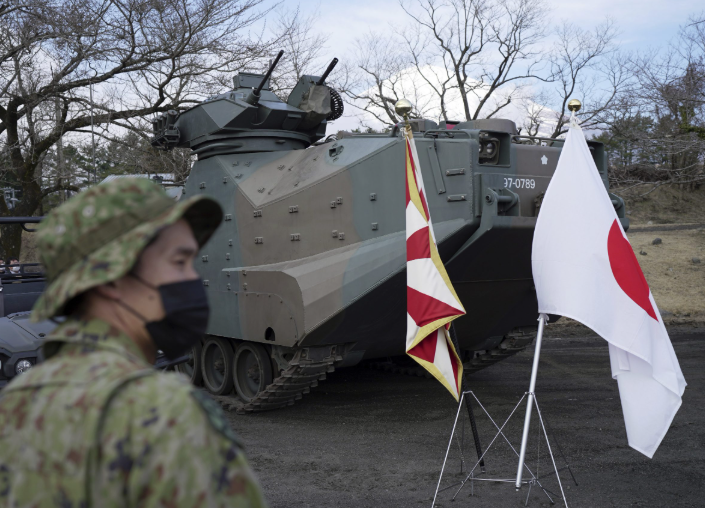
Japan is entering one of the most consequential phases of its postwar security transformation. What is emerging under Prime Minister Sanae Takaichi is not simply a larger military or a faster procurement programme. It is a broader restructuring of the Japanese state around the demands of a more contested Indo Pacific. Intelligence, long range missiles, unmanned systems, cyber capabilities, space based surveillance, defence industry, economic security and international partnerships are increasingly being treated as parts of the same national security system. Japan’s 2026 Defence White Paper describes the country’s security environment as the most severe and complex since the end of the Second World War and places particular emphasis on China’s expanding military reach, North Korea’s nuclear and missile capabilities and the growing strategic coordination among China, Russia and North Korea.
The significance of this moment is that Japan is no longer merely responding to individual threats. Tokyo is changing the architecture through which it understands and responds to them. The transformation began before Takaichi came to power, with the 2022 revision of Japan’s National Security Strategy, National Defense Strategy and Defense Buildup Program establishing the foundations for a substantial expansion of defence capabilities. The Takaichi government is now taking that trajectory further by connecting military modernisation with intelligence reform, industrial policy, technological innovation and a wider network of security partnerships. The result is a Japan that remains constrained by its constitution, democratic institutions and postwar political traditions but is increasingly determined not to allow those constraints to become strategic vulnerabilities.
Japan’s geography explains much of this transformation. Tokyo does not have the luxury of treating the Taiwan Strait, the East China Sea, the Korean Peninsula or the western Pacific as distant theatres. The southwestern Japanese islands lie close to Taiwan and the maritime approaches to the East China Sea, while Japan’s economy depends heavily on uninterrupted sea lanes for energy and trade. North Korea possesses missiles capable of reaching Japanese territory, China’s naval and air forces have expanded their operations around Japan and farther into the Pacific, and Russia remains a major military power in Japan’s northern neighbourhood. For Tokyo, therefore, the distinction between homeland defence and regional security is becoming increasingly difficult to maintain.
That reality has fundamentally altered the logic of Japanese defence planning. For much of the postwar period, Japan’s Self Defense Forces were organised around territorial protection, missile interception and the ability to respond after an attack had begun. That model was built for an era in which Japan could rely heavily on American extended deterrence and maintain a comparatively narrow interpretation of self defence. But missile ranges have increased, surveillance has become global, cyber operations can cross borders instantaneously and unmanned systems can operate at distances that would once have required manned aircraft or naval vessels. Waiting until a threat reaches Japanese territory is no longer necessarily a defensive strategy. In some circumstances, it could mean absorbing the first strike.
This is the central justification for Japan’s development of stand off and counterstrike capabilities. Tokyo maintains that these capabilities remain within the framework of self defence and are intended to respond to an armed attack rather than provide Japan with an unrestricted ability to wage war abroad. The distinction is important. Japan is not formally abandoning its exclusively defence oriented policy. It is attempting to redefine what effective defence means in an environment where an adversary can strike from hundreds or even thousands of kilometres away. If an adversary can launch missiles against Japanese territory without exposing its own forces to immediate retaliation, Japan’s defensive options become increasingly limited. Missile interception remains essential, but interception alone may not provide sufficient deterrence. A credible defensive architecture therefore requires the ability to detect the launch, identify the threat, maintain resilient command and control and possess the means to hold the launching capability at risk under the conditions permitted by Japanese law. Japan’s long range weapons are consequently becoming part of a larger deterrence chain rather than isolated offensive instruments.
Tokyo has already moved beyond planning. Japan has acquired American Tomahawk cruise missiles and is accelerating the development and deployment of indigenous stand off weapons. The Type 25 Surface to Ship Missile and Type 25 Hyper Velocity Gliding Projectile represent the country’s effort to develop increasingly sophisticated domestic systems. But the significance of these programmes is not simply their range. It is the infrastructure that must accompany them. Satellites, radars, electronic intelligence, maritime surveillance, secure communications, artificial intelligence and command networks are required to turn a long range weapon into an effective military capability. This is why Japan’s intelligence transformation may ultimately prove as important as its missile programme.
On July 31, Japan launched its National Intelligence Bureau, replacing the former Cabinet Intelligence and Research Office as the central coordinator of the country’s intelligence system. The bureau began operations with roughly 730 personnel and is designed to improve the collection, coordination and analysis of intelligence across government. A National Intelligence Council chaired by the prime minister is also being established as part of the new architecture. For Japan, this represents a major institutional change. Its intelligence system has traditionally been more fragmented than those of many other major powers, with information distributed among different ministries and agencies. The new bureau is an attempt to create a stronger central control point capable of integrating intelligence from defence, diplomacy, policing, cyber, economic security and other domains.
The importance of this reform becomes clearer when viewed alongside Japan’s changing military requirements. A country developing long range missiles needs better targeting intelligence. A country relying on unmanned systems needs persistent surveillance. A country facing cyber and influence operations needs faster attribution. A country worried about economic coercion needs intelligence that extends beyond traditional military questions. The National Intelligence Bureau therefore represents something larger than an administrative reform. Japan is attempting to create the information architecture necessary for a modern deterrence state. The next logical step is already under discussion, including stronger counter espionage legislation and additional mechanisms for dealing with foreign intelligence activity. Japan has historically been cautious about expanding state powers in this area because of its postwar political culture, so the seriousness with which these measures are now being considered illustrates how far the security debate has moved.
The military transformation is also increasingly technological. Japan’s demographic problem makes a traditional manpower intensive military model difficult to sustain. The country’s population is ageing and its workforce is shrinking, forcing Tokyo to compensate for demographic constraints through technology. Artificial intelligence, autonomous systems, robotics, satellites, electronic warfare and unmanned platforms are becoming central to the Japanese defence model. The SHIELD concept reflects this transition through a layered coastal defence architecture that integrates unmanned aerial systems, unmanned surface vessels, unmanned underwater vehicles and other platforms. The objective is to create a distributed surveillance and defence network capable of monitoring approaches to Japanese territory and complicating an adversary’s attempt to penetrate the country’s maritime perimeter.
This is strategically important because the future battlefield is likely to be defined less by individual platforms than by networks. A destroyer is powerful, but a destroyer connected to satellites, submarines, aircraft, drones, coastal missiles and intelligence systems becomes part of a much larger combat architecture. Japan is moving towards that model because it needs a military that is harder to surprise, harder to paralyse and harder to overwhelm in the opening stages of a conflict. Its defence industrial base is being transformed at the same time. Japan understands that possessing sophisticated weapons is of limited value if it cannot produce ammunition, maintain equipment or replace losses during a prolonged crisis. The 2026 Defence White Paper therefore places greater emphasis on domestic production, technological innovation, research and development and cooperation with private companies and start ups.
This is also why Japan’s defence equipment export policy matters. Tokyo has progressively relaxed restrictions that once prevented its defence industry from operating as a normal international supplier. The objective is not simply to sell weapons abroad. International production and maintenance arrangements can create economies of scale, strengthen supply chains and make Japanese defence companies more competitive while allowing Japan to build security relationships with countries that may not want a formal alliance with the United States. The emerging model is therefore broader than rearmament. Japan is attempting to construct a defence industrial ecosystem that can sustain military capability over the long term.
That ecosystem will increasingly connect Japan with Australia, the Philippines, the United States, India, South Korea and European partners. Tokyo’s objective is not to reproduce a single alliance structure everywhere but to create overlapping networks of interoperability, intelligence sharing, defence production and maritime cooperation. Japan’s growing defence relationship with the Philippines is particularly significant because of the country’s geographical position in relation to the South China Sea and Taiwan. Cooperation with Australia adds another major maritime partner, while India provides strategic depth across the wider Indo Pacific. European countries add industrial and diplomatic weight. This networked approach is one of the most important changes in Japanese strategy because Japan is gradually moving from being a protected pillar of the US alliance system towards becoming one of the principal security providers within a wider regional network.
For Washington, this transformation is highly valuable. The United States faces competing demands across Europe, West Asia and the Indo Pacific. A Japan that can provide more of its own defence, contribute advanced intelligence, operate sophisticated maritime forces and support regional partners reduces pressure on American resources. Japan is also one of the few countries capable of combining advanced manufacturing, technological sophistication and a strategic geographic position with a long standing alliance with Washington. But Japan’s motivation is not simply to do more for America. There is an important element of strategic insurance behind the buildup. Tokyo cannot assume that every future American administration will have the same priorities or the same willingness to commit resources to East Asia. Japan’s objective is therefore increasingly to ensure that the US alliance remains the foundation of its security without allowing the alliance to become a substitute for Japanese capability.
The Taiwan question sits at the centre of this calculation. Japan’s concern is not based solely on political sympathy for Taiwan but on geography. A conflict across the Taiwan Strait could affect Japanese territory, sea lanes, energy supplies and American military facilities in Japan. The southwestern islands could become part of the operational environment even if Japan itself were not the initial target. This makes Taiwan a Japanese security issue whether Tokyo wants it to be or not. That does not mean Japan has decided that it would automatically enter a Taiwan conflict. The legal and political circumstances would determine any response. But Japanese planners cannot responsibly assume that a war around Taiwan would remain geographically confined to Taiwan and mainland China. A blockade, missile campaign or major naval operation could rapidly affect Japan’s own security.
This is one reason the Takaichi government’s position has attracted such strong criticism from Beijing. China has repeatedly objected to Japanese statements concerning Taiwan and has portrayed Tokyo’s defence transformation as a return to militarism. North Korea has adopted an even harsher position and has condemned Japan’s 2026 Defence White Paper while criticising Tokyo’s acquisition of Tomahawk missiles. China’s concern should not simply be dismissed. Japanese long range missiles and expanding military partnerships genuinely alter the strategic balance, and Beijing has historical reasons to remain deeply sensitive to Japanese military power. A Japan capable of striking targets at greater distances creates new risks for Chinese planning, particularly in a Taiwan contingency.
But China’s criticism also ignores the strategic environment that has produced Japan’s response. Japan is not expanding its military in isolation. China’s military power has grown dramatically over the past two decades. The People’s Liberation Army Navy has expanded its fleet and increasingly operates beyond China’s immediate coastline. Chinese aircraft and naval vessels operate around Japan with growing frequency, while Beijing’s military reach is extending beyond the First Island Chain. Japan’s 2026 Defence White Paper places particular emphasis on this growing Chinese ability to project power farther into the Pacific. That matters because Japan cannot change its geography. Tokyo cannot move the Ryukyu Islands farther from China, relocate its maritime trade routes or make North Korea’s missiles disappear. It cannot determine whether a future conflict around Taiwan will remain confined to the Taiwan Strait. The variable it can directly control is its own resilience.
From this perspective, Japan’s military transformation is not difficult to understand. A country surrounded by nuclear armed or heavily armed powers cannot preserve strategic restraint by remaining strategically unprepared. That is the strongest justification for Japan’s current direction. At the same time, Japan must recognise that deterrence has a paradox at its centre. The same weapons that make Japan harder to coerce can also make China more suspicious of Japanese intentions. The same military networks that strengthen regional security can appear to Beijing as an encirclement architecture. The same Japanese involvement in a Taiwan contingency that Tokyo sees as necessary for its own security could be interpreted by China as direct intervention in what it regards as an internal matter. This is the security dilemma that will define East Asia. Japan can be right to strengthen its deterrence while still contributing to a more intense regional arms competition. Both realities can exist simultaneously.
That is why the next stage of Japanese strategy cannot be based on military expansion alone. Tokyo will need stronger crisis communication with Beijing, reliable military hotlines, maritime communication mechanisms and diplomatic channels capable of functioning during periods of political tension. A stronger Japanese military will be most useful if it prevents war rather than merely improves Japan’s ability to fight one. The same principle applies to Taiwan. Japan needs sufficient capability to deter coercion and protect its own territory without creating unnecessary ambiguity about when and how it would intervene. Strategic clarity and diplomatic restraint must operate together.
The nuclear dimension adds another layer of complexity. Japan remains officially committed to the Three Non Nuclear Principles and has repeatedly reaffirmed that it does not possess, produce or permit the introduction of nuclear weapons. At the Hiroshima and Nagasaki commemorations, Takaichi reaffirmed Japan’s commitment to the principles while stressing the need for realistic security policies. Nevertheless, the wider debate around nuclear deterrence is changing. Japan lives under the shadow of China’s growing nuclear arsenal, North Korea’s nuclear weapons and Russia’s enormous nuclear capability, while its security ultimately depends in part on American extended nuclear deterrence. The strategic question is therefore how Japan can preserve its non nuclear identity while ensuring that its deterrence remains credible in a region where nuclear weapons are becoming increasingly central to military planning.
The answer for now is likely to remain conventional strengthening combined with the American nuclear umbrella. A Japanese decision to acquire nuclear weapons would carry enormous regional consequences and could trigger further proliferation in Northeast Asia, giving Tokyo strong reasons to avoid crossing that threshold. Japan’s civilian nuclear capability makes the issue more sensitive because the country possesses advanced nuclear technology and industrial expertise that could provide a substantial foundation for a potential weapons programme if its political leadership ever made such a decision. That does not mean Japan is preparing to do so. Latent capability is not nuclear weaponisation. For China, however, even a latent Japanese capability will remain part of long term strategic calculations.
Russia adds another dimension to Japan’s security dilemma. The country’s northern frontier has become more complicated since Moscow’s invasion of Ukraine and its deepening military relationship with China and North Korea. The situation became more serious with Russian President Vladimir Putin’s visit to Iturup, one of the disputed Kuril Islands, on August 13. Japan strongly protested the visit, while Moscow used the trip to reinforce its claim over the islands. The timing is significant for Tokyo because Japan is facing pressure from three nuclear armed powers in its broader strategic environment. China is its principal military challenge, Russia remains a major military power to the north and North Korea possesses nuclear weapons and ballistic missiles. These countries also have increasingly close strategic relations with one another. Japan therefore has legitimate reasons to prepare for a security environment in which simultaneous or coordinated pressure from multiple directions cannot be ruled out.
This does not mean Beijing, Moscow and Pyongyang constitute a formal military alliance comparable to NATO. They do not, and their interests diverge considerably. But their military cooperation, diplomatic coordination and opposition to the US led regional order are sufficient to complicate Japanese planning. Tokyo does not need to assume a perfectly coordinated adversarial bloc to recognise that cooperation among these powers can create additional risks. That is why the 2026 Japanese strategy should be understood as preparation for a long duration strategic competition rather than preparation for one specific war. Japan is building the ability to see earlier, decide faster, disperse its forces, operate at greater range and sustain a prolonged crisis.
The economic dimension is crucial to all of this. Japan cannot sustain a serious defence transformation without a stronger economy. The country faces high public debt, an ageing population and significant social welfare commitments. Defence spending therefore cannot simply rise indefinitely. Tokyo must ensure that increased defence expenditure produces real military capability and technological innovation rather than simply larger procurement bills. This is why the integration of defence and industrial policy is so important. Japan needs to turn its strengths in robotics, electronics, advanced materials, shipbuilding, automotive manufacturing, artificial intelligence and precision engineering into strategic capabilities. The objective should be a defence industrial base that can innovate quickly, produce at scale and sustain equipment during a prolonged crisis.
Japan’s experience of the war in Ukraine has reinforced this lesson. Modern war consumes ammunition, drones, electronic components and replacement equipment at extraordinary rates. A country that cannot replenish its stocks can possess sophisticated weapons and still become vulnerable during a prolonged conflict. Japan is therefore moving towards a model in which stockpiling, production capacity and supply chain resilience become part of deterrence. The transformation also has implications for the economy beyond the defence sector. Military research can accelerate advances in robotics, artificial intelligence, autonomous systems, sensors, communications and advanced materials. Cooperation between the state and private companies can help Japanese firms develop technologies with both civilian and military applications. If managed properly, defence modernisation can therefore contribute to technological renewal. But Tokyo must avoid turning national security into an excuse for inefficient industrial protection. Defence spending must remain disciplined and procurement competitive. The objective is not to create a larger defence bureaucracy but a more capable state.
Japan’s demographic crisis makes this even more urgent. The country cannot realistically build a military based primarily on increasing manpower. It needs to create greater military effect with fewer personnel. Autonomous systems, artificial intelligence, precision weapons and networked intelligence are therefore not optional additions but increasingly central to the sustainability of Japanese defence. This also explains why Japan’s security transformation is likely to continue regardless of which political faction dominates Tokyo in the future. China’s military growth is not temporary, North Korea’s nuclear programme is not disappearing, Russia’s strategic relationship with China is unlikely to reverse quickly and Japan’s demographic problem will not be solved in a single political cycle. The United States will also continue to debate the appropriate distribution of military burdens among its allies. Takaichi has accelerated the political expression of these pressures, but she did not create them.
That distinction is important because it prevents the transformation from being reduced to the personality of one prime minister. The more important story is the evolution of Japanese strategic thinking itself. Japan is moving away from the assumption that restraint alone can guarantee security and towards the assumption that restraint must be backed by capability. That is a profound psychological change for a country whose postwar identity was built around pacifism and military limitation. Yet it would be a mistake to describe this as a return to imperial Japan. Contemporary Japan is fundamentally different from the Japan of the 1930s and 1940s. Its military is under democratic civilian control, its strategic doctrine is publicly debated, its constitutional framework remains central to defence policy and its security partnerships are embedded within a rules based international order. Its military expansion is being justified primarily through deterrence and national defence rather than territorial conquest.
For Beijing, the most significant change is therefore not simply that Japan has more missiles. It is that Japan is becoming more difficult to intimidate. A Japanese state with stronger intelligence, greater missile range, resilient unmanned systems, better maritime surveillance, a stronger defence industry and deeper partnerships will impose greater uncertainty on Chinese military planning. That could make Beijing more cautious, but it could also make Beijing more aggressive. The outcome will depend heavily on whether Japan and China can prevent deterrence from becoming confrontation. This is why Tokyo’s diplomatic strategy matters as much as its military strategy. Japan should continue economic engagement with China where it serves Japanese interests, maintain political communication and avoid unnecessary symbolic provocations, while making clear that economic interdependence cannot be used to force Japan into strategic submission.
The same principle should apply to the United States. Japan should remain deeply integrated with Washington while developing enough independent capability to prevent excessive dependence. A stronger Japan should not mean a Japan that automatically follows American policy. It should mean a Japan capable of contributing more to regional security while retaining its own political judgement. In fact, the strongest US Japan alliance may ultimately be one in which Japan is more capable of acting independently. This has implications for India as well. A stronger Japan supports a more distributed balance of power in the Indo Pacific. India does not need a formal military alliance with Japan to benefit from greater Japanese maritime capacity, defence technology, supply chain diversification and regional connectivity. Cooperation between New Delhi and Tokyo can strengthen both countries without creating an obligation to participate in every American or Japanese military initiative.
For Southeast Asia, Japan’s rise can provide another strategic option. Many countries in the region do not want to choose between China and the United States. Japanese assistance in coast guard capabilities, maritime surveillance, infrastructure, defence technology and economic resilience can strengthen their ability to maintain strategic autonomy. This may ultimately be Japan’s most important contribution to the Indo Pacific. Tokyo does not need to become the dominant military power in Asia. It needs to become a reliable power that makes regional coercion more difficult. That is a very different objective.
The real test of Japan’s military transformation will therefore not be measured simply by the number of missiles it possesses, the size of its defence budget or the number of military exercises it conducts. It will be measured by whether Japan can combine power with restraint. A country that possesses greater military capability but lacks diplomatic discipline can become a source of instability. A country that possesses strong deterrence while maintaining communication and political control can become a stabilising power. Japan is attempting to become the latter, although the transformation will not be without risks. Chinese military planning will adapt. North Korea will use Japanese rearmament to justify its own military expansion. Russia will continue to exploit strategic pressure around Japan’s northern territories. Domestic debate over defence spending, constitutional interpretation and nuclear deterrence will intensify, and the possibility of an arms competition in Northeast Asia will grow.
But the alternative is not a return to the comfortable security environment of the past. That environment no longer exists. Japan is therefore making a strategic calculation that is difficult but understandable. If the regional balance is changing, remaining static is itself a decision. If adversaries are developing longer range weapons, Japan needs greater reach. If threats are becoming more complex, Japan needs better intelligence. If modern warfare is becoming increasingly autonomous, Japan needs drones and artificial intelligence. If wars are lasting longer, Japan needs industrial capacity and stockpiles. If the United States is asking allies to carry more of their own security burden, Japan needs greater national capability. The emerging Japanese model can therefore be understood as an attempt to turn vulnerability into deterrence.
Its intelligence reform is designed to reduce surprise. Its long range weapons are designed to increase deterrence. Its unmanned systems are designed to compensate for demographic constraints. Its defence industry reforms are designed to create endurance. Its alliances and partnerships are designed to create strategic depth. Its economic security policies are designed to reduce coercive vulnerability. Together, these are not separate programmes. They are pieces of one strategy. China is watching because that strategy changes the military equation along China’s eastern periphery. Washington is watching because Japan is becoming a more capable security partner. South Korea, Australia, India and Southeast Asia are watching because the transformation will reshape the distribution of power across the Indo Pacific.
The challenge for Tokyo is therefore not simply to become stronger. It is to become stronger without becoming reckless. Japan must develop the ability to strike farther without becoming an expeditionary power. It must strengthen intelligence without sacrificing democratic oversight. It must expand defence exports without turning industrial policy into militarisation for its own sake. It must deepen alliances without surrendering strategic autonomy. Most importantly, it must deter China without creating conditions that make conflict more likely. That is the difficult balance Japan now faces.
The 2026 Defence White Paper marks an important point in that transformation because it makes increasingly explicit what has been developing for several years. Japan is no longer preparing only to defend its coastline and intercept incoming missiles. It is building an integrated security architecture capable of detecting threats earlier, operating at greater distances, surviving a prolonged crisis and working with a growing network of partners. The launch of the National Intelligence Bureau makes the information dimension of that transformation especially clear, while the development of stand off weapons and unmanned systems gives the military architecture greater operational reach.
The irony is that Japan’s growing military capability may be both a symptom of regional instability and a potential instrument for preventing it. A weak Japan would not necessarily make East Asia safer. It could instead encourage coercion by creating the perception that Tokyo has limited options. A stronger Japan could raise the cost of aggression and therefore reduce the incentive to use force. But strength will work as deterrence only if it remains connected to diplomacy, political restraint and credible communication. That is why the most important transformation taking place in Japan is not simply military. It is strategic.
The postwar Japan that relied primarily on restraint, economic power and American protection is giving way to a Japan that wants to combine economic strength with intelligence, technology, military capability and a wider network of strategic partnerships. It is not becoming the Japan of the past. It is preparing for a future in which the rules of power are changing, and China understands the significance of that change. Japan is no longer content merely to wait for danger to reach its shores. It wants to see danger coming, understand it earlier, complicate its approach, deter it from advancing and possess the means to respond if deterrence fails. That is the real meaning of Japan’s military transformation.
Tokyo is not simply rearming. It is building the capacity to make coercion against Japan harder, costlier and less certain. For a country situated at the intersection of China, Russia, North Korea and Taiwan, that may no longer be a choice. It may be the price of remaining secure.