

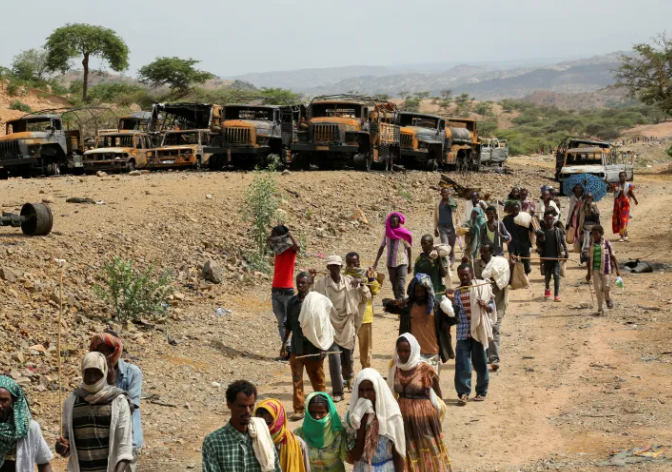
Ethiopia is approaching a dangerous point at which an internal political conflict could develop into a wider confrontation across the Horn of Africa. The renewed fighting in Tigray, the continuing insurgencies in Amhara and Oromia, and the growing hostility between Addis Ababa and Asmara have created a crisis that cannot be resolved through military operations alone. Each confrontation has its own history, political demands and security concerns, yet all are connected by a fundamental question: how can Ethiopia preserve its territorial integrity without denying its diverse communities a meaningful role in governing themselves, and how can neighbouring states protect their security without becoming participants in Ethiopia’s internal conflicts?
The return to fighting in northern Ethiopia is particularly troubling because it has exposed the limitations of the Pretoria Agreement signed in November 2022. That agreement provided a framework for ending the Tigray war, but it did not produce a comprehensive political settlement capable of resolving every dispute over regional authority, territorial claims, security arrangements and the future relationship between Tigray and the federal government. The African Union has called for renewed dialogue under the Pretoria framework, while the United Nations has warned that the latest escalation could destabilise the wider region. The immediate challenge is therefore not simply to restore the conditions that existed before the fighting resumed, but to build a settlement that addresses the reasons those conditions proved insufficient.
Any serious peace initiative must begin with a recognition that none of the principal parties can reasonably expect to secure every objective through force without imposing enormous costs on the country. The federal government has an interest in preserving Ethiopia’s territorial integrity, maintaining functioning national institutions and preventing the emergence of competing armies beyond its constitutional authority. Tigrayan leaders seek meaningful regional self government and credible guarantees against renewed coercion. Fano groups have their own grievances concerning regional security, political representation and territorial disputes, while the Oromo Liberation Army represents a separate insurgency rooted in the political relationship between Oromia and the federal state. Other regional movements also have demands that cannot simply be absorbed into an agreement between the largest armed organisations.
These differences make a single bargain between the federal government and one opposition group inadequate. A settlement confined to Tigray could leave Amhara and Oromia in conflict, while an agreement with a broad opposition alliance might overlook disagreements among its members. The process must therefore be comprehensive without requiring every dispute to be resolved simultaneously. Each party should retain the right to negotiate its political demands, but all must accept common rules against the use of force to determine the outcome.
The first requirement is an immediate ceasefire covering every major theatre of conflict. The federal government and participating armed groups should suspend offensive operations, including drone attacks, airstrikes and attacks on civilian infrastructure. Military units should withdraw from designated civilian protection zones, humanitarian corridors should be opened, and restrictions preventing essential food, medicine and emergency assistance from reaching affected communities should be removed. The ceasefire must cover attacks by all signatories, not merely those committed by the party that happens to be under the greatest diplomatic pressure.
An independent monitoring commission should verify compliance through agreed reporting procedures, field inspections where access is possible and direct communication between military commanders. Each side should be required to report alleged violations promptly, preserve relevant evidence and permit impartial investigation. A disputed incident should trigger verification and emergency consultation rather than automatic retaliation. Where a violation is established, the commission should recommend proportionate corrective measures and refer serious abuses to the appropriate legal authorities. The purpose would not be to excuse violations but to prevent an isolated clash from destroying the entire peace process.
The ceasefire must also be separated from the final political agreement. If every side is required to concede its territorial, constitutional and security demands before the guns fall silent, negotiations will have little chance of succeeding. The initial commitment should be narrower: stop fighting, protect civilians, refrain from territorial advances and enter negotiations without prejudice to outstanding claims. Political concessions can then be negotiated under conditions in which participants are not attempting to improve their positions through battlefield gains.
The second requirement is a national political compact that preserves Ethiopia’s existing institutions while making room for a more inclusive distribution of power. One possible arrangement would be a time limited transitional administration with representation from the federal government, the principal opposition movements, regional authorities and independent civic representatives. Its mandate would be confined to implementing the ceasefire, restoring essential services, negotiating constitutional and security reforms, and preparing a credible political transition. It should not possess unlimited authority to rewrite the constitutional order or indefinitely postpone elections.
The precise composition of such an administration would have to be negotiated. The federal government might prefer an expanded government operating through existing institutions, while opposition groups might insist on a more neutral transitional council. A third possibility would be a parliamentary arrangement supported by an independent mediation mechanism and binding rules for resolving disputes. None should be imposed in advance. The parties should agree on the composition, decision making procedures, duration and oversight of the transitional authority before it begins operating.
The central principle is that political participation must offer a genuine alternative to armed struggle. Opposition representatives should be able to contest policies, organise politically and seek public support without fearing that participation will leave their communities exposed to coercion. At the same time, joining a transitional administration must not confer permanent authority on armed groups merely because they possess weapons. The eventual distribution of political power should be determined through agreed constitutional procedures and credible elections rather than military strength.
A transitional arrangement lasting approximately eighteen to twenty four months could provide a practical starting point, subject to review against clearly defined benchmarks. These should include the implementation of the ceasefire, restoration of public administration, progress in security sector reform, conditions for displaced people to return and the establishment of credible electoral arrangements. Any extension should require a transparent procedure and independent review. Otherwise, a temporary settlement could become another indefinite struggle over political legitimacy.
The third requirement is a renewed federal compact. Ethiopia’s political stability cannot depend solely on who controls the federal government in Addis Ababa. The relationship between the centre and the regions must be sufficiently clear and credible that communities do not regard armed resistance as their only means of protecting their interests.
Regional administrations should retain constitutionally defined authority over local administration, education, cultural affairs and regional development. Federal intervention in regional security matters should operate under clear legal rules, with independent oversight and safeguards against collective punishment. Regional governments, in turn, must respect constitutional obligations, protect minorities within their jurisdictions and refrain from using regional institutions to exclude political opponents.
A federal compact should also establish a credible process for resolving territorial disputes. Competing historical claims cannot be settled simply by determining which side currently controls a town. A commission should consider constitutional provisions, administrative history, the rights of residents, property ownership, displacement and the possibility of voluntary local arrangements where legally permissible. No party should be allowed to create permanent territorial facts through military advances while the process is under way.
Tigray requires a dedicated settlement within this wider framework. Its regional administration should be determined through an agreed political process, while disputed territories should be handled through an independent mechanism rather than unilateral military control. The safe return of displaced residents, restoration of property and access to public services must form part of the settlement. Communities that have suffered displacement should not be expected to accept a territorial arrangement that prevents their return or strips them of their rights.
A special administrative arrangement may be necessary in particularly contested areas, but it should not be confused with the permanent transfer of sovereignty or the creation of a separate state. Temporary joint administration, locally elected councils, guarantees for linguistic and cultural rights, and independent adjudication of property claims could be considered where they are consistent with Ethiopia’s constitutional framework. The purpose would be to protect residents while preventing territorial disputes from becoming permanent military front lines.
The fourth requirement is a security agreement that links disarmament to credible guarantees. Demanding that every opposition group surrender its weapons immediately would be unrealistic if its members believe that disarmament could expose them to retaliation. Allowing armed movements to retain permanent independent armies, however, would leave Ethiopia divided among competing centres of military power. The settlement must avoid both outcomes.
All participating armed groups should first register their personnel, weapons and command structures under an independently verified process. Heavy weapons could then be placed in monitored storage, and forces could withdraw from designated areas around major towns and civilian infrastructure. Eligible personnel should have access to transparent programmes for integration into reformed national or regional security institutions, while others should receive assistance for civilian reintegration, education and employment.
Integration must not become a mechanism for allowing one faction to capture the national armed forces. Recruitment, promotion and command appointments should follow professional standards, transparent procedures and safeguards against ethnic or political discrimination. Regional security institutions should have clearly defined responsibilities and lawful chains of command. Their size, equipment and relationship with federal forces must be negotiated rather than left to informal arrangements that could reproduce the conflict.
The same rules should apply to the federal government. Security sector reform cannot succeed if opposition forces are required to disarm while the state remains free to use its military without independent oversight. Civilian protection, lawful detention, transparent deployment procedures and accountability for abuses must therefore be part of the security compact. A credible agreement would offer guarantees to communities while preserving the state’s ability to defend the country and maintain public order.
Political reconciliation must accompany these measures. Ethiopia’s successive conflicts have produced grave allegations of unlawful killings, sexual violence, forced displacement and other abuses. Ignoring these allegations would deny victims justice and leave grievances available for future mobilisation. Yet using criminal accusations to exclude every political opponent from negotiations could make a settlement impossible.
The appropriate distinction is between political participation and individual criminal accountability. Negotiations should remain open to representatives capable of ending hostilities, while credible allegations of serious crimes should be investigated through independent legal procedures. There should be no blanket immunity for grave international crimes and no presumption of collective guilt based on ethnicity, political affiliation or membership in an armed organisation.
A transitional justice programme should document abuses, provide victims with access to legal remedies, support the return of displaced people and establish reparations where appropriate. Restoring schools, hospitals, electricity, banking and communications is equally important. Peace will remain fragile if communities are asked to trust political institutions while living without basic services or the means to rebuild their livelihoods.
The crisis also requires a separate agreement between Ethiopia and Eritrea. The deterioration in relations between Addis Ababa and Asmara has raised the possibility that Ethiopia’s internal conflict could develop into a direct interstate confrontation. Ethiopia has accused Eritrea of sending troops across its border, while Eritrea has rejected Ethiopia’s account and raised its own allegations. These claims must be investigated impartially. Neither government should treat an unverified allegation as sufficient justification for an unlimited military response.
The two countries should negotiate a non aggression agreement covering territorial sovereignty, border security and non interference in each other’s internal affairs. Any foreign forces verified to be operating inside the other state without consent should withdraw according to an agreed timetable. A joint border commission should investigate incidents, establish military communication channels and recommend measures to prevent accidental clashes. Both governments should commit not to supply weapons, intelligence or operational assistance to armed groups seeking to overthrow the other’s government.
This arrangement would require concessions from both sides. Ethiopia would have to demonstrate that its pursuit of maritime access does not amount to a claim over Eritrean territory. Eritrea would have to accept a verifiable process for addressing border incidents and refrain from using Ethiopia’s internal instability to advance its own security objectives. Restoring diplomatic relations and resuming economic exchanges could follow once the parties demonstrate compliance.
Ethiopia’s lack of a coastline is a strategic and economic concern, but it does not require a territorial confrontation. A long term commercial port access agreement with Eritrea could provide Ethiopia with predictable access to maritime trade while preserving Eritrean sovereignty. The agreement could establish transit fees, customs procedures, transport infrastructure, commercial rights, dispute arbitration and mutually agreed security arrangements. Any military use of port facilities would require separate, explicit consent.
Such an arrangement would give Ethiopia a route towards greater economic security without requiring Eritrea to surrender sovereign territory. Eritrea could receive transit revenue, infrastructure investment and expanded commercial opportunities. The precise location and terms would need to be negotiated, and the agreement should not be presented as a naval base or territorial lease unless both countries explicitly chose to negotiate such provisions. Maritime access should be treated as a commercial and diplomatic question rather than a justification for war.
The regional dimension cannot be ignored. Egypt’s dispute with Ethiopia over the Grand Ethiopian Renaissance Dam, Sudan’s ongoing civil war and Somalia’s objections to Ethiopian arrangements concerning Somaliland all contribute to a wider environment of mistrust. These disputes are connected, but they should not be bundled into a single negotiation in which failure on one issue blocks progress on every other.
Ethiopia and Egypt should pursue a separate technical and political process on the Nile, including information sharing, consultations over dam operations, drought management and procedures for addressing disagreements. Ethiopia should retain its right to pursue development and electricity generation, while Egypt’s concerns about predictable water supplies should receive substantive consideration. Sudan’s water security and its own circumstances must also be taken into account. A durable arrangement requires practical cooperation rather than demands that either side abandon its essential interests.
Ethiopia and Somalia should likewise pursue any maritime or transport agreement through negotiations that respect territorial sovereignty and international law. Commercial access should not be tied to unilateral recognition of disputed political claims. Sudan, Somalia, Egypt and Eritrea should commit to refraining from support for armed escalation inside Ethiopia, while Addis Ababa should make a reciprocal commitment concerning their territories. Allegations of external interference should be investigated rather than treated as established facts merely because they serve a party’s political narrative.
The African Union should lead the principal mediation effort, drawing on its role in the Pretoria Agreement and the work of its High Representative for the Horn of Africa. The United Nations could support humanitarian coordination, independent verification and diplomatic engagement. Regional institutions could contribute to specific negotiations where their mandates and the consent of the parties permit. External governments could provide reconstruction funding and technical assistance, but they should not dictate Ethiopia’s constitutional arrangements or turn mediation into a competition for strategic influence.
Implementation should proceed in phases. The first fourteen days should focus on the ceasefire, humanitarian access, military communication and protection of civilian infrastructure. During the following weeks, the parties should establish monitoring arrangements and negotiating committees. Over the next six months, they should work towards an interim political compact, a framework for disputed territories and an agreement on security sector reform. The subsequent period should focus on reintegration, reconstruction and preparations for a credible political transition.
These deadlines should be treated as negotiating targets rather than promises. Progress must be measured through verifiable benchmarks, including the cessation of attacks, access for humanitarian organisations, the withdrawal of forces from agreed areas, the restoration of services and compliance with security arrangements. Independent monitors should publish periodic assessments, subject to safeguards for civilians and sensitive security information. If a party violates the agreement, the response should follow a predetermined procedure involving investigation, consultation and proportionate corrective action.
The settlement must also recognise that not every group will initially sign the same agreement. Some movements may reject the transitional arrangement, while local commanders may not comply with their political representatives. The framework should therefore permit separate accession agreements under common principles, provided that all participants accept the ceasefire, civilian protection and peaceful resolution of disputes. Communities not represented by the major armed groups must have a route to participate without being forced to join one of the existing political camps.
The objective is not to guarantee that every party will obtain its preferred outcome. It is to create a structure in which no party needs to rely on military force to protect its political existence. The federal government would preserve Ethiopia’s territorial integrity and retain functioning national institutions. Regional communities would obtain stronger guarantees of self government and representation. Armed movements would receive a credible path into political and lawful security structures. Eritrea would receive assurances over its sovereignty, while Ethiopia would gain a framework for pursuing maritime access through negotiation. Neighbouring states would have a mechanism for addressing their disputes without turning Ethiopia into the arena for a wider regional confrontation.
Ethiopia does not need another agreement that merely pauses the fighting. It needs a political settlement that changes the incentives sustaining the conflict. That requires the federal government to accept meaningful limits and oversight, opposition groups to recognise that armed struggle cannot be the permanent basis of political authority, and neighbouring states to distinguish their legitimate security concerns from interference in another country’s affairs.
The test of a successful settlement will not be whether one side emerges with the language of victory. It will be whether civilians can return home, regional disputes can be handled without armed mobilisation, national institutions can function without systematic exclusion, and Ethiopia can pursue its economic and strategic interests without placing its neighbours under threat. A peace agreement cannot erase the history of the conflict, but it can prevent that history from determining the country’s future. The most durable compromise is one in which Ethiopia remains united because its communities have a meaningful stake in that unity, and the Horn of Africa becomes more secure because political differences are managed through negotiation rather than force.