

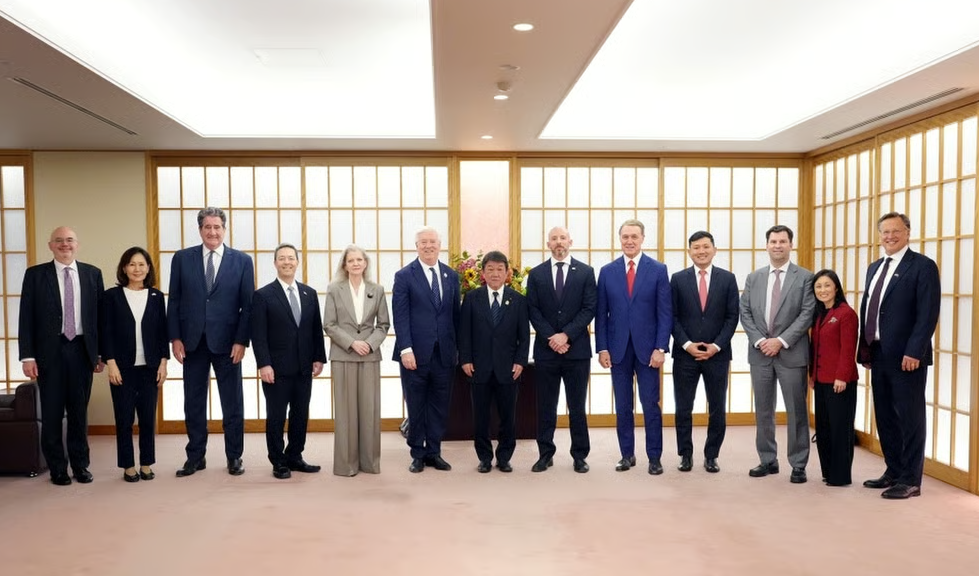
The gathering of senior American diplomats, administration officials and military commanders in Tokyo from October 7 to 9 has highlighted the strategic importance Washington attaches to President Donald Trump’s planned November visit to China. Described by one source as an unusual meeting, the gathering brought together officials responsible for diplomacy, regional security and military planning at a time when the United States is attempting to manage its relationship with Beijing while maintaining the confidence of its allies across the Indo Pacific. Hosted by US Ambassador to Japan George Glass, the meeting was presented as an inaugural Indo Pacific ambassadorial summit. Its significance, however, lies less in its formal designation than in the breadth of participation and the timing of the discussions. With several high level engagements approaching, Washington appears intent on ensuring that its diplomatic representatives and military leadership share a common understanding of regional priorities before Trump enters another round of direct engagement with Chinese President Xi Jinping.
The meeting brought together US Ambassador to China David Perdue, the ambassadors to South Korea, the Philippines, Australia, New Zealand, Thailand and Vietnam, as well as the American ambassador to the Association of Southeast Asian Nations. Raymond Greene, director of the American Institute in Taiwan, also attended. Senior State Department officials, including Under Secretary of State for Political Affairs Allison Hooker and counsellor Daniel Holler, participated in the discussions. The programme included a visit to the US naval base at Yokosuka, where Admiral Samuel Paparo, commander of US Indo Pacific Command, briefed the ambassadors and senior officials. Rear Admiral Kyle Gantt, deputy commander of the US Seventh Fleet, was also present. The combination of diplomatic, administrative and military representation distinguished the gathering from the established practice of American ambassadors meeting to exchange information and coordinate diplomatic reporting. It brought officials responsible for interpreting regional developments into closer contact with those responsible for assessing their military implications.
The timing is particularly important because Trump’s upcoming engagements could influence the direction of American policy towards China and its regional partners. According to the report, the Tokyo discussions included preparations for the president’s meetings with counterparts from the Philippines, China, Japan, India and Australia. A possible meeting with Russian President Vladimir Putin and a potential encounter with North Korean leader Kim Jong un were also under consideration. Such an extensive diplomatic schedule creates both opportunities and risks for Washington. Direct engagement with multiple leaders can help the American president communicate priorities, negotiate areas of cooperation and prevent disagreements from escalating. Yet the positions Washington adopts in one bilateral relationship can affect its standing in another. An understanding reached with Beijing, for example, could influence how Japan and the Philippines assess American security commitments, while discussions with Moscow or Pyongyang could alter regional calculations concerning military cooperation and strategic stability. Coordinating these relationships requires more than arranging presidential meetings. It requires a clear understanding of what Washington hopes to achieve and how its decisions will be interpreted across the region.
The Tokyo summit also reflects the importance of consistency in American diplomatic messaging. The officials assembled in Japan were reported to have discussed regional priorities, intelligence and the coordination of diplomatic communications. These functions are essential in a region where individual countries face different security challenges and maintain varying relationships with China. Japan is concerned about Chinese military activity and maritime disputes, while the Philippines faces continuing confrontations with Chinese vessels in the South China Sea. South Korea must contend with North Korea’s nuclear capabilities and the wider implications of Pyongyang’s relationship with Moscow. Australia has its own security commitments and economic interests, while Southeast Asian countries generally seek to preserve room for cooperation with both Washington and Beijing. A common American strategy must account for these differences without allowing them to undermine broader coordination. If Washington communicates conflicting priorities through different diplomatic channels, its partners may struggle to determine whether American policy is changing or whether individual officials are simply presenting different interpretations of the same objectives.
The presence of Paparo and senior Seventh Fleet leadership gave the meeting a particularly important military dimension. The United States maintains a substantial regional military presence, and its ability to support allies depends on the relationship between diplomatic commitments and operational preparedness. A visit to Yokosuka provided an opportunity to connect discussions about regional strategy with the military capabilities that underpin American engagement in the western Pacific. The reported briefing also covered Chinese activities in the Indo Pacific and North Korea’s alleged assistance to Russia in its war against Ukraine. These issues demonstrate how developments in one region can affect assessments of security elsewhere. Washington must consider whether military cooperation among countries with competing interests could complicate its regional planning, while distinguishing verified developments from broader strategic concerns. Effective coordination between diplomats and military commanders can help ensure that policy decisions are informed by operational realities and that military preparations support, rather than contradict, diplomatic objectives.
The most consequential question surrounding the meeting, however, concerns the relationship between Trump’s personal diplomacy with Xi and the wider American commitment to regional security. Trump has repeatedly referred to the Chinese president as a friend, even as his administration continues to confront Beijing over strategic and economic issues. His approach places considerable emphasis on direct negotiations between leaders, with the expectation that personal engagement can create opportunities for agreements that might otherwise remain out of reach. There is value in maintaining communication between the leaders of the world’s two most powerful countries. The absence of dialogue could increase the danger of miscalculation, particularly when military forces operate in close proximity or when disputes involve competing territorial claims. Nevertheless, personal rapport cannot resolve every underlying disagreement, nor can it substitute for a consistent policy supported by diplomatic institutions and military planning.
This tension became more visible during Xi’s state visit to Washington in September, which reinforced the importance both governments attach to managing their relationship. Trump’s description of the United States and China as allies during the Second World War also echoed Beijing’s emphasis on their shared wartime history, including its narrative of resistance against Japan. Although historical cooperation can provide a basis for diplomatic engagement, it does not eliminate the strategic differences that define the present relationship. Japan remains a central American ally and a major component of Washington’s regional security arrangements. Any language that appears to privilege a bilateral understanding with Beijing over the concerns of established partners can therefore generate uncertainty, even when the intention is to encourage cooperation. The challenge for the Trump administration is to demonstrate that improved relations with China do not require the United States to weaken its commitments elsewhere in the region.
Taiwan is the clearest test of that distinction. Beijing considers the self governed island part of China and has not ruled out the use of force to achieve unification. The United States does not recognise Taiwan as an independent state, but it opposes attempts to determine the island’s future by force and continues to support its defence. Washington must therefore maintain a difficult balance between discouraging unilateral changes to the status quo and preserving the possibility of a peaceful resolution. Trump’s reported description of a pending US$14 billion arms package for Taiwan as a negotiating chip has raised questions about how his administration intends to handle this balance during its engagement with Beijing. If security assistance becomes entangled in wider negotiations, Taiwan and other regional partners may question whether established American commitments could be adjusted to secure unrelated diplomatic or economic gains.
The implications extend beyond Taiwan itself. Japan has a direct interest in the stability of the Taiwan Strait, while the Philippines occupies a strategically important position in the western Pacific. A serious crisis involving Taiwan would therefore affect the security calculations of several American partners simultaneously. For these countries, the credibility of Washington’s position depends not only on presidential statements but also on the consistency of its actions. A policy that combines dialogue with Beijing and continued support for regional security can preserve diplomatic flexibility. However, if allies perceive that their security concerns are being subordinated to a bilateral understanding between Washington and Beijing, they may become more cautious about relying on American assurances. The Tokyo meeting is significant in this context because it brought the American representative responsible for Taiwan into discussions involving senior diplomats and military commanders ahead of Trump’s next engagement with Xi.
The South China Sea presents another immediate challenge. Confrontations between Beijing and Manila over competing maritime claims have continued, placing pressure on the American commitment to a free and open Indo Pacific. For the Philippines, the issue is not simply one of diplomatic language. It concerns the practical ability to protect maritime interests and prevent disputes from being resolved through coercion. Washington must reassure Manila that its security relationship remains meaningful while avoiding steps that could unnecessarily escalate tensions. This requires clear communication about American commitments, coordination between diplomatic and military officials and mechanisms to manage dangerous encounters at sea. The broader objective should be to preserve freedom of navigation and the ability of regional states to pursue their interests without force determining the outcome of maritime disputes.
Japan faces a similar need for reassurance. Its security relationship with the United States is central to its regional planning, but Tokyo must also manage an economically important relationship with China. The presence of American diplomatic and military leadership in Japan ahead of Trump’s visit offers an opportunity to align regional assessments, yet the real test will be whether Washington can maintain a consistent approach when diplomatic negotiations place competing interests under pressure. Japan and other American partners do not necessarily oppose engagement with Beijing. They have strong reasons to favour stable relations and the avoidance of conflict. Their concern is whether negotiations will be conducted in a way that preserves regional stability or whether short term agreements could create uncertainty over security commitments. A credible American strategy must demonstrate that diplomacy and deterrence are complementary instruments rather than competing objectives.
The Korean Peninsula adds another dimension to the coming diplomatic agenda. The Tokyo meeting reportedly included discussions about denuclearisation, while Trump has expressed interest in meeting Kim Jong un. The two leaders met three times during Trump’s first term, but those encounters did not produce a lasting breakthrough on denuclearisation. A further meeting could reopen communication, particularly if Beijing helps facilitate contact, but the prospect should be assessed in terms of concrete objectives rather than diplomatic symbolism. Any renewed initiative would need to address the verification of commitments, the reduction of nuclear risks and the security concerns of South Korea and other affected countries. A presidential encounter could provide an opening for negotiations, but a durable outcome would depend on sustained engagement beyond the meeting itself. The inclusion of Korean Peninsula denuclearisation in the reported Tokyo discussions indicates why Washington needs to coordinate its diplomatic ambitions with the assessments of officials responsible for regional security.
The report also places the gathering within a wider debate about Chinese and Russian assistance to Iran. American officials have expressed concerns about cooperation among these countries, while Trump has publicly played down the reported level of such assistance, describing it as very limited. The distinction between confirmed activity and allegations is important. Broad claims about strategic cooperation cannot replace evidence concerning the nature, extent and consequences of particular arrangements. At the same time, Washington has reason to examine whether developments involving Russia, Iran or North Korea could affect its military planning and diplomatic priorities in Asia. A global power operating across multiple regions must consider the possibility that a crisis in one theatre could complicate its commitments in another. Coordination between diplomatic missions and military commanders can help identify these connections, but assessments must remain grounded in evidence rather than assumptions about a unified opposing bloc.
Trump’s planned November engagements will provide a practical test of whether the coordination undertaken in Tokyo can translate into a coherent regional approach. Before travelling to China, he is expected to meet Philippine President Ferdinand Marcos Jnr in Manila. He is also expected to meet Japanese Prime Minister Sanae Takaichi, Australian Prime Minister Anthony Albanese and Indian Prime Minister Narendra Modi on the sidelines of the ASEAN summit. Trump is scheduled to attend the ASEAN summit in Manila on November 16 before travelling to Shenzhen for the APEC leaders’ meeting on November 18 and 19. Putin has confirmed his attendance at the APEC summit, according to the report, while a possible Trump meeting with the Russian president remains uncertain. A meeting with Kim Jong un is also being considered, but neither Pyongyang nor the White House has confirmed such an encounter. These possibilities make advance coordination particularly important, since the diplomatic signals emerging from the visit could influence perceptions across several regions.
The notable absence of US envoy to India Sergio Gor from the Tokyo gathering is also a detail worth observing, although it does not by itself establish a change in Washington’s approach towards New Delhi. The reported participation of officials responsible for India’s regional partners demonstrates the breadth of the meeting, but attendance alone cannot establish the administration’s priorities or the reasons behind an individual official’s absence. The more important consideration is how Washington intends to coordinate its relationships with the region’s major powers while preparing for renewed engagement with Beijing. India, Japan, Australia and the Philippines have distinct national interests, and their cooperation with the United States does not mean that they will approach every issue in the same way. A regional strategy is more likely to endure if it recognises those differences rather than assuming that diplomatic alignment must translate into uniform political positions.
Following the gathering, US Ambassador to the Philippines Lee Lipton stated on social media that the American commitment to a free and open Indo Pacific could not be clearer. The statement reinforced Washington’s established regional message, but declarations alone cannot resolve the uncertainty surrounding the administration’s approach to China. The credibility of that commitment will be judged by how Washington handles Taiwan, responds to maritime confrontations, coordinates with its allies and manages negotiations with Beijing. If diplomatic engagement produces greater stability without undermining regional security, it could strengthen the American position. If it creates doubts about whether security commitments will survive changes in political priorities, it could weaken confidence among partners even without a formal change in policy.
The Tokyo meeting should ultimately be understood as an attempt to bring greater coherence to American diplomacy at a sensitive moment in US China relations. Its unusual composition reflects the importance of coordinating diplomatic reporting, intelligence assessments and military planning before a series of high level engagements. Yet the meeting itself does not prove that Washington has settled its regional strategy or resolved the tensions within it. The decisive question is whether the Trump administration can pursue a workable relationship with Beijing while maintaining credible commitments to its partners and preserving the space for peaceful diplomacy. The coming engagements will test whether the United States can reconcile these objectives in practice. Washington does not have to choose between talking to China and maintaining regional security. It does, however, have to demonstrate that its pursuit of an understanding with Beijing will not leave its allies uncertain about the principles and commitments on which the American presence in the Indo Pacific rests.