

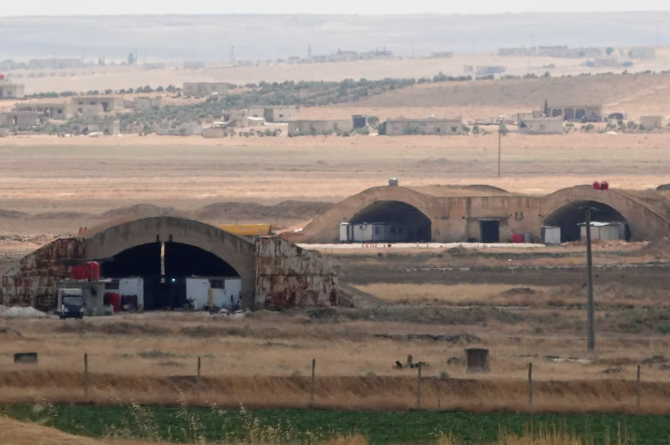
The Israeli air strike on the Abu al-Duhur military airfield in Idlib is far more consequential than the destruction of another degraded military facility. It signals a decisive shift in the post-Assad conflict, where the central contest is moving away from who governs Damascus to who determines the strategic limits of the Syrian state. Executed after a Turkish military delegation visited the installation to inspect plans for its rehabilitation, the raid drew swift condemnation from Ankara and a rare public rebuke from Washington, which warned against unnecessary escalation. Beneath this immediate clash lies a confrontation involving Syrian sovereignty, Turkish regional ambitions, Israeli military supremacy, and an increasingly difficult American effort to prevent its partners from colliding.
The significance of Abu al-Duhur rests in what the installation represents rather than what it currently holds. Syria’s military infrastructure was severely degraded during the final years of the civil war and systematically targeted by Israel after the fall of Bashar al-Assad. Rebuilding that infrastructure would not simply restore an old military establishment; it would begin the reconstruction of Syrian strategic power. A functioning air force, integrated radar network, and national command structure would give the transitional government under Interim President Ahmad al-Sharaa something Damascus has lacked for years: the ability to impose military consequences on foreign forces operating in its airspace. The core issue is consequently not whether Turkey places personnel at a single base. It is whether Syria can eventually recover control over its own skies.
That possibility fundamentally alters Israel’s strategic calculations. Israel has built its regional doctrine around maintaining overwhelming air superiority and the freedom to strike perceived threats before they mature. Syria’s weakness made that doctrine exceptionally effective, allowing Israeli aircraft to operate against adversary positions and military infrastructure with limited resistance. Recent steps by Damascus to rebuild its air capability—including recruitment, pilot training, and initial flight exercises—introduce a level of uncertainty that Israeli planners have not had to confront in years. The restoration of an integrated defense network represents a strategic shift long before Syria possesses the capability to challenge Israel directly.
This is where Turkey enters the equation. Ankara is not merely offering political backing to the new Syrian authorities. It has a direct interest in shaping a security architecture capable of controlling territory, suppressing armed groups, and securing its southern border. Turkey also seeks to keep Syria within a political and economic orbit where Ankara holds substantial sway. These objectives make a functional Syrian state useful to Turkey and make Turkish involvement in Syrian military reconstruction inevitable. The problem is that the same reconstruction that strengthens Damascus directly curtails Israel’s operational freedom.
The emerging Israeli-Turkish rivalry is structurally distinct from the earlier confrontation between Israel and Iran inside Syria. Iran relied primarily on non-state networks, militias, and logistical corridors. Turkey is a sovereign state and NATO member with its own air force, air defense technology, intelligence apparatus, and deep strategic reach. Israel cannot target Turkish-aligned military infrastructure as it did Iranian-affiliated facilities without risking a confrontation with a power capable of direct retaliation. The presence of Turkish personnel operating alongside a reconstructed Syrian military creates a new deterrence equation. An Israeli strike against Syrian infrastructure carries the risk of hitting Turkish assets, transforming what was a largely one-sided campaign into a state-to-state crisis.
The contest over air defense is therefore far more critical than disputes over troop deployments. Ground forces can be relocated, but an integrated defense network is much harder to roll back. Once radar stations, command nodes, and surface-to-air missile systems are operational across Syrian territory, they become part of a permanent national security architecture. Their primary significance lies not only in their ability to shoot down aircraft, but in establishing an alternative authority over Syrian airspace. Israel has historically operated on the assumption that it can decide when and where to apply force inside Syria. A functional air defense network directly challenges that assumption without firing a missile.
This creates a strategic dilemma for the al-Sharaa government. Syria needs a national military, as no state can permanently outsource control over its borders. Yet the reconstruction of those forces is unfolding in an environment where every new capability is viewed by neighboring powers through the lens of their own security. Damascus must rebuild while avoiding the appearance of creating a new regional threat. It must accept foreign technical and material assistance without becoming dependent on an external military patron. The challenge extends beyond organizing an army; it requires constructing a cohesive military identity after years in which Syrian territory was fragmented among competing external actors.
Syrian sovereignty thus becomes the vital variable. The country cannot achieve lasting stability if its government lacks the authority to determine its own defense policy. Yet sovereignty cannot mean ignoring the security concerns of neighboring states. Syria’s future defense architecture will have to assure Israel that its territory will not serve as a platform for hostile networks, while assuring Turkey that Syrian land will not be utilized by Kurdish armed groups targeting Ankara. It must also reassure broader regional actors that military reconstruction is intended to restore state authority rather than project power abroad.
The danger is that these competing security demands could produce a Syria that is formally unified but strategically partitioned. Turkey could dominate the security environment in the north, while Israel maintains military red lines and buffer zones in the south. Damascus might administer the capital and civil governance while remaining unable to exercise authority over its borders or airspace. Such an outcome might not trigger immediate open conflict, but it could entrench a condition where Syria’s legal sovereignty exists in theory while remaining conditional in practice.
This dynamic alters the regional balance of power. The fall of the former regime removed a major pillar of Iran’s regional alignment, opening a strategic vacuum. Turkey is moving to expand its influence in that space, while Israel acts to prevent any emerging arrangement from threatening its security parameters. This competition extends beyond Syria; it is part of a broader redistribution of power across the Levant. Gulf states seek stability without allowing any single regional power to dominate Damascus, while other global actors maneuver to preserve their remaining footholds.
The United States finds itself uniquely positioned yet constrained. Washington maintains a security alliance with Israel, strategic relations with Turkey, and an interest in a stable Syrian transition. However, these priorities are pulling in different directions. The United States wants a consolidated Syrian state, but unilateral strikes against military assets disrupt that transition. Washington values its partnership with Ankara, but expanding Turkish military footprints risks triggering Israeli countermeasures. The core policy challenge for Washington is moving beyond temporary deconfliction to foster conditions under which competing security interests no longer spark kinetic friction.
Managing this dynamic requires a political framework rather than perpetual crisis management. Deconfliction channels can prevent mid-air incidents between foreign aircraft, but they cannot settle the future of Syrian state power. A durable arrangement must address what foreign military presences are permissible, what conventional capabilities Syria can develop, what security guarantees neighboring states receive, and what ultimate authority Damascus holds over its sovereign territory. Without such an understanding, every attempt to rebuild military facilities will serve as another test of competing red lines.
Israel’s strategic approach also faces a long-term paradox. A weak Syria reduces immediate conventional threats, but persistent weakness leaves territory fragmented and vulnerable to non-state actors and foreign intervention. A state incapable of securing its borders cannot reliably prevent hostile elements from operating within them. A predictable Syrian state with a disciplined national military may ultimately offer greater long-term stability than a permanently fragmented territory managed by external powers. The key question for planners in Jerusalem is how to reconcile Syrian state consolidation with Israel’s security requirements.
Turkey faces a similar balance. Ankara can assist Damascus in rebuilding institutions and expand its regional role, but an overly dominant military footprint risks provoking internal friction and deepening regional opposition. Transforming its presence into a permanent sphere of influence risks reproducing the structural instability Syria is trying to resolve. Turkey’s long-term interests are better served by a Syrian state capable of self-governance and border security while maintaining cooperative relations with Ankara.
Damascus must avoid becoming a passive theater for this strategic competition. The central diplomatic task for the new government is converting competing external interests into leverage. Neighboring states, regional powers, and international actors all have distinct stakes in Syrian stability, border security, and regional equilibrium. Damascus can leverage these shared interests to negotiate support for the gradual restoration of full sovereignty, ensuring that external aid strengthens state institutions rather than entrenching foreign dependence.
This restoration depends on rebuilding institutions alongside hardware. Syria requires unified national command structures, secure border controls, professional security forces, and a political framework that prevents armed factions from operating independently. Acquiring military hardware without institutional consolidation risks creating new sources of internal instability. The primary goal is not military expansion for its own sake, but the establishment of a professional security apparatus that answers to the state and functions within a clear legal structure.
The strike on Abu al-Duhur serves as an early test of the post-Assad framework. If every effort to rebuild military infrastructure is targeted before becoming operational, Syria risks remaining permanently reliant on external security arrangements. If regional powers expand their military footprints without mutual constraints, friction will continue to rise. If Syrian territory becomes the primary arena for competing strategic doctrines, Damascus could lose the operational sovereignty essential for its recovery.
The broader danger lies in the accumulation of military precedents. When one actor establishes a red line and another moves across it, military responses can trigger a cycle of expansion and counter-deployments. Over time, temporary security measures risk solidifying into permanent arrangements. Syria could evolve into a collection of overlapping security zones, where external actors possess enough force to block rivals but none possess the authority to establish a durable peace.
Such a system would leave the country suspended between active reconstruction and militarized uncertainty, legal sovereignty and operational dependence. The fundamental question shaping the transition is not merely the political composition of the government in Damascus, but whether Syria can re-emerge as a fully functional state with authority over its territory, borders, and airspace. Without those institutional foundations, political sovereignty remains incomplete.
Abu al-Duhur has exposed these underlying fault lines. Israel seeks to maintain an operational environment where no regional deployment threatens its security parameters. Turkey aims to prevent a security vacuum on its border while expanding its regional depth. Damascus seeks to rebuild state authority without substituting one form of external influence for another. Washington attempts to maintain regional stability among its partners. The future of Syria will ultimately depend on whether the region can accommodate a basic principle: lasting stability requires a Syrian state capable of securing its own territory, operating within a framework that assures the security of its neighbors