

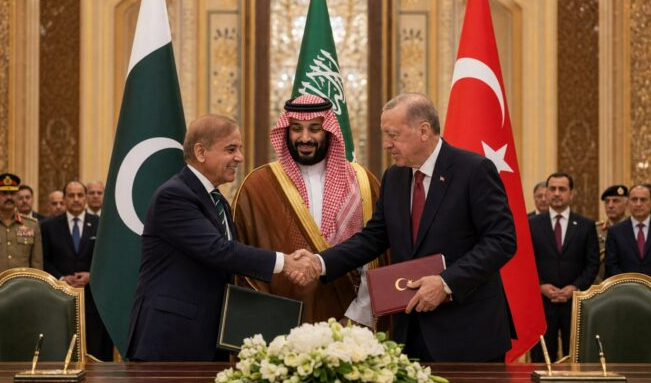
The signing of the Mecca Joint Defence Agreement by Saudi Arabia, Türkiye and Pakistan on August 7 marks a significant shift in the security politics of West Asia and the wider Muslim world. Signed in Mecca by Saudi Crown Prince and Prime Minister Mohammed bin Salman, Turkish President Recep Tayyip Erdoğan and Pakistani Prime Minister Shehbaz Sharif, the agreement establishes a collective defence principle under which an armed attack against one of the three countries will be regarded as an attack against all three. The timing is as important as the agreement itself. It comes after months of war and regional instability involving Iran, Israel and the United States, growing threats to Gulf states and disruption around critical maritime routes. It also reflects a growing conviction in Riyadh, Ankara and Islamabad that regional security can no longer be left entirely to external powers.
The agreement did not emerge overnight. Saudi Arabia and Pakistan had already signed a Strategic Mutual Defence Agreement in September 2025, creating a bilateral commitment to respond collectively to aggression. Türkiye’s entry expands that arrangement into a wider strategic triangle linking the Gulf, Anatolia and South Asia. The three countries bring different forms of power to the table. Saudi Arabia provides financial strength, energy influence and considerable diplomatic weight. Türkiye contributes a large military, an expanding defence industry and a strategically important position between Europe, West Asia and the Black Sea. Pakistan contributes military experience, manpower and the strategic significance of being the Muslim world’s only nuclear armed state.
The immediate catalyst has been the deterioration of the regional security environment. The war involving Iran demonstrated the vulnerability of Gulf states even when they host substantial American military infrastructure. Missile and drone attacks, threats to maritime traffic and the possibility of disruption in the Strait of Hormuz exposed the limits of relying on external protection alone. Türkiye was also drawn into the consequences of the conflict despite not being a direct belligerent, while Pakistan became increasingly involved in efforts to prevent the confrontation from developing into a wider regional war. For Riyadh in particular, the lesson was not that the United States had become irrelevant. It was that American protection could no longer be the only pillar of national security.
That calculation explains Saudi Arabia’s broader foreign policy. Riyadh continues to maintain a major strategic relationship with Washington while simultaneously strengthening relations with China, maintaining coordination with Russia through OPEC Plus and expanding defence cooperation with Türkiye and Pakistan. These policies are not necessarily contradictory. They reflect a deliberate attempt to reduce strategic dependence by maintaining several powerful relationships at the same time. The Mecca agreement fits into this wider Saudi strategy of diversification rather than representing a break with Washington. Riyadh is seeking greater freedom of action without closing the door to its existing alliances.
For Pakistan, however, the agreement carries a different significance. Islamabad has increasingly occupied two positions during the regional crisis. It has presented itself as a diplomatic intermediary capable of maintaining communication between Washington and Tehran, while its military relationship with Saudi Arabia has moved towards a more operational level. The Mecca agreement brings these two roles closer together. Pakistan can continue to mediate while also becoming part of the security architecture that determines the regional balance of power. Its influence therefore rests not only on diplomacy but also on the military credibility it can provide to a strategic partnership.
This development places Field Marshal Asim Munir at the centre of the equation. The growing visibility of Pakistan’s military leadership alongside the civilian government during major strategic engagements reflects the increasing connection between Pakistan’s foreign policy and its security establishment. Shehbaz Sharif remains the principal political and diplomatic representative of Islamabad, particularly in mediation efforts. Munir represents the military dimension of the country’s regional strategy. The Mecca agreement strengthens that dimension by giving Pakistan’s military relationships with Saudi Arabia and Türkiye a formal collective security framework. Islamabad is consequently moving beyond the traditional role of mediator towards a more direct role as a regional security actor.
Türkiye brings a different strategic advantage. Ankara remains a NATO member, yet it has spent years expanding its freedom of action beyond the traditional Western alliance structure. Its relations with Russia, China, the Gulf states, Pakistan and Central Asia have developed alongside its NATO commitments. Turkish defence manufacturing has become an important instrument of national influence, particularly in drones, missiles, naval systems and electronic warfare. Saudi Arabia has become an important partner in this process. The Mecca agreement consequently strengthens Türkiye’s position as both a military power and a defence technology provider in the region.
Turkish Foreign Minister Hakan Fidan’s remarks after the agreement provide an important indication of Ankara’s approach. He said the collective defence principle was technically comparable to NATO’s Article 5 while emphasising that the agreement was defensive and not directed against any particular country. That qualification matters. The pact does not possess NATO’s integrated command system, institutional depth or established military planning structure. It is therefore premature to describe it as an Islamic NATO. Its importance lies instead in the creation of a political commitment that could gradually develop into more structured military cooperation.
The possibility of expansion could determine how far that process goes. Egypt has emerged as the most important potential addition. Turkish officials have indicated that Cairo could join after technical matters are resolved. Yet Egypt’s possible entry should not be treated as automatic. Analysts have pointed out that Cairo may be cautious about assuming binding defence commitments that could draw it into conflicts beyond its immediate interests. Egypt maintains important relationships with the United States, Israel, the Gulf states and other international powers. Its decision will therefore depend on whether the pact is viewed as a stabilising regional mechanism or as an alliance that could eventually require military involvement in conflicts with Iran, Israel or other actors.
This highlights one of the first major weaknesses of the Mecca agreement. Its collective defence principle is politically powerful but operationally undefined. What exactly happens after an attack? Does every member have to deploy forces? Does assistance include intelligence, weapons and logistics, or does it require direct military intervention? Who determines whether an incident qualifies as an armed attack? What happens if one member believes military intervention would threaten its own national interests? These questions are not minor technicalities. They determine whether collective defence is a genuine military commitment or primarily a deterrent declaration.
The problem is particularly serious because the three countries have different threat perceptions. Saudi Arabia is primarily concerned with Iran, missile attacks, Gulf security and the protection of critical energy infrastructure. Türkiye’s strategic priorities extend across Syria, Iraq, the Caucasus, the Black Sea, the Mediterranean and its relationship with NATO. Pakistan remains heavily focused on India, Afghanistan, internal security and the Arabian Sea. An attack that Riyadh considers an existential threat may not carry the same significance for Ankara or Islamabad. Without detailed mechanisms for consultation and decision making, the collective defence clause could create political disputes precisely when rapid coordination is most necessary.
The pact also carries an escalation risk. Although Ankara has insisted that the agreement is not aimed at Iran, Tehran will inevitably examine the strategic consequences of a defence arrangement connecting Saudi Arabia, Türkiye and Pakistan. The mere perception that Pakistan’s military capability and Türkiye’s defence industry are being placed behind Saudi security could alter Iranian calculations. Tehran may respond by strengthening its own partnerships with Russia, China and regional non state actors. What begins as a deterrence mechanism could therefore contribute to another round of regional military balancing. The danger is not necessarily an immediate confrontation but the gradual creation of competing security networks that make miscalculation more likely.
There is another contradiction at the heart of the pact. Its strength comes from the complementary capabilities of the three members, but those same differences can limit cohesion. Saudi Arabia has enormous financial resources but remains dependent on external suppliers for sophisticated military systems. Türkiye has a growing defence industry but also has its own strategic priorities and relations with Iran and NATO. Pakistan possesses substantial military experience and a nuclear deterrent but faces economic constraints and remains heavily focused on its own regional security challenges. The pact can combine these strengths, but it cannot automatically eliminate the limitations of each member.
Pakistan’s position presents an especially difficult calculation. Islamabad wants to remain a mediator in disputes involving Iran and the United States while simultaneously strengthening its military partnership with Saudi Arabia. A collective defence commitment could make neutrality harder to maintain during a future crisis. If Iran were to attack Saudi Arabia, Pakistan could face pressure to respond militarily even while attempting to negotiate with Tehran. Conversely, if Pakistan faced a major crisis with India, Saudi Arabia and Türkiye would have to decide how far they were prepared to become involved. The agreement therefore increases Pakistan’s strategic weight but also increases the number of commitments it must manage.
For Saudi Arabia, the risk is different. Riyadh wants greater strategic autonomy, but it does not want to replace American security guarantees with another form of dependence. A successful pact must therefore supplement rather than substitute Saudi Arabia’s existing defence relationships. If Riyadh becomes too dependent on Pakistani manpower or Turkish technology, it could simply exchange one form of external reliance for another. The long term objective must be to create a network in which Saudi Arabia itself possesses greater domestic defence capacity and can use partnerships to strengthen rather than replace national capability.
Türkiye also faces a balancing problem. Ankara is attempting to operate simultaneously within NATO and a separate regional defence framework. That is possible, but the two systems could come into tension during a major crisis. If the Mecca agreement eventually develops into a military structure that takes positions contrary to NATO policy, Türkiye could face difficult choices. Its participation may also raise questions among NATO members about the extent to which Ankara is willing to coordinate with countries outside the alliance during a conflict. For Türkiye, strategic autonomy brings greater influence, but it also creates greater responsibility.
The relationship with Washington is therefore another potential fault line. The agreement does not amount to an anti American alliance. Saudi Arabia remains a major American security partner, Türkiye remains inside NATO and Pakistan continues to maintain relations with Washington. Nevertheless, the emergence of an independent regional defence mechanism demonstrates that the United States is no longer the only organiser of security partnerships in the region. Washington may welcome greater regional burden sharing, but it will also have to consider how autonomous security arrangements affect American military planning, arms sales and political influence.
Israel faces a similarly complicated environment. The pact does not designate Israel as an adversary and there is no formal indication that the three countries intend to create an anti Israeli military bloc. Nevertheless, Türkiye, Saudi Arabia and Pakistan have all strongly criticised Israeli military operations in Gaza and elsewhere in the region. Greater military coordination among them could increase diplomatic pressure on Israel and reduce the fragmentation that has traditionally characterised regional responses to Israeli policy. At the same time, the different national interests of the three states make a unified anti Israeli strategy unlikely. The more realistic consequence is increased strategic coordination rather than automatic military confrontation.
The possibility of expanding the pact creates another challenge. Egypt is the most obvious candidate, but expansion could make the alliance more difficult to manage rather than automatically stronger. Every additional member brings additional capabilities, but also additional disputes, obligations and threat perceptions. Qatar, Kuwait, Jordan and other potential participants would each bring different relationships with Washington, Tehran, Israel and the Gulf Cooperation Council. If membership expands without a clear institutional structure, the pact could become politically ambitious but operationally fragmented.
The economic dimension also deserves caution. Defence cooperation can create opportunities for technology transfer, joint manufacturing and industrial investment, particularly between Saudi Arabia and Türkiye. Yet large defence programmes require sustained funding, technological compatibility and political continuity. Defence procurement can also create competition between national industries rather than cooperation. If each member prioritises its own suppliers and strategic interests, the industrial benefits of the pact could remain limited. A successful defence industrial partnership would require common standards, joint research and long term procurement planning rather than simply signing equipment contracts.
The maritime dimension provides perhaps the strongest opportunity for practical cooperation. Saudi Arabia, Türkiye and Pakistan sit close to several critical energy and trade routes, including the Red Sea, Arabian Sea and Mediterranean approaches. The Strait of Hormuz and Bab al Mandab have demonstrated how quickly regional conflict can become a global economic problem. Joint maritime surveillance, intelligence sharing, protection of commercial shipping and coordination on critical infrastructure could give the agreement tangible strategic value without immediately turning it into an offensive military alliance.
For India, the development requires careful attention. New Delhi has strong economic and strategic relations with Saudi Arabia and the Gulf while maintaining a complex relationship with Türkiye. Pakistan’s deeper military links with Ankara are already a concern for India, and a formal trilateral framework could increase Islamabad’s diplomatic and strategic space. Yet Saudi Arabia has powerful reasons to preserve its relationship with India, particularly in trade, energy, investment and technology. The pact therefore does not automatically create an India focused security bloc. India’s most effective response is likely to be continued engagement with Riyadh, Cairo and other regional capitals while strengthening its own network of strategic partnerships.
The BRICS dimension adds another layer. Saudi Arabia and Egypt are part of the expanded BRICS framework, while Türkiye has sought closer engagement with the grouping and Pakistan maintains a close strategic relationship with China. The Mecca agreement is not a BRICS military initiative, but it illustrates the increasingly blurred boundary between economic, diplomatic and security networks. Countries can participate in BRICS related structures while maintaining relations with Washington and NATO and simultaneously joining regional defence arrangements. This is one of the clearest characteristics of the emerging multipolar system.
The wider strategic trend is therefore not the creation of two opposing blocs but the emergence of overlapping networks. The United States retains enormous military power. China remains a major economic and strategic force. Russia continues to possess significant military and energy influence. NATO remains the strongest Western military alliance. BRICS is expanding its political and economic reach. At the same time, regional powers are increasingly creating their own mechanisms. The Mecca agreement belongs to this broader transformation. Its significance lies in giving regional actors another instrument through which to shape their security environment.
Yet multipolarity also carries risks. More centres of power can mean greater autonomy, but they can also produce more competing commitments. A crisis involving Iran, Israel, India, Pakistan or another regional actor could potentially activate several overlapping partnerships at once. The danger is that a local conflict could acquire a wider strategic dimension because different countries feel compelled to support partners. The more security agreements are layered across the region, the more important clear rules of engagement and crisis communication become.
The greatest test for the Mecca agreement will therefore be implementation. The establishment of a permanent secretariat and ministerial mechanism would provide an institutional foundation, but genuine military credibility requires much more. Intelligence sharing, joint exercises, air and missile defence coordination, logistics, communications, military planning and defence industrial integration will determine whether the collective defence principle can function under pressure. Without these mechanisms, the agreement risks becoming a powerful political statement without the operational capacity required to support it.
The pact’s future will also depend on whether the three governments can preserve strategic trust. Saudi Arabia, Türkiye and Pakistan have strong relations, but they do not share identical foreign policies. Ankara has its own relationship with Tehran. Islamabad has an interest in maintaining dialogue with Iran. Riyadh has pursued a policy of reducing tensions with Tehran even while strengthening deterrence. Their ability to cooperate without demanding complete alignment will be the key to the agreement’s survival.
For Pakistan, the agreement represents both an opportunity and a burden. It strengthens Islamabad’s position in the Gulf and gives its military establishment greater regional relevance. It also creates new responsibilities. Pakistan must now balance its role as a mediator with its obligations as a security partner. Shehbaz Sharif’s diplomacy and Munir’s military influence can complement one another, but the distinction between mediation and military commitment could become difficult to maintain during a major crisis. The pact gives Pakistan greater strategic weight, but greater weight inevitably brings greater expectations.
For Saudi Arabia, the agreement is a further step towards strategic autonomy, but autonomy should not be confused with isolation. Riyadh’s most effective strategy is likely to remain one of diversification, combining the United States with Türkiye, Pakistan, China, India and other partners. For Türkiye, the pact provides another avenue for projecting influence while maintaining NATO membership. For Pakistan, it creates a stronger bridge between South Asian and Gulf security. For Egypt, the decision whether to join will reveal whether the framework is developing into a genuinely broad regional mechanism or remaining a selective partnership among three powers.
The Mecca agreement should therefore not be described as the birth of an Islamic NATO. The comparison with NATO Article 5 is useful in explaining the collective defence principle, but the institutional and military foundations remain very different. Its more important significance lies in the emergence of a regional arrangement designed by regional powers themselves. It is an attempt to supplement existing alliances with a mechanism that reflects their own interests and capabilities.
The drawbacks are therefore inseparable from the pact’s ambitions. Its collective defence clause could create deterrence, but it could also create obligations that become difficult to honour. Its expansion could increase its strategic weight, but also multiply internal disagreements. Its relationship with NATO could strengthen Türkiye’s influence, but also complicate alliance politics. Its deterrence of Iran could reduce the likelihood of attacks, but could also encourage Tehran to build counter alliances. Its defence industrial potential could strengthen regional self reliance, but could also produce competition over contracts and technology. Its promise of strategic autonomy is real, but so are the costs of maintaining it.
That is why the success of the Mecca agreement cannot be judged by the ceremony in Mecca alone. The real test will be whether Saudi Arabia, Türkiye and Pakistan can build institutions capable of managing their differences while converting their combined capabilities into credible deterrence. If they succeed, the pact could develop into a durable regional security network and potentially attract Egypt and other states. If they fail, it could remain a politically impressive declaration whose collective defence promise is stronger on paper than in practice.
The significance of Mecca ultimately lies in this tension between ambition and capability. The three countries are attempting to gain greater control over their security environment at a time when confidence in the existing regional order has weakened. They are not abandoning Washington, NATO, China, Russia or other major partners. They are trying to ensure that none of those relationships becomes indispensable to the point of strategic dependence.
The Mecca Defence Agreement is therefore neither the birth of an Islamic NATO nor merely another diplomatic declaration. It is an experiment in regional strategic autonomy. Its success could strengthen the ability of regional powers to shape their own security and accelerate the emergence of a genuinely multipolar order. Its failure could demonstrate the limits of trying to combine different national interests under a single collective defence commitment. The coming years will determine which of these two futures emerges from the agreement signed in Mecca.