

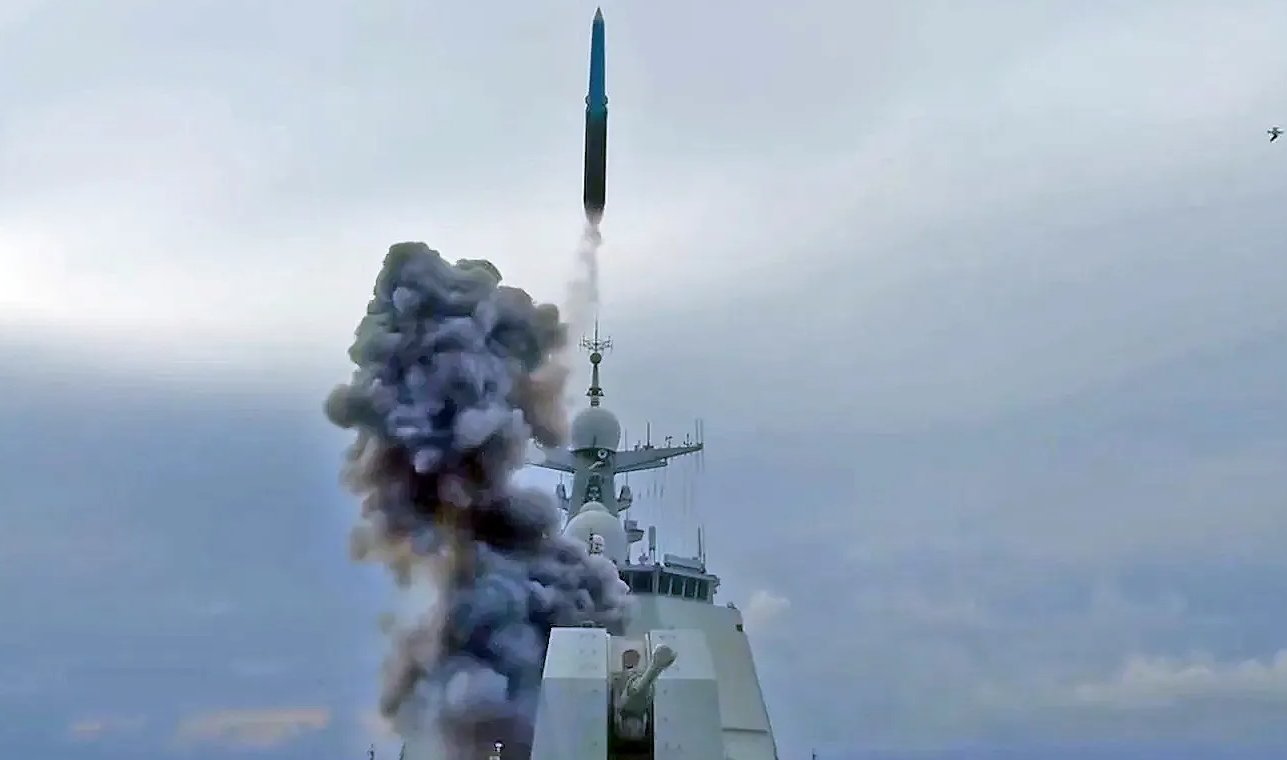
For years, Western defense analysts watched the development of China’s maritime strike capabilities through the lens of capital ships. When Beijing unveiled its YJ-20 hypersonic anti-ship ballistic missile, Western military planners largely focused on the massive Type 055 cruiser-class destroyer as the primary delivery platform. Displacing over eleven thousand tonnes and armed with 112 vertical launch cells, the Type 055 was the obvious flag-bearer for China’s long-range Anti-Access/Area Denial architecture. However, recent footage broadcast by Chinese state media showing a YJ-20 launched from the smaller, far more numerous Type 052D destroyer fundamentally changes that tactical calculus.
This transition from elite capital ships to workhorse destroyers signals that China’s hypersonic weapon programs are no longer experimental novelties or limited boutique assets. Instead, the People’s Liberation Army Navy is actively integrating hypersonic strike capabilities deep into its surface fleet. By expanding the reach of its carrier-killer weapons across dozens of surface combatants, Beijing is creating a complex operational environment for the United States Navy and its regional allies in the Western Pacific.
The engineering required to launch a hypersonic ballistic missile from a standard naval hull is substantial. Measuring under nine metres in length and less than 850 millimetres in diameter, the YJ-20 has been engineered to fit within the HT-1 universal vertical launch system. This means China did not need to redesign its fleet architecture to accommodate hypersonic strikes. The same standard missile cell that fires air defense or conventional cruise missiles on a Type 052D can now house a hypersonic weapon.
The flight profile of the YJ-20 presents profound defense challenges. Departing its launch cell, the missile ascends into the upper atmosphere before deploying a maneuvering biconic re-entry vehicle. During its midcourse phase, the weapon cruises at speeds exceeding Mach 6 at altitudes between 40 and 60 kilometres. This specific corridor in the upper atmosphere falls into a well-documented blind spot for many legacy naval radars, which are optimized either for lower-altitude sea-skimmers or traditional high-altitude ballistic trajectories.
At its maximum range, estimated between 1,000 and 1,500 kilometres, the YJ-20 covers its full trajectory in roughly 13 to 14 minutes. During terminal descent, the warhead accelerates toward Mach 10 while conducting sharp lateral maneuvers designed to disrupt tracking solutions. The combination of extreme kinetic energy and warhead detonation creates a devastating impact mechanism capable of disabling or sinking large surface combatants, including nuclear-powered aircraft carriers.
The technical parameters of the YJ-20 are formidable, but its operational significance multiplies when combined with ship production statistics. While the People’s Liberation Army Navy maintains a fleet of 10 Type 055 destroyers, it currently operates approximately 35 Type 052D destroyers. The Type 052D, displacing around 7,500 tonnes with 64 vertical launch cells, forms the backbone of China’s modern surface operations.
Equipping both classes means China now possesses more than 40 surface vessels capable of launching hypersonic anti ship missiles. The normalization of hypersonic weapons across standard destroyers fundamentally elevates the People’s Liberation Army Navy’s overall combat capability. Opposing fleets can no longer focus on monitoring only a handful of Type 055 destroyers to assess the immediate hypersonic threat. Every Type 052D operating in the South China Sea, the Taiwan Strait, or the Philippine Sea must now be regarded as a potential hypersonic strike platform. This significantly complicates operational planning, expands China’s distributed strike capability, and forces rival navies to allocate greater surveillance and missile defence resources across a much broader maritime battlespace.
This creates a severe quantitative challenge for Western naval commanders. Integrating potent anti ship weapons across a larger portion of the Chinese fleet makes operational access near Taiwan and throughout the South China Sea increasingly hazardous for surface ships. Even if Western intelligence successfully tracks high value Chinese naval assets, the growing presence of dispersed Type 052D destroyers significantly expands the People’s Liberation Army Navy’s defensive coverage, complicates targeting priorities, and stretches surveillance and missile defence resources across a much wider operational area.
For modern naval warfare, the fundamental problem posed by hypersonic weapons is not necessarily that they are impossible to intercept, but that intercepting them requires extraordinary resources. Aegis-equipped destroyers and cruisers relying on Standard Missile 3 and Standard Missile 6 interceptors possess sophisticated missile defense capabilities. Military research into hypersonic defense, including ongoing efforts to develop specialized glide-phase interceptors, aims to close these defensive gaps over time.
However, defensive math rapidly favors the attacker in a high-density operational scenario. Naval vessels carry a finite number of vertical launch cells, which cannot be reloaded while underway at sea. If a salvo of maneuvering hypersonic missiles arrives alongside lower-speed cruise missiles and uncrewed aerial systems, defensive battle management systems face instant saturation. A defender might expend multiple multi-million-dollar interceptors to neutralize a single incoming threat, exhausting magazine reserves within minutes.
When hypersonic launchers are concentrated on a few large vessels, defensive forces can prioritize tracking and striking those specific targets early in a conflict. When those same missiles are distributed across dozens of medium destroyers, the attacker gains the flexibility to execute coordinated strikes from widely separated geographic axes. This distributed lethality forces defenders to divide their sensor attention and interceptor stockpiles across multiple threats simultaneously.
It is vital to recognize that a missile, no matter how fast, is only as effective as the intelligence system guiding it. For the YJ-20 to strike a moving aircraft carrier group over 1,000 kilometres away, the People’s Liberation Army Navy relies on a vast, interconnected reconnaissance-strike network. This chain includes satellite constellations, over-the-horizon backscatter radars, maritime patrol aircraft, and uncrewed surveillance platforms.
In a real-world conflict, this targeting infrastructure would face aggressive electronic warfare, cyber attacks, and kinetic anti-satellite measures from Western forces. If the initial target acquisition pipeline is disrupted, the tactical utility of long-range hypersonic missiles drops significantly. Modern naval analysis emphasizes that weapons like the YJ-20 do not operate in a vacuum; they represent single nodes within a larger, contested battle network.
Nevertheless, the strategic message delivered by Beijing’s latest operational milestone remains clear. By proving that its standard Type 052D destroyers can launch hypersonic carrier-killer missiles, China has solidified a multi-layered anti-access posture across the First Island Chain. This development complicates Western naval planning, demanding faster adaptations in missile defense, electronic warfare, and long-range strike capabilities to balance the changing maritime equilibrium in the Indo-Pacific.