

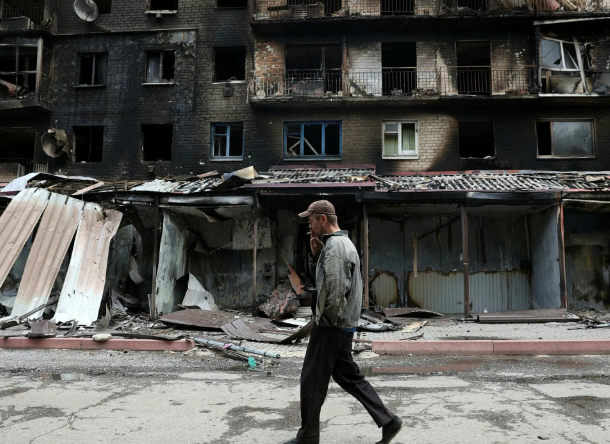
The Donbas remains the hardest territorial question in any potential Russia Ukraine peace settlement. The region, broadly comprising Donetsk and Luhansk, has been at the centre of the conflict since 2014 and became the main focus of the fighting after Russia launched its full scale invasion in 2022. Russia has formally claimed Donetsk and Luhansk, along with Zaporizhzhia and Kherson, as part of the Russian Federation, while Ukraine and most of the international community continue to regard these territories as part of Ukraine. Russia has continued to demand control of the remaining Ukrainian controlled parts of Donetsk, while Ukraine has rejected territorial concessions. This has left the Donbas question as more than a dispute over a line on a map. It is simultaneously a question of sovereignty, administration, security, identity, language, political representation and the future of the people living there.
A workable settlement therefore may require the territorial issue to be approached differently from a conventional peace agreement in which one side formally accepts the other’s claim to the disputed territory. The central idea could be to separate questions that are normally treated as inseparable. Military control, local administration, internal self government, defence, external relations and the ultimate legal question of sovereignty do not necessarily have to be resolved through one decision made on one day. A special status arrangement for Donbas could create an institutional framework in which the immediate security and governance problems are addressed first, while the most difficult question of final territorial status is managed through a separate legal and political mechanism.
The most useful comparison in this context is the institutional structure created for Hong Kong. The circumstances are fundamentally different and there should be no suggestion that Donbas and Hong Kong are historically, legally or politically identical. Hong Kong entered its special administrative arrangement after sovereignty had already been settled between Britain and China. Donbas would be entering any special arrangement while sovereignty itself remained disputed. The value of the Hong Kong example is therefore not its specific political history but the principle that sovereignty and local administration can be structured as distinct questions. Under the Hong Kong Basic Law, Hong Kong is a part of China while exercising a high degree of autonomy, with its own executive, legislature and independent judicial power. Defence and foreign affairs remain the responsibility of the central government, while the regional government is responsible for local administration and public order.
An adapted Donbas arrangement could begin with a legally defined special administrative status covering the territory concerned. The precise boundaries would have to be negotiated rather than assumed. The agreement could establish locally elected institutions with responsibility for education, culture, language policy, municipal services, economic development, healthcare and other domestic matters. Local institutions would be formed through elections conducted under agreed rules and monitored by an independent international mechanism. The objective would be to give residents a direct role in governing their daily affairs while creating sufficient safeguards to prevent the territory from becoming an arena for permanent military confrontation.
Language would be a particularly important component of such a settlement. Donbas has a significant history of Russian language use and a population whose cultural identities have been deeply affected by the conflict. A special status arrangement could provide legally enforceable protections for both Ukrainian and Russian language use in administration, education, culture and public life. These protections could be placed beyond ordinary political bargaining by incorporating them into the constitutional or treaty framework governing the region. The arrangement would need to protect individual rights rather than impose political preferences through language policy. That distinction would be essential to creating confidence among residents with different identities and political loyalties.
The security structure would be the second major pillar. One possible model would establish Donbas as a territory with clearly defined limitations on the presence and deployment of heavy military forces. The purpose would be to prevent the region from becoming a forward military platform for either side. Monitoring could be conducted by an international mechanism agreed by the parties, with access to designated areas and procedures for investigating alleged violations. Any security restrictions would need to be reciprocal, transparent and independently verifiable. The question of who provides security would be especially sensitive. A settlement could therefore distinguish between local public order responsibilities and wider external defence responsibilities rather than allowing competing military forces to operate freely inside the territory.
The most politically difficult element would be sovereignty. A special status arrangement does not by itself resolve the competing Russian and Ukrainian claims. That is precisely why an interim model could be considered. Ukraine could maintain its legal position that the territory remains part of Ukraine, while Russia could maintain its own legal position without requiring immediate international recognition of its territorial claim. The settlement could state explicitly that the special administrative arrangement does not, by itself, constitute recognition or renunciation of either side’s ultimate legal position. This would create a temporary legal bridge between fundamentally different claims.
Such a formula would also require a carefully designed relationship between Donbas and the Ukrainian state. The region could remain connected to Ukraine for purposes such as currency, citizenship, external trade and selected national institutions, while exercising substantial autonomy over internal matters. At the same time, the agreement could specify which powers remain with the central authorities and which belong exclusively to the regional administration. The greater the ambiguity in this division, the greater the risk of renewed conflict. A successful framework would therefore need a detailed constitutional document, not simply a political declaration.
The issue of external military alliances would need separate treatment. If neutrality were part of the wider peace settlement, Donbas could have additional restrictions concerning foreign military bases, permanent foreign troop deployments and offensive weapons systems. Those restrictions could be accompanied by guarantees from outside states that the territory would not be used as a staging ground for future military operations. Such an arrangement would address one of Russia’s long stated security concerns while also requiring firm protections for Ukraine against the possibility that the special status could become a mechanism for renewed military pressure.
Economic reconstruction could become another stabilising element. Donbas was one of the most industrialised parts of Ukraine before the war, but years of conflict have damaged housing, transport networks, industrial facilities, mines, utilities and public infrastructure. A special economic reconstruction programme could bring together Ukrainian institutions, international financial organisations and other participating states under transparent rules. Reconstruction funds could be tied to verified progress in security and governance, while property claims and compensation disputes could be handled through a dedicated legal mechanism. The aim would be to make economic recovery an institutional part of the peace settlement rather than leaving it to uncertain negotiations after the political agreement.
The humanitarian dimension would have to be built into the arrangement from the beginning. The settlement would need mechanisms for the return of displaced civilians where conditions permit, reunification of families, exchange of prisoners, resolution of missing persons cases and restoration of civil documentation. Residents who remained in the territory throughout the conflict would also need protection from discrimination or collective punishment because of their perceived political loyalties. A special status model would be difficult to sustain unless people on both sides of the political divide believed that the new institutions protected their basic rights.
Perhaps the most important feature would be the creation of a long term mechanism for the unresolved sovereignty question. Instead of forcing an immediate final decision, the agreement could establish a review process after a defined period during which the special status operates under international guarantees. Any future discussion of sovereignty would then take place through agreed legal and political procedures rather than military force. The parties could also agree in advance that disputes concerning implementation would be referred to an international arbitration or mediation mechanism. This would reduce the incentive to use military pressure whenever disagreement emerges.
The proposed framework would therefore not be a simple transfer of Donbas from one side to another. It would be an attempt to create a political space between the two existing positions. Russia’s demand for control and recognition would not automatically translate into immediate Ukrainian acceptance of territorial loss. Ukraine’s insistence on territorial integrity would not automatically require the restoration of every previous administrative and security arrangement before peace could begin. Instead, the settlement would separate immediate governance from the unresolved question of ultimate sovereignty and establish enforceable rules for both.
The comparison with Hong Kong has clear limitations. The Hong Kong arrangement was built around an already agreed transfer of sovereignty and a constitutional relationship between the territory and China. Donbas has an active dispute over sovereignty and has experienced prolonged warfare and population displacement. Hong Kong therefore cannot simply be copied as a ready made formula. Its relevance lies in demonstrating that a territory can operate under a distinct internal administrative system while defence and foreign affairs are structured at another level. Any Donbas framework would have to be negotiated from the ground up and would require considerably stronger international guarantees because the underlying territorial dispute would remain unresolved.
The essential principle of a Donbas settlement would therefore be to stop treating every territorial question as something that must be resolved immediately or entirely by one side. A special administrative status, strong local institutions, enforceable language and political rights, defined security restrictions, international monitoring, reconstruction guarantees and a separate mechanism for the question of sovereignty could provide a structured path away from permanent military confrontation. It would not eliminate the fundamental disagreement between Moscow and Kyiv, but it could transform that disagreement from a military contest into a managed political and legal process. For a region that has become the central territorial obstacle to peace, that distinction could form the basis of a serious settlement framework without requiring either side to abandon its wider position at the first stage.