

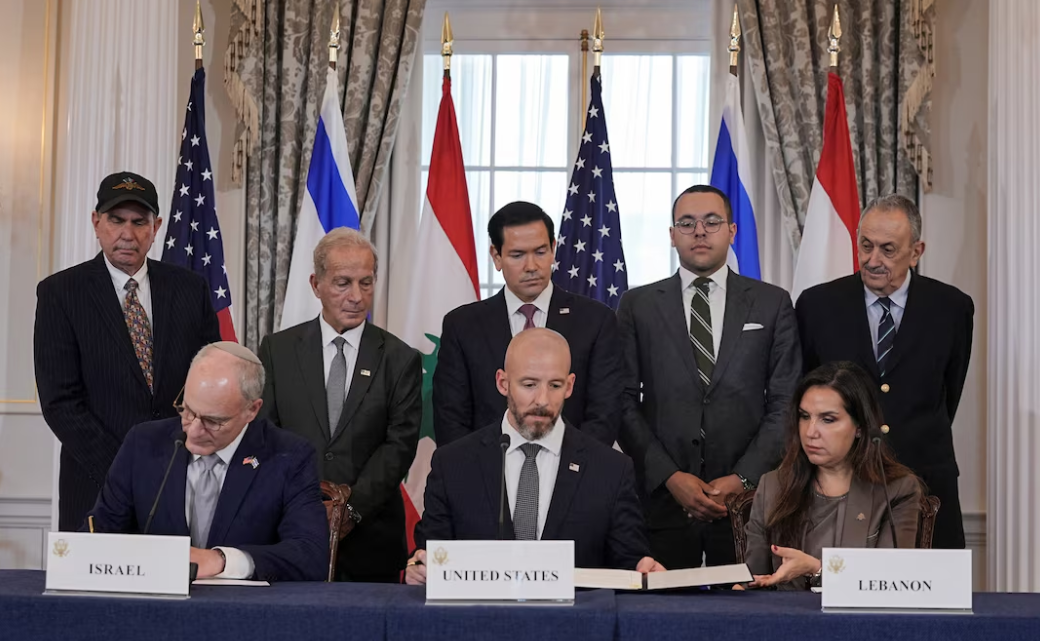
The signing of the trilateral framework agreement in Washington between representatives of Israel, Lebanon, and the United States marks a seismic, yet extraordinarily precarious, pivot in the modern history of the Levant. Brokered under the intense auspices of the American administration at the State Department, the document was formalised by Lebanese Ambassador Nada Moawad and her Israeli counterpart Yechiel Leiter, with United States Secretary of State Marco Rubio representing the mediating superpower. While the ceremony itself was accompanied by the expected rhetorical flourishes of a major diplomatic breakthrough, the reality on the ground is defined by deep fractures and unresolved contradictions. The agreement is explicitly framed by all participating parties not as a final, comprehensive peace settlement, but as an initial, highly tentative step on a path that promises to be exceptionally treacherous. It attempts to construct a fragile bridge between two nations that technically remain in a state of perpetual war, aiming to halt a devastating conflict that erupted following cross border hostilities. However, the foundational premise of the deal relies on the systematic disarmament of Hezbollah, an Iranian backed militant group and political powerhouse that has already declared its total and unyielding opposition to the entire framework.
Structurally, the agreement operates not as a bilateral treaty, but as a complex trilateral matrix of commitments heavily guaranteed and financed by Washington. To facilitate the execution of this delicate transition, Secretary Rubio announced the creation of a trilateral Military Coordination Group for Lebanon, which will serve as the primary vehicle for oversight, verification, and strategic implementation. Recognizing that diplomatic framework agreements are hollow without institutional enforcement and immediate humanitarian stabilization, the United States has committed significant resources to the endeavor. This includes an immediate injection of one hundred million dollars in humanitarian assistance, slated to be distributed in close coordination with the United Nations to alleviate the catastrophic displacement crisis plaguing the region. Furthermore, the State Department and the Pentagon have pledged over thirty million dollars under existing United States authorities and appropriations specifically to reimburse and upgrade the capabilities of the Lebanese Armed Forces. The strategic calculus behind this funding is transparent, as the United States aims to empower the official Lebanese military so that it may effectively establish state sovereignty throughout its national territory and assume control over zones currently dictated by non state actors.
The human and geopolitical cost of the conflict that led to this diplomatic junction cannot be overstated. This particular round of intense hostilities ignited when Hezbollah opened fire on northern Israel, a move that came just days after a combined United States and Israeli military strike against targets inside Iran. The subsequent military fallout was swift and devastating. Israeli air and ground campaigns tore through southern Lebanon, resulting in the deaths of more than four thousand people in Lebanon and the displacement of well over one million civilians from their homes and villages. On the Israeli side, the toll of this specific confrontation includes the confirmed deaths of at least thirty-two soldiers and four civilians, alongside the displacement of thousands of residents from northern border communities. While Hezbollah notoriously maintains strict operational secrecy and does not release official figures regarding its war dead, foreign intelligence and journalistic assessments, including reports from major international press agencies, indicate that several thousand Hezbollah fighters were neutralized over the course of the intensive fighting.
The immediate mechanism for testing the viability of this newly signed framework centers on a concept described by Israeli Prime Minister Benjamin Netanyahu as pilot zones. Under this formula, the Israeli military will execute highly conditional, gradual pullbacks from specific portions of the southern Lebanese territory it currently occupies. The Lebanese Armed Forces are expected to immediately move into these evacuated pilot zones, organizing themselves to assume total security and administrative control. For Israel, this occupied territory has long been defined as a vital security zone or buffer zone, a geographic shield deemed absolutely necessary to prevent Hezbollah from launching direct incursions, anti-tank missiles, and rocket barrages into Israeli towns. Prime Minister Netanyahu has made it explicitly clear that the ultimate determination of an internationally recognized, secure, and agreed upon border, alongside the concession of subsequent pilot zones, is entirely dependent on the performance of the Lebanese state. If the Lebanese army fails to dismantle and disarm Hezbollah within these initial sectors, the agreement grants Israeli forces the explicit right to maintain their military occupation of southern Lebanon indefinitely.
This conditional withdrawal strategy has exposed deep rifts between public declarations and the tactical realities on the ground, creating an atmosphere of intense skepticism. Just prior to the formal resumption of talks in Washington, both sides had agreed to a nominal halt to active fire, even as Israel maintained its heavy ground troop presence inside sovereign Lebanese territory. Despite this ceasefire agreement, lethal violence has persistently bubbled beneath the surface. Illustrating this volatility, the Israeli military announced that its troops had struck and neutralized seven Hezbollah members who were actively operating in close proximity to the Israeli occupied zone, though independent journalists could not immediately confirm the specific operational details. This fluid and aggressive posture was punctuated on the very day of the Washington signing when the Israeli military dropped air leaflets over the southern Lebanese town of Mansouri, ordering its remaining residents to evacuate immediately. A senior Lebanese military official revealed that Israel had recently absorbed Mansouri into its active occupation zone, creating a paradox where farmers could enter and leave during the day to tend to crops but were barred from residing there. The Israeli military defense for this action was that the leaflet drop was merely a protective reminder to civilians that they were entering an active military security zone. This persistent friction underscores the warnings of veteran diplomats like Alan Eyre, who suggest that Israel may have signed the document primarily to placate its American patrons and diminish political pressure from the Trump administration, rather than out of a genuine belief that the framework can be executed in good faith to its logical conclusion.
For the Lebanese state apparatus, the agreement is being championed as a vital, sovereign triumph, albeit one laced with extreme domestic risk. Lebanese President Joseph Aoun expressed profound gratitude to the United States administration and the American president for hosting the grueling negotiations, while extending thanks to friendly Arab and international nations that reaffirmed their commitment to Lebanon’s territorial independence and economic prosperity. In an official statement from the presidency, Aoun praised his negotiating team for securing a framework that he views as the critical first step toward restoring undivided state sovereignty over every inch of Lebanese soil, promising the displaced populace that their destroyed homes would be rebuilt without any foreign or domestic partner sharing in the state’s authority. This sentiment was echoed by Lebanese Prime Minister Nawaf Salam, who stressed on public platforms that the primary national constant of his government remains the extension of exclusive state authority through its official armed forces. Salam emphasized that the Lebanese state alone must hold the ultimate, undivided monopoly over decisions of war and peace, looking forward to the complete eviction of occupying forces so the reconstruction workshop could begin.
Yet, this vision of a unified, sovereign Lebanese state collides violently with the reality of Hezbollah’s domestic military supremacy. From the perspective of political analysts and regional observers, the Washington framework represents an existential threat to Hezbollah’s entire structural paradigm. Because the deal mandates the total disarmament and dismantling of the militant group as a prerequisite for Israeli withdrawal, it essentially asks the organization to sign its own death warrant. Hezbollah lawmaker Hassan Fadlallah delivered a scathing critique of the framework, stating bluntly through regional broadcasters that the Lebanese authorities possess absolutely no domestic capability to enforce such an agreement on the ground. Fadlallah warned that any attempt by the central government to forcibly implement these commitments would require them to deliberately trigger a bloody civil war. He made it clear that Hezbollah’s opposition to the deal is deadly serious, and that the group will actively confront any measure taken by state authorities while tightening its grip on its massive arsenal. This internal defiance is mirrored by other prominent Hezbollah members of parliament, such as Amin Sherri, who openly labeled direct negotiations with Israel a catastrophic mistake, arguing that Israel is merely attempting to achieve through internal Lebanese civil strife what it failed to secure through two consecutive, highly destructive wars.
Ultimately, the United States finds itself anchored to a diplomatic construct that is as brilliant in its theoretical design as it is fragile in its practical application. Secretary Rubio’s candid characterization of the agreement as the beginning of the beginning underscores Washington’s acute awareness that the hardest work lies ahead. The fundamental crisis of the framework is that it is a trilateral agreement designed to reshape the security architecture of Lebanon, yet the most powerful military entity on the ground in Lebanon was entirely excluded from the negotiation table. The Lebanese government and its armed forces lack the military teeth, the political mandate, and the institutional willpower to disarm a battle hardened, heavily entrenched militia without fracturing the nation along sectarian lines. Consequently, the agreement risks becoming a tragic recipe for a renewed domestic explosion. By binding the timeline of Israeli military withdrawal to an impossible domestic condition, the framework may inadvertently legitimize a permanent Israeli security zone in the south while leaving the rest of Lebanon caught in a vice between foreign occupation and the looming specter of internal collapse