
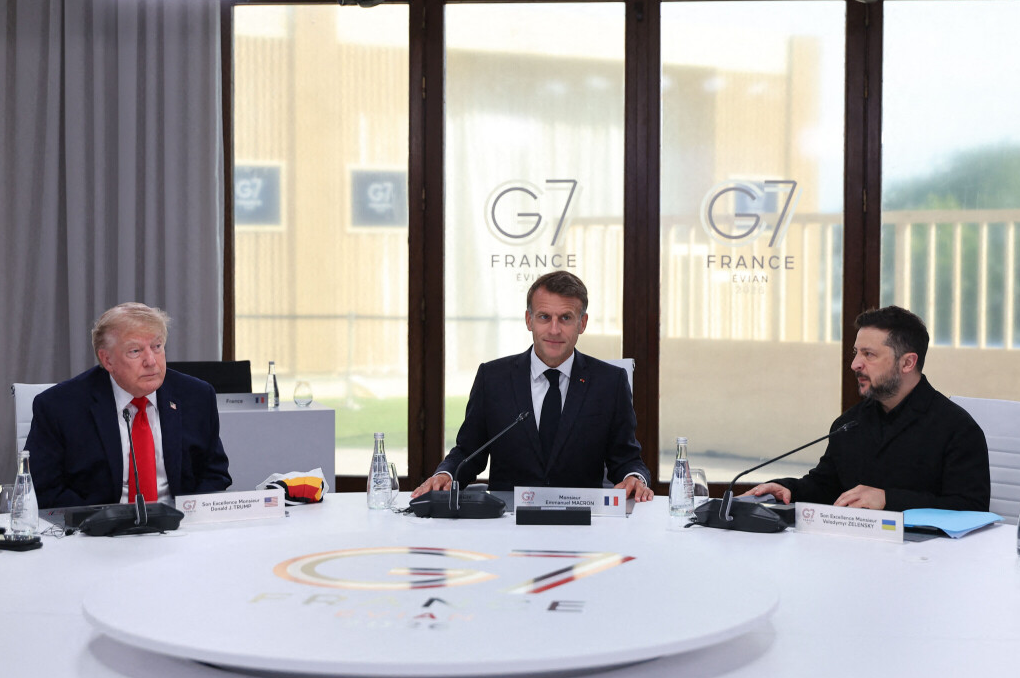
The annual gathering of the Group of Seven nations often plays out like highly choreographed theater, but the three-day summit in the lakeside French resort of Evian has delivered something entirely rare: a genuine tectonic shift in global diplomacy. What began as a highly tense meeting clouded by fears of American unilateralism concluded with an extraordinary display of geopolitical leverage. US President Donald Trump dominated the stage, leaving his allies astonished by a sudden hawkish convergence on Russia and a breathtaking, candlelit diplomatic breakthrough with Iran at the Palace of Versailles.
For months, the international community viewed Trump’s return to the White House with deep trepidation. Memories of his early exit from previous summits and his transactional disdain for multilateralism hung heavy over Evian. French President Emmanuel Macron, anchoring the final chapter of his own presidency, painstakingly engineered this summit to contain his unpredictable American counterpart, even delaying the schedule to accommodate Trump’s domestic calendar. Yet, instead of tearing up the script, Trump rewrote it, forcing a unified front on Ukraine that few observers thought possible.
The most striking development to emerge from the formal sessions was the hardening of the American stance toward Moscow. European leaders, particularly German Chancellor Friedrich Merz and Italian Prime Minister Giorgia Meloni, have spent a year worrying that Washington might force Ukraine into a premature, punitive capitulation. Instead, Trump showed an unexpected impatience with Russian President Vladimir Putin, driven by frustration over the staggering, stagnant casualty toll of the conflict. By the close of the summit, the G7 had achieved a level of convergence that Meloni described as historic.
The joint communiqué, which Trump notably signed, outlines a significant escalation in the economic warfare against the Kremlin. The leaders agreed to drastically choke the Russian war economy by targeting its remaining lifeline: fossil fuel revenues. Furthermore, in a massive boost to Kyiv’s domestic defense capabilities, the G7 approved licensing agreements allowing Ukraine-based companies to directly manufacture long-range missiles and air defense systems. Macron openly marveled at what he termed a profound change in the US approach, noting that Trump seems to have finally accepted that Putin has no immediate interest in a genuine peace.
If Evian was the crucible of hard power, the historic Palace of Versailles served as the stage for a spectacular diplomatic grand finale. Macron invited the American president to a private, candlelit dinner in the sumptuous Lower Gallery, an evening designed to appeal directly to Trump’s well-known affinity for opulence. Flanked by billionaires and industrial captains, including LVMH chief Bernard Arnault and TotalEnergies CEO Patrick Pouyanne, the dinner transformed from a celebratory cultural tour into a historic geopolitical event.
Seated beneath the gilded ceilings, Trump put his physical signature to the Islamabad Memorandum of Understanding, an ambitious fourteen point accord aimed at ending the multi-month war between the United States and Iran. The agreement, which went into immediate effect following a separate signing by Iranian President Masoud Pezeshkian, triggered an instant reaction in the global markets. Brent crude prices fell over one percent as the deal promised the immediate lifting of the American naval blockade on Iranian ports and the reopening of the strategically vital Strait of Hormuz.
The scope of the memorandum is remarkably vast, mapping out an aggressive sixty day timeline to negotiate a permanent end to hostilities across all West Asian fronts, including Lebanon. Under the terms, Tehran has agreed to dilute its stockpile of highly enriched uranium and reaffirm its commitment to remain non-nuclear under international supervision. In exchange, the deal paves the way for immense economic relief, including the unfreezing of Iranian assets and a staggering US-backed economic development program valued at three hundred billion dollars.
Yet, the euphoria of the Versailles signing remains tethered to a fragile reality. Even as the guests applauded, Trump made sure to broadcast his trademark blend of diplomacy and raw deterrence. He bluntly warned that if Tehran failed to abide by its obligations, the United States would instantly resume devastating military operations, colorfully threatening to drop bombs right back in the middle of their heads. Compounding the friction, Iran’s chief negotiator, Mohammad Bagher Ghalibaf, quickly went on state television to frame the deal as a failure for Washington, declaring that the Strait of Hormuz would never return to pre-war conditions and hinting at impending shipping fees.
The underlying friction was not confined to foreign wars; it bled into the digital realm during a high-stakes G7 working lunch. The summit brought together the titans of Western artificial intelligence, including OpenAI chief Sam Altman, Anthropic leader Dario Amodei, DeepMind founder Demis Hassabis, and Arthur Mensch of the European rival Mistral AI. European leaders pushed hard for aggressive, state-mandated guardrails to protect minors and enforce digital sovereignty, a regulatory zeal that has long irritated Washington.
The resulting debate highlighted the deep ideological divide between European state protectionism and American technological exceptionalism. While the G7 ultimately issued a joint statement urging tech firms to develop safe, age-appropriate experiences, the tech executives themselves delivered a sobering warning. Altman explicitly cautioned world leaders against ceding their sovereign governance responsibilities to the private corporations building these omnipotent technologies. Macron, meanwhile, warned that a lack of regulatory alignment among democratic nations risked leaving a dangerous vacuum that autocracies would gladly exploit.
As the diplomatic caravan leaves France, the international order finds itself in a strange, unmapped territory. For three days, European leaders tried to manage Donald Trump, only for the American president to loudly declare to the world who was running the show. His final, unvarnished pre-session declaration of being the boss was not just rhetorical bravado; it was a reflection of the reality that unfolded across Evian and Versailles.
The G7 achieved an essential victory in projecting an ironclad, unified resolve against Russia, but the long-term stability of the global order now hinges on two incredibly volatile calculations. The world must wait to see if the Kremlin will buckle under the newly intensified economic and military pressure, and whether the fragile, high-stakes peace deal signed in the Hall of Mirrors can survive the next sixty days without shattering.